My Terrorist Eye

I’m trying something a little different here. I wrote “My Terrorist Eye: Risk, the Unexpected, and the War on Terrorism” between 2004 and 2008. The events that inspired it are made clear in the essay. The link below leads to a PDF that you should be able to download and read at your leisure.

In the wake of the shootings in Newtown, Connecticut, there’s been much talk about safety and how to ensure it. I come at the question from a slightly different angle: Given that we can’t reduce risk to zero, how much risk is acceptable and what are the tradeoffs?

            Our world, no less than the worlds of so-called primitive peoples, is so riddled with dangers, the wonder isn’t that some people are phobic. The real wonder is that we all aren’t incapacitated by fear. We can take precautions, but precautions don’t guarantee that accidents won’t happen. Nevertheless, many people cling to the conviction that bad things happen only to the careless, the godless, or the karmically unfortunate. They can’t bear to acknowledge the wild card.

terrorist eye web

Posted in musing, writing | Tagged , , , | Leave a comment

Giving Local 2

Here’s the promised musical follow-up to “Giving Local,” un/fashionably late, as usual. I’m not a musician, but the grassroots music scene has been a vital part of my life since I landed on the rock.  It’s been a vital part of island life for a lot longer than that. Some homegrown musicians have played on distant stages, like the late bluesman Maynard Silva (1951–2008) and the very much alive Willy Mason (b. 1984). Willy now plays internationally, but he’s having the release party for his newest CD at the Pit Stop tomorrow night. He’s the son of two island-based musicians, Jemima James and Mike Mason.

ape woman2012 isn’t over yet, but my nominee for stand-out performance of the year is the world premiere of The Ape Woman at the Pit Stop at the end of August. May Oskan’s “rock opera” is stellar — moving, infuriating, eloquently sung and played by an ensemble that includes May’s mother, Michele Jones, on guitar and her sisters Marciana Jones (vocals and autoharp) and Nina Violet (vocals and strings; more about her below). May not only wrote and composed The Ape Woman, she sings lead vocals and plays ukulele.

The great news is that a world premiere performance was recorded live by Anthony Esposito. It’s available for MP3 download from Bandcamp.

nina coverConfession time: Nina Violet’s stupendous CD We’ll Be Alright came out a year ago. I’ve been wanting to review it ever since but have been seriously hung up on the “I can’t write about music” blues. Well,  no, not quite: it’s more that I don’t have a language to describe what I’m hearing, so how could I write anything worth reading?

So why do I love this CD? I’m a sucker for vocal harmonies, that’s one thing, especially women’s vocal harmonies. You’ll notice that these share some textures with those in The Ape Woman, and with good reason: they’re produced by the same trio, Nina and her sisters May Oskan and Marciana Jones. The instrumental textures underpin and embellish the vocals in ways that transport the listener — like a sea voyage, I keep thinking, and the lyrics often suggest likewise: “Wake of the Ship” is one title, and “Run to the Stream” contains one of my favorite images:

Your eyes the color of the water in the channel
My mother told me not to swim in
because it would take me out to sea
wouldn’t be able to swim back in . . .

If you’re not persuaded yet, go read Dan Waters’s M.V. Times review. He’s a musician as well as a writer. This helps. Then you can download We’ll Be Alright from Bandcamp or order the CD from CDBaby. If you’re on the Vineyard,  you can probably find the CD at Aboveground Records or at the Pit Stop (about which more follows).

Tristan Israel (front) and Paul Thurlow

Tristan Israel (front) and Paul Thurlow

Tristan Israel, Tisbury’s singing selectman, has to be one of the very few who could make a catchy tune out of something as serious as hepatitis C, but with “Hep C,” on his new CD, The Sound After the Flash, he pulls it off. Strange but true: He did the same for tularemia a few years ago. Tristan is ably backed up by Nancy Jephcote on fiddle and Paul Thurlow on — everything? “One-man band” doesn’t do this guy justice: acoustic guitar, electric guitar, bass, keyboards, and percussion. Paul also produced and I’ll bet good money he is at least partly responsible for the intriguing and often unexpected rhythms and instrumentation on this satisfyingly varied collection of songs. Both CD and MP3 download can be had from CDBaby.

As the title suggests, to me at any rate, several of these songs explore life after the flash of youth is long past. They range from the sweetly straightforward “Home” to the bluesy, tongue-in-cheeky “I Don’t Think About You” to”Ask Me in the Morning” — loneliness and angst never sounded so upbeat. The threat of loss often lingers between the lines. Sometimes it’s somber, as in  “Maynard,” a tribute and a promise to the late Maynard Silva. Other times, the songwriter grins while daring fate to do its worst, as in “Angry Lost Mad & Sad.” And still other times he emerges from life and loss with a slightly surprised “Maybe I Am Someone” — one of my favorite cuts on the CD. I’m wary of songs about endangered species, mainly because I’ve heard so many that are mawkishly sentimental, blatantly anthropomorphic, or both, but “Bonobos” works, in part because of the haunting arrangement.

And finally, while we talking about giving local, the Pit Stop is celebrating its first birthday right around now. It’s already a key part of the Vineyard music scene. Nina’s We’ll Be Alright was recorded there. The Ape Woman had its world premiere there. Anthony Esposito’s popular Monday open mikes are giving the next wave of island musicians a place to hone their craft and try out new work. Take yourself to a show. Take a friend too. And buy yourself a membership. For $100 ($150 for families), you get a discount on every performance you attend and the satisfaction that comes with supporting something wonderful.

See you at the Pit!

Posted in Martha's Vineyard, music | Tagged , , , , | 5 Comments

Newtown

I wasn’t going to blog about Newtown. “Mud of the place” and all that: my feet aren’t in the mud of that place, and I’m trying to watch where my mouth is.

On the other hand, I do have my feet in the mud of some of the issues involved, and have been occasionally spattered with the mud of some others. Whenever the news media descend on a place en masse and start talking when their feet have barely touched the ground — I’ve been there.

Whenever people start jumping to conclusions and misperceptions based on the reporting and commentating of people who have deadlines to meet and ratings to worry about and precious little mud on their shoes — Welcome to Martha’s Vineyard.

Last week I blogged about living in a place where I can leave my door unlocked and my keys in the car and walk in the woods alone after dark without fear. Earlier this year there was a shooting in my town. A man armed with a rifle and a pistol, Kenneth Bloomquist, broke into the home of his estranged wife, Cynthia Bloomquist. He wounded her. She shot and killed him, apparently with one of his own guns. The incident happened a mile or so up the road from me, but it didn’t affect my perception of my own safety, not then, and not now, almost nine months later.

I’m thinking about it now, though. The man was described by those who knew him as “volatile” in the aftermath of his marital breakup. He had threatened his wife in the past. She was worried enough to seek a restraining order. She didn’t get one. So — was this guy “mentally ill”?

In the coverage of the massacre at Sandy Hook Elementary School and in the discussions I’ve read, listened in on, and occasionally participated in, “mental illness” has loomed large. The shooter, Adam Lanza, had Asperger’s syndrome. Connection between the shooting and the syndrome? Possibly, but let’s not let mental illness overwhelm the other significant factors: the availability of firearms, the mother’s apparent survivalist proclivities, the possible influence of violent video games, and so on.

Many have called for improved access to mental health care, and for removing the stigma attached to mental illness. Yes and yes. But in one story I read, a medical professional estimated that the number of mentally ill people in the U.S. could be as high as 25 percent. 25 percent? With a figure that high, could we possibly be talking about the most serious forms of mental illness, the ones with chemical and/or physiological causes that can be treated, at least to some extent, with medication?

How about the “volatile” Mr. Bloomquist? How about the person who’s pleasant and soft-spoken when sober but a screaming banshee when drunk? (My mother was like that.) How about the person who’s thrown into a tailspin by the death of a loved one or a financial disaster? I’ve had times in my life when I was so low I wouldn’t have dared keep pills in the house, never mind a gun. Am I, or was I, “mentally ill”?

I just looked up “psychosis” on MedLine Plus, a service of the U.S. National Library of Medicine at the National Institutes of Health (NIH). “Psychosis,” it says, “is a loss of contact with reality that usually includes:

  • False beliefs about what is taking place or who one is (delusions)
  • Seeing or hearing things that aren’t there (hallucinations).”

It can indeed be caused by “alcohol and certain illegal drugs, both during use and during withdrawal,” as well as by several diseases and infections that affect the brain, and by certain prescription drugs.

Mental illness and psychosis are not synonymous: I understand that. I also suspect that someone who suffers from delusions and/or hallucinations, given the right (or wrong) conditions plus access to firearms, might snap and start shooting. And this condition is not necessarily the result of a long-term or permanent abnormal brain chemistry. It can be brought on by, among other things, alcohol or various other drugs. How to identify people who might snap? If it’s even possible, the number would probably be huge.

In the aftermath of Newtown, much attention has been focused on mass shootings by lone gunmen. (And they are, overwhelmingly, men.) I’ve heard them called “rampage killings,” as if the killer lost control, went nuts. But how about, say, Timothy McVeigh and Anders Breivik? They didn’t lose control. On the contrary: they were scarily in control. Each had a political purpose in mind and believed that killing a large number of people would serve that purpose. Were they “mentally ill”? What distinguishes them from the Ann Coulters, Rush Limbaughs, and others whose politics are just as hateful but who don’t act them out with guns?

How about people who take the Bible for the literal, historical truth, in the face of much empirical evidence that it isn’t? Are they “mentally ill”? How about members of the military, who kill when they are commanded to do so? How about the officers who issue the commands?

I’m thinking too of atrocities committed by ordinary, “normal” people: Srebrenica, Rwanda, My Lai, the Holocaust. In college I read Milton Mayer’s They Thought They Were Free: The Germans, 1933–45, about the ordinary people without whose participation Nazi Germany could not have become the horror that it was. I’ve carried that book in my head ever since. Standing outside the situation, we recognize those things as appalling. To them, though, those things were literally “normal” — what everyone around them was doing.

Slavery was once “normal” in this country. Now it isn’t. Now denying people health care because they can’t pay for it is “normal.” Maybe someday people will look back at us and wonder how we could have sanctioned such injustice.

Posted in musing | Tagged , , , , , | 6 Comments

Giving Local

“Living local” is all the rage, on Martha’s Vineyard as elsewhere, and like most rages I can get pretty cynical about it. I’ve been known to call it “living lo-cal,” or Living Lite, or living without thinking too hard about how once upon a time “living local” wasn’t a sign of high-minded civic virtue; it was just what people did.

Self-portrait of ear and Cecilia's earring

Self-portrait of ear and Cecilia’s earring

On the other hand, I think it’s sort of cool that Tom Barrett made the brown sheepskin slippers on my feet, Cecilia Minnehan the earrings in my ears, and Lisa Strachan the white porcelain butter dish that I can see from where I sit and the matching milk pitcher that I can’t see because it’s in the fridge.

Still-life with slipper and Hekate the laptop. The panda speaker wasn't made locally, but it's still cute.

Still-life with slipper and Hekate the laptop. The panda speaker wasn’t made locally, but it’s still cute.

My father gave me my green marble rolling pin. A long-ago housemate gave me the big bowl I still rise bread in. Several of my mixing bowls came from my grandmother’s house. I love it that things given me by people dead or long gone are still part of my life. I love knowing who made the things that I use or wear every day. Maybe other people make jams and jellies and mustards as good as Linda Alley’s, but I don’t know those people — and in any case I doubt it.

There is something to this living local thing.

white porcelain

White porcelain butter dish and milk pitcher

So it’s the time of year that many people give gifts to one another. Here are some local things that are part of my life. Some of them I had a hand in making. Others not, but at least I got to listen in. You could give them to yourself. You could give them to someone else. Or you could just smile to yourself knowing that they, and the people who made them, are doing neat things on Martha’s Vineyard.

I blogged about Bountiful when it appeared last summer, just in time for the 151st Martha’s Vineyard Agricultural Society Livestock Show and Fair. With text by Susan Klein and photographs by Alan Brigish and a host of anonymous photographers whose historic plates, prints, and negatives were found in attics and basements across the island, this is a beautiful and indispensable look at island history. It left me feeling, with Tennyson’s Ulysses, that

Though much is taken, much abides; and though
We are not now that strength which in old days
Moved earth and heaven; that which we are, we are;
One equal temper of heroic hearts,
Made weak by time and fate, but strong in will

To strive, to seek, to find, and not to yield.

bountiful coverBountiful is available through the Ag Society’s recently revamped website.

You’d also do well to check out Martha’s Vineyard Now & Zen, a look at contemporary Martha’s Vineyard by the same team, storyteller Klein, an island native, and photographer Brigish, who came here from South Africa.

And Susan Klein’s own stories of growing up on Martha’s Vineyard in the 1950s and ’60s, Through a Ruby Window, which can be had as a book and as a recording. I recommend both. You can find them on Susan’s website.

Mr. January

Mr. January

I also blogged earlier this fall about Lisa Bibko-Vanderhoop’s Vineyard Seadogs calendar — but of course! Travvy is Mr. January! The whole calendar is stunning. There’s no Vineyard seascape that can’t be improved by the presence of a dog, or, even better, several dogs.

The 2013 calendar is available at several locations on the Vineyard, among them Good Dog Goods, Alley’s, and Cronig’s. It can also be ordered online.

Author Cynthia Riggs signs a book at an Artisans' Festival, fall 2011.

Author Cynthia Riggs signs a book at an Artisans’ Festival, fall 2011.

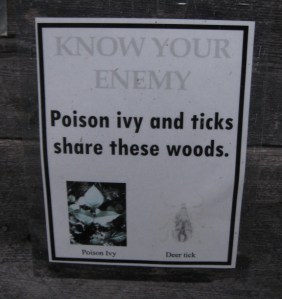
Finally, here’s another book I helped edit: Victoria Trumbull’s Martha’s Vineyard. If you follow Cynthia Riggs’s Martha’s Vineyard Mystery Series, you know who Victoria Trumbull is: the 92-year-old sleuth who’s the protagonist of the series — and who’s based on Cynthia’s mother, the late Dionis Coffin Riggs. This isn’t your standard-issue guidebook. It’s wonderfully idiosyncratic: Cynthia’s text incorporates allusions to the mysteries — the 11th of which, Poison Ivy, was recently published — local color, and poems by and anecdotes about Dionis, and it’s enriched by the photographs of Lynn Christoffers and maps by Stephen Wesley. If you’re not on the island (and even if you are), you can order it through Cynthia’s website.

Here ends “Giving Local,” part the first. Part the second will follow in a day or two. It’s mostly about music.

Posted in Martha's Vineyard | Tagged , , , , , , , | 2 Comments

The M.V. Roundabout Nightmare Song

A front-page story in the current Martha’s Vineyard Times announces “Roundabout Construction Expected to Begin in March.” If it actually happens, we’ll be able to use the whole sordid saga as a case study in how democracy can fail with no input from the so-called 1%. Here’s hoping the boondoggle can still be derailed.

Until now, the struggle against the roundabout has lacked a key ingredient: its own song. Tristan Israel, Tisbury’s singing selectman, has rectified this deficiency. Here, with the songwriter’s permission, are the lyrics. You can hear him sing it on YouTube:

The Martha’s Vineyard Roundabout Nightmare Song

Well I like to travel the roads each day,
I deal with the traffic and I’m rarely late
but one fine day I got stuck in a jam
the circle I was in had the traffic dammed.

I’m going round about on the roundabout and I can’t get out of this roundabout,
so all I do is holler and shout
won’t someone save me from this roundabout.

So no one could enter from the left or right
and I think I saw a lady get bumped off her bike.
The people trying to cross were running for their lives,
I could hear their screams as they dodged that bike!

I’m going round about on the roundabout and I can’t get out of this roundabout,
so all I do is holler and shout
won’t someone save me from this roundabout.

Next a bus just stopped in the middle of the circle
and the traffic backed up as it discharged people.
Angry horns blared as the time it passed,
and I saw that I might be running out of gas.

I’m going round about on the roundabout and I can’t get out of this roundabout,
so all I do is holler and shout
won’t someone save me from this roundabout.

Well my truck it died in the rotary
and the traffic backed up to downtown Tisbury.
It also backed up the other way,
there were cars stacked up past Price’s Way.

I’m going round about on the roundabout and I can’t get out of this roundabout,
so all I do is holler and shout
won’t someone save me from this roundabout.

Now many hours later I am sitting here still,
I think I’m gonna die where’s my blood pressure pills?
Won’t someone save from this circle today
or will I be like Charlie on the MTA?

I’m going round about on the roundabout and I can’t get out of this roundabout,
so all I do is holler and shout
won’t someone save me from this roundabout.

Well it cost a lot to build the roundabout
but they got it covered so the politicians shout.
Meanwhile the rest of us got to figure out
how to get the hell around this here roundabout!

(Sing chorus 3+ times)

I’m going round about on the roundabout and I can’t get out of this roundabout,
so all I do is holler and shout
won’t someone save me from this roundabout.

© 2012 by Tristan Israel

Posted in Martha's Vineyard, music | Tagged , , | Leave a comment

Waskosims Rock

These photos were supposed to be part of “Faith,” which I posted two days ago, but as usual my words wandered off in a different direction and the photos didn’t fit. There was a connection, though. The sun was close to setting when Travvy and I pulled into the trailhead at the M.V. Land Bank’s Waskosims Rock property. It slipped below the horizon while we were walking, and by the time we got back to the car it was almost pitch-dark.

OK, so skunks weren't the only thing I had to worry about.

OK, so skunks weren’t the only thing I had to worry about.

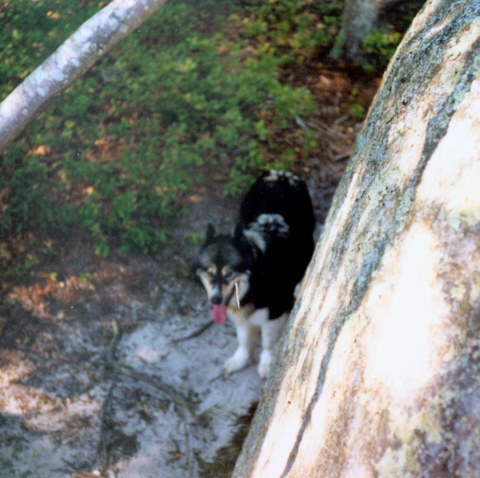
There was a pickup at the trailhead, the same one that had been there when we arrived, but no sign of any people. I’d seen no one on the trail. What was the worst thing I could imagine? That Travvy might pounce on a skunk in the underbrush and get us both sprayed.

In my D.C. days, when I was still a bookseller, Janet Kauffman published a collection of short stories: Places in the World a Woman Could Walk. I never read this book, probably because about 90% of the fiction I read in those days (and for a couple of decades thereafter) was science fiction or fantasy, but I’ve loved that title from the moment I first heard it. Such places are uncommon enough to be remarked upon; otherwise Kauffman wouldn’t have chosen that title and it wouldn’t have been vibrating in my mind all these years.

Martha’s Vineyard is one of those places in the world a woman can walk. I walked a lot in my city days, but always warily; I didn’t realize how warily until I moved here. I live in a place where a woman can walk, and leave her front door unlocked and her car keys in the ignition.

Rhodry on the stile, probably 1995.

Rhodry on the stile, probably 1995.

stile 1

Travvy on the same stile — which has probably been repaired and rebuilt a few times in the last 17 years.


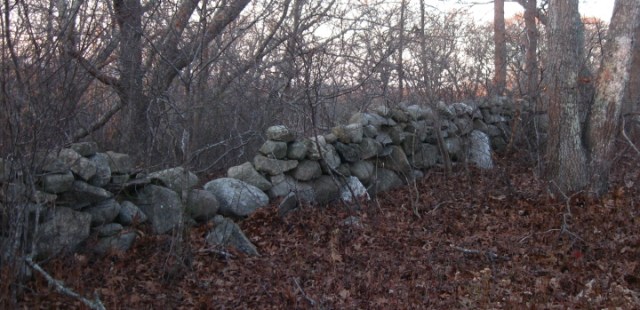
There is indeed a Waskosims Rock, a gift from the glacier that once covered Martha’s Vineyard. According to a news story I just found online, “In the 17th century, Waskosim’s Rock was the centerpiece in a stone wall that marked the boundary between English and Wampanoag lands.” Pace the apostrophe that often appears in the name, Waskosim wasn’t a person. The word is said to be Wampanoag for “new stone.”

Trav & rock

Rho at rock

Rhodry seen from the top of the rock, ca. 1998.

This was Travvy’s first visit to the rock. Rhodry and I were regulars in the years before I got back into horses. From 1999 onward we only went places that we could get to on horseback. Waskosims Rock wasn’t one of them.

Rhodry used to scamper up the rock — the way the rock is split makes this pretty easy, even for the non-athletic — but Travvy displayed no inclination to do likewise. I thought of taking his photo from the top, but climbing the rock with Trav’s lead in one hand did not seem wise, and the last time I tied Travvy up with his Flexi, he broke it and got loose. Martha’s Vineyard might be a place in the world where a woman can walk, but it is not a good place for an Alaskan malamute to run loose.

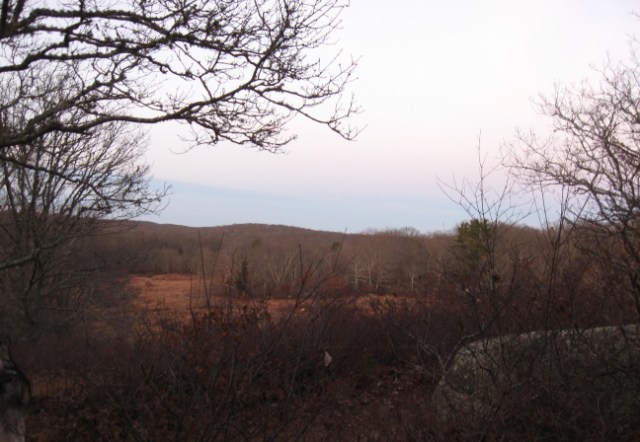
Vista from the ridge trail

Vista from the ridge trail

Before the sun went down

Before the sun went down

Posted in Martha's Vineyard, outdoors | Tagged , , , , | 5 Comments

Faith

The other day word went round that a friend’s sign had been stolen from its accustomed place at the end of his road. This wasn’t just any sign: it’s unique, hand-crafted and -painted, and big enough to be legible from several hundred feet off.

As it turned out, the report resulted from a miscommunication. The sign hadn’t budged from its accustomed place at the end of the road. Whew.

Between the first report and the second, we of course speculated busily over who might have done such a thing, and why: the sign’s monetary value would make its theft a felony, and the sign itself is so instantly recognizable that any attempt to sell it would probably bite the thief-seller in the butt, later if not sooner.

But art thieves make off with paintings that are even more recognizable and valued at hundreds of thousands if not millions of dollars. Presumably there’s a market for such high-end swag: individuals who will pay big bucks for the satisfaction of having private access to a masterpiece, and perhaps of having put one over on the authorities.

Besides — in our speculations we reminisced about artistic roadside signs that had been stolen for real and never recovered. Travvy’s vet lost hers that way. Hell, never mind “artistic”: When Fred Fisher Jr. was still alive, Nip N Tuck Farm had to stop selling its raw milk in returnable glass bottles, because some customers wanted to keep them as souvenirs or sell them as “collectibles” for considerably more than the $2.50 deposit. (Need I add that we law-abiding year-round customers were absolutely 100% sure that the miscreants weren’t from here.)

So I was thinking about all this when Travvy and I headed up to Waskosims Rock late yesterday afternoon, to take the walk we couldn’t take during shotgun season, when we went to Great Rock Bight instead. What I was thinking was that many people would have been surprised at our surprise that the beautiful sign had been stolen: What kind of idiot leaves something so valuable out in plain sight anyway?

To which question I replied: The kind of idiot who wants to live in a place where you can leave something so valuable out in plain sight and not have it disappear unexpectedly.

As it turned out, we idiots do still live in such a place. In summer, gardeners still leave vegetables and cut flowers unattended at roadside stands, along with a posted price and a coffee can to put money in. Yes, signs do get stolen, and money sometimes gets swiped, and I’m sure the occasional customer helps him/herself without paying. My car keys are nearly always in the ignition, and I don’t know where my house keys are. My car could get stolen or my apartment broken into — well, not literally: the door’s unlocked so you don’t have to break anything — but it hasn’t happened (yet).

I want to live in a place where I can leave the car keys in the ignition and my front door unlocked, so I leave the keys in the ignition and the front door unlocked. Be the change you want to see in the world, so the saying goes. It’s like that.

In my first months on Martha’s Vineyard, going keyless was such a wonder that I wrote “The Key Sestina” about it. I did indeed lock my doors in my D.C. days, but since I didn’t own a car, I walked, biked, and took public transportation all over the place, often by myself. I wasn’t stupid — there were some places I wouldn’t go, especially at night — and I was indeed luckier than some of my friends. When I worked in the suburbs, though, my co-workers were continually amazed that those of us who lived “in the District” made it to work alive every morning. They thought we lived 24/7 in the bad-news clips they saw on TV.

I’ve got this hunch that part of what’s fueling the so-called “blue state/red state” divide is that so much of what we know about people we don’t know comes from TV and social media. If I hadn’t lived in D.C. all those years, I’d probably think it was one big 24-hour-a-day crime wave. I’d probably think it was all about the federal government and nothing but the federal government. Yeah, right: like Martha’s Vineyard is all about celebrities and summer people.

We live where we live, and we live the way we want that place to be; the way we live is what that place becomes. And — to steal Grace Paley’s great line one more time: “If your feet aren’t in the mud of a place, you’d better watch where your mouth is.”

Posted in Martha's Vineyard, musing | Tagged , , , , | 2 Comments

Farmer Kills Dog

The last few weeks I’ve had my nose to the grindstone, or rather my eyes on the laptop screen and my fingers near the keyboard, so I didn’t pick up on this story till 11 days after it happened. I’ve been thinking about it ever since.

Short version: On Sunday, November 11, two dogs got away from their owner in Vineyard Meadow Farms, a West Tisbury subdivision off the Edgartown–West Tisbury Road. After a few minutes, the owner heard gunshots. The shooter later contacted the assistant animal control officer and turned the body of one of the dogs over to him. The other dog came home with a “wound on its neck,” according to the original Martha’s Vineyard Times story posted on November 20, “but [the owner] wasn’t sure what caused the wound.”

By the time I got to that story, two days later, it had more than a hundred comments on it. (Just looked: the tally is now up to 175, but as you might suspect, it’s the same old dogs chewing on the same old bones.) A follow-up story, “West Tisbury Sees No Further Action on Dog/Chicken Incident,” was posted on December 5.

People are still talking about the incident. I’m still thinking about it, not least because I have a dog who would happily help himself to someone else’s chickens if he got the chance. My very first thought when I saw the photo of Chi, the dog that was killed, was Whew. It’s not a northern-breed dog. A high-profile case in my town last winter involved Akitas. An even-higher-profile case in Tisbury a few years back involved Siberian huskies. Travvy is a northern-breed dog. There but for fortune . . .

My second thought  followed hard on the first: Huh? Was that dog really trying to kill the chickens? Chi looked like a herding dog. He was indeed a sheltie–border collie mix. Yes, individuals vary tremendously within any breed or type. General truths don’t predict what any individual is going to do. But a certain skepticism slithered into my brain — a skepticism that never would have surfaced if the dead dog had looked like a Sibe or an Akita or an Alaskan malamute.

What were the dogs doing? Had they visited the shooter’s place before? We don’t know and we aren’t going to know. The town’s animal control officer (ACO) doesn’t have to release this information. Hard as it is for some people to believe, we the public don’t have the right to know everything, and in this case I agree with the ACO’s decision not to disclose the shooter’s identity. No good purpose could be served by releasing it, and it would almost certainly trigger anonymous and not-so-anonymous harassment of that individual. On Martha’s Vineyard, as elsewhere, our capacity for intemperate rhetoric and general nastiness seems to increase with our distance from the situation.

According to state law, “Any person may kill a dog found out of the enclosure of its owner or keeper and not under his immediate care in the act of worrying, wounding, or killing persons, livestock or fowls.” No report need be filed, and no liability is incurred unless there’s evidence of intentional cruelty on the part of the shooter, which in this case there wasn’t.

The law is clear. Just about everyone around here knows that farmers (and non-farmers too, for that matter) have the right to shoot dogs that are hassling their “livestock or fowls.” But the law is black and white, and the issues raised by this case live in the great gray expanse that the law doesn’t cover.

For instance, the law says a person can shoot a dog hassling his or her livestock, but it doesn’t say a person has to shoot the dog. Choice comes into play here, and where choice is involved we’re talking ethics at least as much as we’re talking law. You or I might have made a different choice in similar circumstances, but the choice wasn’t ours to make. That’s hard to accept, but accept it we must.

Even harder to accept is the sheer bad luck involved. Two dogs got away from their owner. Within a short time one of them was dead. Dogs get away from their owners all the time, but usually nothing bad happens. When Travvy’s prey drive was starting to kick in, around his first birthday, he got away from me several times before I realized that, unlike the late Rhodry, he couldn’t come with me on trail rides and would probably never be reliable off-leash. Nothing bad happened on his escapades: he wasn’t killed and he didn’t kill anything. Chi wasn’t so lucky.

Most days most of us get away scot-free from at least one situation that could have serious consequences. We’re carrying a too-heavy load down the stairs and almost fall. We’re woolgathering behind the wheel and almost run a stop sign into oncoming traffic. We get into a car whose driver is at least a little bit tipsy but we get home OK. We get away with these things so often that when the sword actually falls, we’re shocked. Angry even. Deep down we know that luck is unreliable and ours has finally run out, but that doesn’t make it easier to accept.

Especially when death is the consequence. Death is non-negotiable. Some injuries aren’t reversible. But no, we aren’t going to start acting as if the worst-case scenario were inevitable, or even likely. That way lies depression and paralysis.

Once upon a time, “farmer kills dog” wouldn’t have caused so much controversy. Farmers kept livestock. Their livestock was part of their livelihood. Farmers also kept dogs, for herding, guarding, and hunting. Everybody knew the rules: a dog that threatened livestock was a menace, a luxury that no one could afford.

These days working dogs are far outnumbered by pets. Many pet owners consider their dogs members of the family. You can calculate the price of livestock, but “members of the family” don’t have a price tag. If a neighbor’s child threatens your chickens, or even your sheep, cattle, or horses, you are not entitled to shoot it.

Consider, too, that these days people keep fowl and even other small livestock on properties that are more accurately described as house lots, not farms. A loose dog doesn’t have far to travel before it’s on a neighbor’s property. In this case, the dog lived in a subdivision. We don’t know that the shooter lived in the same or any other subdivision. Still, the question does come up: If you’re not supposed to discharge a firearm within 500 feet of an inhabited dwelling, is it OK to do so if you’re protecting your livestock from a loose dog?

Things have changed enough that the law could stand some scrutiny and possibly some amendment, but in this particular case the hard-to-swallow truth is that Chi’s luck ran out and sometimes you don’t get a second chance.


Posted in dogs, Martha's Vineyard | Tagged , , , | 8 Comments

Great Rock Bight

All work and no play makes Susanna a dull girl and Travvy a bored boy, so after we’d done our banking and our post officeing yesterday, I decided a trip to Waskosim’s Rock was in order. So what if it was less than 45 minutes till sunset? Live dangerously, I say.

Well, we got to Waskosim’s and a fellow in a blaze orange cap reminded me that Waskosim’s — one of the bigger properties in the M.V. Land Bank’s collection — was closed for shotgun deer season. Duh! I wasn’t ready to live that dangerously. The fellow mentioned that Great Rock Bight, a mile or so up the North Road, was open.

OK, I thought, we’ll go there, never mind that for me Chilmark is “here be dragons” territory, over the edge of my psychic map. Waskosim’s Rock reservation, straddling West Tisbury and Chilmark as it does, is practically home turf. Great Rock Bight is wholly in Chilmark, the town where I invariably get lost on dark dirt roads and then whack my bumper on a stone wall trying to find my way out.

So I’ll live dangerously enough to risk a whacked bumper but not dangerously enough to risk being mistaken for a deer. To Great Rock Bight we went. Here’s proof.

stone wall

If you don’t see at least one stone wall, you aren’t really in Chilmark.

bulletin boardYou could spend quite a while reading all the signs on the bulletin board. I didn’t bother. I did note the handwritten copy on the NO DOGS sign: it said no dogs on the beach between 10 a.m. and 5 p.m. Summer hours and summer prohibitions don’t apply in December.

The trail from the trailhead down to the beach is steep and uneven. Lucky me, my canine companion is good on leash, even when that leash is a Flexi. Otherwise I might have bumped down the trail on my butt.

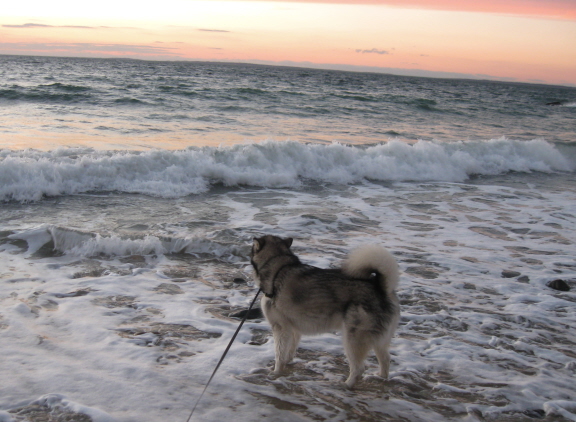
facing eastThe hour before sunset may be the most beautiful time of day. Especially if you’re on a beach in December with no people in sight.

paw waterConsidering he lives on Martha’s Vineyard (and is a bona fide Vineyard Seadog — we have Lisa Bibko-Vanderhoop’s calendar to prove it), Travvy doesn’t get to see much of the ocean. He was fascinated by the waves, and not at all hesitant about wading in them and even wooing at them.

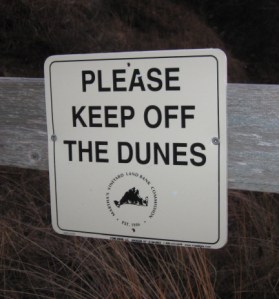
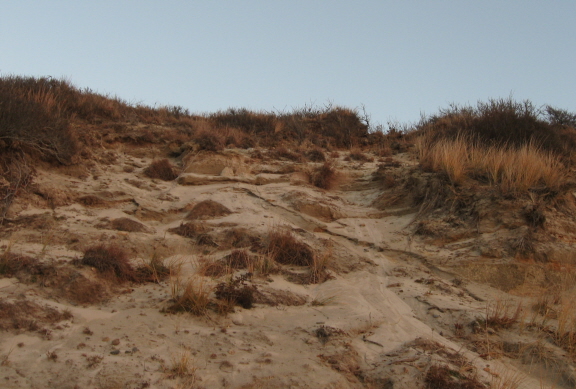
sea dog 1shore dogdunes signNeedless to say, we obeyed the sign and just looked at the dunes.

dunetrav & signThe one person we ran into on the beach was coming back from beyond the sign. He said there was a dead dolphin beached about half a mile up. If the sun hadn’t already gone down behind the water, Trav and I would have gone exploring. In the off-season you can say “No, thank you” to “Please turn back.”

sunset

Posted in Martha's Vineyard, outdoors | Tagged , , , , | 10 Comments

November License Plate Report (Etc.)

Nothing to report. Nothing nothing nothing. Rather than piss, moan, whine, and make excuses, I’m gonna blog about bread. If life gives you lemons, make lemonade. If life doesn’t give you lemons, make something else.

Besides — license plates, right? Bread goes on plates. There is a connection.

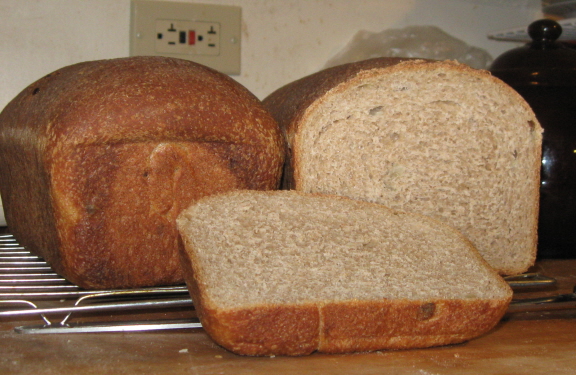
I made bread yesterday. This is what it looked like this morning:

The loaf on the left is now frozen. The crust in front is history.

The loaf on the left is now frozen. The crust in front is history.

I’ve been using sourdough almost exclusively since my 25-year-old starter died in March 2009. I got a new one going and I give it plenty of exercise. If you don’t have a starter, this recipe — such as it is — can be converted for active dry yeast. Instructions at the bottom.

All measurements are approx. The only time I’ll give is for kneading. Everything else depends on the peppiness of your starter and the temperature of your dwelling. In summer loaves often rise to baking size (“double in bulk,” as the saying goes) in a little over two hours. These guys took about six and a half. Active dry yeast is faster, but temperature still makes a difference.

The night before you want to bake, whisk and/or stir together the following:

1 cup sourdough starter
1 3/4 cups chicken stock (my usual liquid is fruit juice, but I had some left over)
1/4 cup vegetable oil
2 tablespoons honey (i.e., 2 long squirts from a teddy bear squeeze bottle)
3+ cups flour (I use half whole wheat, half unbleached white)

Add the flour gradually. What you want is a stirrable batter, what bread people call a sponge — not a dough ball.

Leave it out all night, at least 10 hours. Longer in cool weather. In warm weather the rising will be obvious. In cool weather, not so much, but it should look more bubbly than it did the night before.

Stir it down, then add:

8 ounces grated Parmesan (fresh, please)
1/2 medium yellow onion, coarsely chopped
scant 1 tablespoon kosher or sea salt
1/2 teaspoon baking soda

Now start adding flour, a cup at a time. First you’ll be stirring, but after 2 or 3 cups it’ll be stiff enough to knead. I start kneading in the bowl, then turn it out on a floured bread board and go to it. Add flour as needed to keep it from sticking. Knead for at least 10 minutes, longer if you want. (If you’re kneading by hand, you can’t overknead.) You want a cohesive, resilient dough ball that’s smooth on the surface.

Loaf it however you want. I usually use two good-size loaf pans. Small pans and round loaves also work. Grease the pans before you put the loaves in. Let the loaves rise until “doubled in bulk,” then bake for about 40 minutes (less for small loaves) at 375 degrees F.

Active dry yeast method:

Instead of sourdough starter, use 2 packets active dry yeast. That’s 2 very scant tablespoons (approx.). Combine 2 or 3 cups of flour with yeast and other dry ingredients in a big bowl. Skip the baking soda: that’s mainly to temper the sourdough if it gets too pungent. Add liquid (and cheese and onion if you haven’t already). Add flour a cup at a time until you have a kneadable dough. Knead as above.

Grease the big bowl and put the dough ball in it, rolling it around so it’s greasy enough to not stick to the bowl. Let rise till doubled in bulk. Punch down, knead out the bubbles, then loaf. Let rise in the loaf pans till doubled in bulk. Then bake as above.

P.S. If you see anything glaringly wrong in these instructions, let me know soonest. I make bread on automatic pilot. Trying to describe it step by step is like trying to give step-by-step instructions for tying a shoe.


Posted in home, license plates | Tagged , , | 3 Comments