No One Ever Gave Women the Right to Vote

This isn’t especially about the Vineyard, but it speaks so powerfully to why I am so caught up in this particular election.

Hecate Demeter's avatarhecatedemeter

Women weren’t “given” the right to vote.

Our great-grandmothers and grandmothers clawed it for us from the Patriarchy, one beating after another, one force feeding after another, one terrified night in a jail cell after another.  One wife threatening to tell what she knew, to never sleep with him again, to leave.  One mother guilt tripping her son, one sister calling in the childhood favor, one mistress swearing she’d go to the papers, one farmwife writing off the debt she couldn’t afford to write off and crediting it all to her great-great-granddaughters.

Here, at Samhain, when the veil between the worlds is thin, if you stop for just a moment, you can hear the women of your own blood calling out to you.  The women of your own line will talk to you:

I was too afraid to join them, but in my heart, I knew we deserved the vote…

View original post 302 more words

Posted in public life | Tagged , , | 1 Comment

Campaigning

I spent a couple of hours yesterday knocking on doors in Oak Bluffs on behalf of Dylan Fernandes, Democratic candidate for state representative from our district, and Julian Cyr, Democratic candidate for state senator.

Cute dog campaign picture

Cute dog campaign picture

Knocking on strangers’ doors is way out of my comfort zone. I’m a written-word person after all. However, I’m excited by the caliber and the potential of both these guys. I’d already given money, put up flyers, sent emails, and worn out my Facebook friends with shares and cute dog pictures. Maybe there was something else I could do?

I’ve also got Eleanor Roosevelt’s words firmly embedded in my memory for those times when I’m afraid that I’m unequal to the task or that the task will blow up in my face. “You must do the things you cannot do,” she said. And “You gain strength, courage, and confidence by every experience in which you really stop to look fear in the face.”

Both Fernandes and Cyr are running grassroots campaigns that emphasize one-on-one contact with the citizens they aspire to represent.  They’re knocking on doors and appearing regularly at house parties. They’re emphasizing two-way communication, listening as well as talking. Most campaign methods are strictly one-way, like speeches, rallies, TV and radio and newspaper ads, and robocalls.

Going door to door becomes less and less feasible as the size of the district increases. In large cities, states, and the whole USA it’s pretty much impossible.

But the average state senate district in Massachusetts contains 163,691 citizens (according to 2010 census figures) and the average house district 40,923. (Figures from Ballotpedia, where it’s much easier to find Massachusetts election-related info than on the Mass.gov site. Go figure.) Last I heard, Fernandes et al. had knocked on some 3,000 doors on the Vineyard alone and well over 7,000 in the district as a whole.

This is impressive enough in itself, but the Barnstable Martha’s Vineyard Nantucket district has to be the most geographically challenging in the commonwealth because it comprises two islands and a chunk of the mainland. The issues that confront us are similar in so many ways, but getting from one place to another is daunting enough that most of us on the Vineyard have little contact with Nantucket, and Falmouth is the local equivalent of a flyover state: we drive through it on the way to somewhere else. The relative dearth of personal connections leads to the mutual suspicion I blogged about last month in “Ballot Box Exceptionalism.”

In this particular election year, the word “campaign” provokes groans and eye rolls and heartfelt wishes that it were over yesterday. But what’s going on in this district — and I bet in many others across the state and the country — is cause for celebration. “Campaign” derives from the military: its roots mean field, open country, battlefield. It’s now understood more generally. Says the American Heritage Dictionary: “An operation or series of operations energetically pursued to accomplish a purpose.”

Especially on the local level, a political campaign can accomplish so much more than getting a worthy candidate elected to public office. In addition to introducing the candidate to the people, it introduces the people to the candidate. It fosters a two-way communication that can continue long past the counting of ballots if “we the people” do our bit to keep the conversation going. Often we don’t, then we blame the officeholder for being out of touch.

Playing a bit part in this effort was enough to push me out of my comfort zone, and you know what? I wasn’t bad at it, and it wasn’t all that scary.

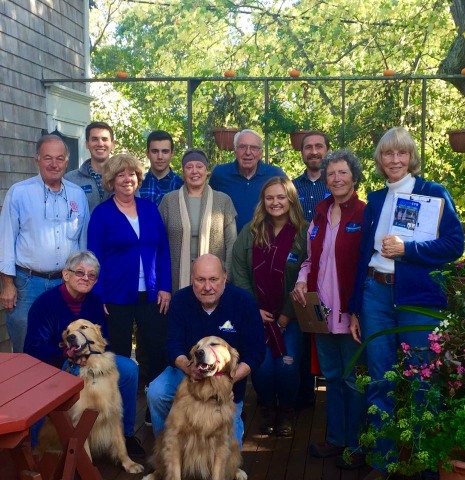
Canvassers about to hit the streets of Oak Bluffs. I'm second from the right. Dylan Fernandes is at the far left of the back row. Campaign manage Amaury Dujardin isn't in the photo because he took it.

Canvassers about to hit the streets of Oak Bluffs. I’m second from the right. Dylan Fernandes is at the far left of the back row. Campaign manager Amaury Dujardin isn’t in the photo because he took it.

Posted in musing, public life | Tagged , , , | 2 Comments

Deer on the Road

Last Sunday, on my way to writers’ group, I hit a deer. After dozens of near misses over the years, it finally happened. Long time ago I learned that when a deer bounds across the road in front of you, slow way down because there’s usually another one close behind. That’s saved me more than once.

The deer’s head appeared directly in front of me, as perfectly framed as a portrait, its big brown eye in the middle, surrounded by tawny-brown fur. I had just enough time to register Wha—? I’m going almost 40 on Old County Road and there’s a deer right in front of me? before I felt a bump. Then the deer vanished. My car was still rolling forward. I didn’t want to be late to writers’ group. There was nothing I could do about the deer in the dark. I kept going.

Did the deer’s eye see me through the windshield?

No dent

No dent

Dent

Dent

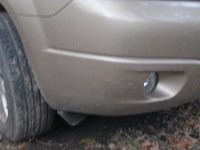
It wasn’t till the sun came up the next morning that I saw the dent, down low on Malvina Forester’s front fender, just to the right of the driver’s-side fog light.

After I got home Sunday night, I mentioned the incident on Facebook. Several friends offered their sympathy, and their own deer-collision stories. The next day a neighbor commented that in the previous few days he’d seen two dead does along that stretch of road — Old County near Misty Meadows, with open field on one side and woods on the other — one of them around 8:30 that very morning.

That almost had to be the one I hit. Travvy and I had walked that way around 10 a.m., looking for traces. From far across the field I’d spotted a white SUV parked on the grassy shoulder not far from the little parking area. Could it have something to do with the deer? If someone were collecting a deer carcass, a pickup would have been a more likely vehicle. By the time Trav and I got that far, the car was gone. Trav sniffed vigorously at the scrubby undergrowth, but this is not unusual. I saw no traces, but I’m no tracker either.

Last January a deer carcass appeared on a trail Trav and I walk most days, a stone’s throw from Old County, not far at all from where I hit the deer last weekend. Trav noticed it first and of course wanted to investigate. I caught on soon enough to reel in his Flexi. Deer hunting season had been over long enough that I guessed it had been hit by a car. Cold preserved it intact till spring thaw brought it to the attention of the neighborhood carnivores. Over the next few weeks the carcass was reduced to a scattering of bones. By then even Trav had lost interest, though even now he sometimes glances in that direction, as if longing for the feast that might have been.

When in my early years as a year-rounder I lived on the West Tisbury side of the Chilmark line, quite a few down-island friends refused to come visit after dark because they were afraid they might hit a deer. By then I knew that deer-car collisions could cause serious damage and human injury, but since I regularly drove back and forth between home and work in Vineyard Haven, often at night, without incident, I had a hard time taking this excuse at face value.

Malvina Forester sustained minimal damage in my deer-car collision, and I none at all, but Tuesday morning I called my insurance company anyway. The incident, I learned, was covered by the “comprehensive” part of my policy, the deductible was $500, and since I wasn’t at fault, it wouldn’t affect my good-driver rating or my premium. The appraiser came out Thursday to take a photo of Malvina’s bumper. If the estimate is more than $500 I’ll get a check, but I’m guessing it’ll be less so probably I won’t.

The deer wasn’t at fault either, but the deer is, most likely, dead. I still see that eye meeting mine through the windshield.

Travvy meets a deer in broad daylight.

Travvy meets a deer in broad daylight.


Posted in Martha's Vineyard, outdoors | Tagged , , , , | 3 Comments

Why We’re Cautious

Travvy

Wolfie is based on Travvy, my Alaskan malamute, but he has a different backstory.

Wolfie, my novel in progress, takes place on Martha’s Vineyard, as did its predecessor, The Mud of the Place. Those who eventually read it may have no acquaintance whatsoever with the island, and those who do don’t live on the same Martha’s Vineyard that my characters do. So from time to time I do a little of what fantasy and science fiction writers call “world-building”: showing readers what they need to know about the world the characters live in.

I’m especially fond of this bit. Shannon, my co-protagonist, has to go to a West Tisbury selectmen’s meeting on account of — you guessed it — a dog. Wolfie, the dog in question (and also the novel’s title character), is suspected of killing chickens and hassling livestock. A few days before the appointed date, she thinks:

Nevertheless, walking into town hall was venturing into a web of histories and connections some of which were obvious and others opaque, and you better know who you were talking to before you said anything stupid. Underneath its pretty beaches and picturesque fields Martha’s Vineyard was a tangle of feuds and grudges. They lay like smoldering embers till a spark or strong wind brought them roaring back to life. At that point a handful of cooler heads would step in to contain the blaze with buckets and garden hoses, and if they were lucky and the wind died down, the fire would do likewise before too many people got scorched.

Until something flared it up again.

No, Travvy has never been busted for killing anything. This is because I don’t let him run loose. I have been to a selectmen’s meeting on his/our behalf, however. See “No Dogs! No No No!” More than four years later, the sign is still up on the tennis court, but Trav and I practice there occasionally when the court isn’t padlocked for the summer. My grudge against Parks & Rec isn’t exactly incendiary. I don’t vote for any of them in town elections, true, but this doesn’t matter because they always run unopposed.

Posted in dogs, Martha's Vineyard, writing | Tagged , , , , , , , | 3 Comments

From Off Island

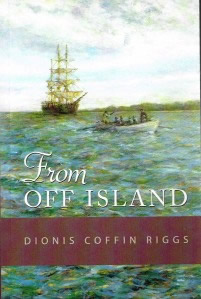
From Off Island, by Dionis Coffin Riggs, in collaboration with Sidney Noyes Riggs. New York: McGraw-Hill, 1940.

from-off-island

The cover for the new edition was painted and designed by Elizabeth R. Whelan.

This is the 2016 facsimile edition of the novel first published in 1940 by McGraw-Hill’s Whittlesey House imprint, based on the life of Mary Carlin Cleaveland, the grandmother of author Dionis Coffin Riggs (1898–1997). In the fall of 1852, Mary Carlin, then 16, left her home in Sydney to live with her sister and brother-in-law in San Francisco. During a layover in the Sandwich Islands (now Hawaii), she met, fell in love with, and married James Cleaveland, a whaling captain from Martha’s Vineyard who was more than a decade her senior. Instead of San Francisco, she eventually made port in Holmes’s Hole (now Vineyard Haven), then a bustling center of the seagoing trades.

To say that Mary Ann Cleaveland, James’s mother, was not amused by her son’s impulsive marriage is to greatly understate the case. In the 19th century, and well into the 20th, Martha’s Vineyard was insular in more ways than one. Vineyard families were all interrelated, and anyone from “off” (now, as then, on the Vineyard “off” is frequently employed as a noun) was by definition beyond the pale. Mary Ann made young Mary’s life intolerable, and it got worse while James was away on his next whaling voyage. The younger woman escaped her mother-in-law’s petty but relentless cruelties by, in effect, adopting herself into another family. When James left again, his wife went with him. During the five-year voyage she gave birth to her older two daughters.

From Off Island vividly evokes life both on 19th-century Martha’s Vineyard and on board a whaling ship, all from the women’s perspective. The book is rigorously researched — the author’s husband, educator Sidney Noyes Riggs, was her collaborator — and the notes at the end on sources and how the Riggses found them make for fascinating reading. But newspapers and ship’s logs can tell only so much. It’s the poet-author’s imagination, skill with language, and deep knowledge of the Vineyard that bring both the people and the places to such vivid life. The book will be of special interest to anyone interested in whaling, New England (especially, of course, Martha’s Vineyard), and women’s lives in the mid-19th century.

Fans of Cynthia Riggs’s Martha’s Vineyard Mysteries will be interested to know that Dionis Coffin Riggs, the author of From Off Island, was Cynthia’s mother and the model for Victoria Trumbull, Cynthia’s intrepid 92-year-old sleuth.

The new edition of From Off Island is available at both Vineyard bookstores, Bunch of Grapes and Edgartown Books. Cynthia will be at the Thanksgiving weekend Artisans Fair at the Ag Hall, retailing this along with her own books, and it should shortly be available for mail order via her website.

Note: This review is very slightly adapted from the one I just published on Goodreads.

Posted in Martha's Vineyard | Tagged , , , , , | 3 Comments

Early Fall Laundry

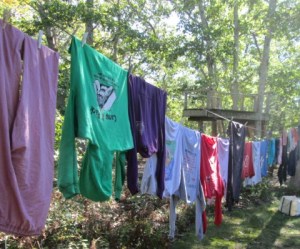
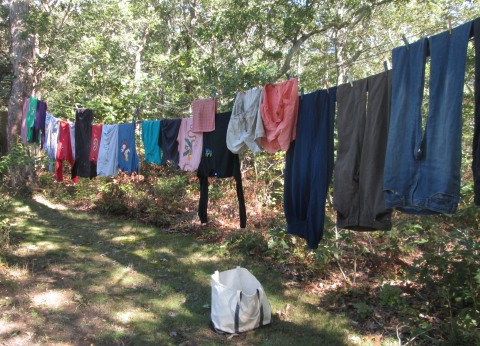
It rained and rained and rained all day yesterday, but today has been a perfect laundry day: bright and very breezy.

Sleeves, I see sleeves . . .

Sleeves, I see sleeves . . .

Usually I do laundry when I’m about to run out of underwear. This time I’d run out of jeans. It was either do laundry or perform the Great Seasonal Clothing Switch. There are more jeans in my two winter clothes bins, but there are also longjohns and sweaters, gloves and Yaktrax and other things I’m not ready to face yet.

This was a quintessential early fall laundry: a blend of summer and fall. Jeans hanging next to shorts. T-shirts sleeveless, short-sleeve, and long-sleeve. Two sweatshirts. Some mornings I go out walking in jeans, long-sleeve T, and sweatshirt, but by noon I’ve shed the sweatshirt and changed jeans for shorts. Then at the end of the day I do it in reverse.

20161010-early-fall-line

Jeans, shorts, sleeves, no sleeves . . .

Posted in home | Tagged , , | 3 Comments

In Praise of Career Politicians

mocha chipComing home from grocery shopping yesterday, I pulled in to down-island Cronig’s to see if I could find a few things that Reliable either was out of (stew beef and no-beans chili) or doesn’t carry (Brigham’s mocha chip ice cream — the best).

Tobias Glidden, independent candidate for state representative, was outside talking with voters and passing out copies of his position paper. I stepped up and said that although I was actively supporting Dylan Fernandes, the Democratic nominee (which had to be obvious because I was wearing Dylan’s sticker on my shirt), I’d liked what Tobias had to say at the candidates’ forum this past August. It was good, I said, to have two qualified candidates running. The district would be well served no matter who won.

As I headed into the store, he said, “You know, I’m not planning to run for higher office.” I laughed and said he was young, who knew what would happen, he probably shouldn’t say things like that. He said no, he meant it.

And I’ve been wondering ever since why not planning to run for higher office was a plus.

No, I’m being disingenuous. Before I picked up my basket inside the store, I got the subtext: I’m not using the district as a stepping-stone to further my own career.

Unlike, ran the sub-subtext, my opponent.

This is a local variation on what I blogged about the other day in “Anti-Delusional”: “In national politics, inexperience and downright incompetence have become virtues, even among those who must know how many skills are required to understand and balance the interests of a diverse population and to keep the craft moving forward.”

Glidden’s experience is impressive. He’s demonstrated considerable competence. This is why he impressed me at the candidates’ forum. So perhaps he seeks to set himself apart from his equally experienced and competent opponent by insinuating that he’s not a career politician.

Google “career politician” and you’ll quickly gather that career politicians are in a class with pederasts, drug pushers, and serial killers. Why is this? Do we sneer at, say, career teachers or career carpenters in quite the same way? We do not.
town meeting

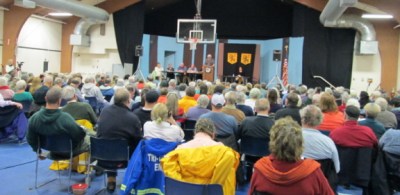
Town meeting is about as democratic as it gets these days, but the citizens would have a hard time getting anything done without those who put in the time to develop expertise.

What’s going on here?

Maybe we’ve got the old image in our heads of citizen farmers and scribes laying down the tools of their respective trades, serving a term or two in Congress, then going back to the plow or the quill.

Sorry, it doesn’t work that way anymore, if it ever did.

According to my favorite dictionary, a politician is one who engages in politics, and politics is “the art or science of government or governing, especially the governing of a political entity, such as a nation, and the administration and control of its internal and external affairs.”

This takes aptitude, skill, training, and expertise. Not everybody has it. And even those with aptitude need experience to develop their skills.

I’m an editor by trade. Although editing takes both aptitude and experience, plenty of people think that anyone who can read and write is a potential editor.

Um, no. Maybe this is why it bugs me so much that some people believe that politics doesn’t require aptitude, expertise, and experience.

So back to this guy who thinks it’s a plus that he doesn’t plan to run for higher office. Say he gets elected this time, next time, or in the not-too-distant future. Does he plan to keep running for re-election and (most likely) getting re-elected till he hits retirement age?

I see a couple of problems with this. One is that he’s effectively blocking anyone else from winning the seat and acquiring the experience that serving as state rep brings. Another is that at some point he’s bound to realize that he’s getting a little bored, a little stale, and wanting to move on. Where to? Well, higher office would seem to be a sensible choice: he could take his experience and his understanding of his own district to the next level.

But oh no: that would make him a career politician.

Of course he could always go back to his plow or his quill — noble trades both — but is that the best use he could make of his political experience?

I don’t think so. I would love to see Dylan Fernandes and Julian Cyr (Democratic candidate for state senate) take their energy and the skills they hone in the state legislature and move on to the next level, taking their deep knowledge of the Cape and Islands with them. If one of them knocked our so-so (Democratic) congressman off his perch, I’d be thrilled.

Among Barack Obama’s many assets as president is his experience of being a black man in the U.S. No previous president has had it. It’s freaked some people out, and led others to nurse unrealistic expectations of what he could achieve. Something similar will play out when Hillary Clinton takes the oath of office next January. No previous president has had the experience of being a woman in our very sex-divided society.

I would love to be represented in Congress or in the Massachusetts statehouse by someone who carries in his/her mind and heart what day-to-day life in the Cape and Islands is about, what we’re good at, what we worry about. And that is not going to happen if our elected representatives choose not to go any further, lest they be considered career politicians.

Posted in musing, public life | Tagged , , , | 11 Comments

Anti-Delusional

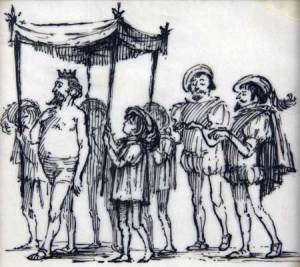
emperor's clothes“The Emperor’s New Clothes” has been my favorite fairy tale for a long, long time. Everyone identifies with the lone child who points out that the emperor is parading down the street in his undies. They’re sure they’d be brave enough to shout out the self-evident truth when everyone else was oohing and aahing at robes that were not there.
I’ve long suspected that in the U.S. the child would be torn limb from limb for saying any such thing, unless a few quick-thinking adults snatched her away to safety.

Thanks to this presidential election cycle, I’ve got a new take on “The Emperor’s New Clothes.” In this take, the child calls out that the emperor has no clothes on, the emperor (or one of his quick-witted advisers) says that robes are passé, the undies are a fashion statement, and the faux tailors get away with their swindle.

In national politics, inexperience and downright incompetence have become virtues, even among those who must know how many skills are required to understand and balance the interests of a diverse population and to keep the craft moving forward. It is no coincidence that this disregard and even contempt for experience and competence has reached a crescendo when the most experienced, competent candidate is female. When a woman surpasses the men by the current rules, there must be something wrong with the rules, right?

Disruption is all the rage. This is not surprising. Experience corrupts, but disrupting is easy. It takes little skill or experience and no patience at all. But what comes next?

In dystopian fiction, the usual scenario is that some apocalypse wipes the earth clean of all its corruption, Noah’s Flood style, and a valiant band of survivors build utopia on its hopefully not-too-radioactive ashes.

If you want to see what disruption looks like in real life, check out what happened when the former Yugoslavia fragmented into mutually hostile states. Or when the U.S.-led invasion knocked out central authority in Iraq. “Central authority” may be flawed to the point of despicable, but when it collapses, whether from within or without, what follows is not pretty.

In other places — say, the U.S. after the Civil War or Russia after the breakup of the Soviet Union — the old order manages to reconstitute itself and conditions for the oppressed do not improve. From the ashes of slavery arose not emancipation but Jim Crow, and not for nothing is a recent biography of Vladimir Putin titled The New Tsar.

So often those calling most loudly for disruption and “revolution” (a form of disruption) seem unaware of what they’re disrupting, and what their world would look like without it.

Decades ago I took to heart something Sir Thomas More said in Robert Bolt’s play (and film) A Man for All Seasons. More is arguing with William Roper, his hotheaded and idealistic son-in-law. Roper has just said that he’d “cut down every law in England” to get to the Devil, and More responds:

“Oh? And when the last law was down, and the Devil turned ’round on you, where would you hide, Roper, the laws all being flat? This country is planted thick with laws, from coast to coast, Man’s laws, not God’s! And if you cut them down, and you’re just the man to do it, do you really think you could stand upright in the winds that would blow then? Yes, I’d give the Devil benefit of law, for my own safety’s sake!”

When King Henry VIII declared himself head of the Church of England, in order to sanction his own divorce and remarriage, More refused to go along. The law couldn’t protect him — he was beheaded for treason — because the king was above the law. The lesson here isn’t that law doesn’t matter but that no one should be above it.

More’s conscience got him killed, a fate that does not await those whose consciences won’t permit them to vote for Hillary Clinton. Do any of these people truly believe that Jill Stein of the Greens or Gary Johnson of the Libertarians is of presidential caliber? More important, do either the Greens or the Libertarians offer, or even aspire to offer, the kind of infrastructure that gets people involved in the political process, not only during election campaigns but afterward? That encourages qualified people to run for office and offers the resources (e.g., volunteers, mailing lists, and know-how) necessary to support their campaigns?

Without political parties, each aspirant has to build an organization from scratch. That’s exhausting, and I’m pretty sure it favors those with the money to pay out of pocket for everything they need.

From where I sit on Martha’s Vineyard, the Democrats at least are looking pretty good. The primary races for state senator, state representative, register of deeds, and county sheriff were all contested by qualified candidates, quite a few of whom are in their twenties or not much older. No one’s calling for disruption. They’re too busy talking about the issues, listening to constituents, and working for change.

Photogenic dog lured by string cheese into supporting Dylan Fernandes for state rep and Julian Cyr for state senator.

Photogenic dog lured by string cheese into supporting Dylan Fernandes for state rep and Julian Cyr for state senator.

Posted in musing, public life | Tagged , , , | 3 Comments

September License Plate Report

201609-sept-license-map

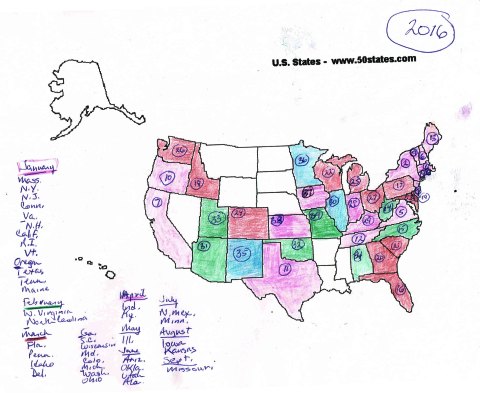
Just one September sighting: Missouri. Fall pickings are notoriously slow in the license plate game, so this may be it for the year. Eleven states are still blank on the map. On the other hand, Nevada, Wyoming, and Louisiana aren’t all that rare, and didn’t I spot Nebraska in the last days of December 2015?

It ain’t over till it’s over.

Posted in license plates | Tagged | 1 Comment

Ballot Box Exceptionalism

In the wake of last Thursday’s primary election, I’m thinking once again about Vineyard exceptionalism. This is nothing new. I’ve blogged about it, I rant about it, sometimes I obsess about it. But first here’s how my candidates fared:

  • Paulo DeOliveira won his race for Dukes County register of deeds. This is not surprising, since he’s got the most experience and was highly recommended by the retiring incumbent, his current boss. What might have been surprising is how handily he won it: garnering 68% of the vote in a four-way race is an impressive mandate.
  • Marc Rivers lost his race for Dukes County sheriff to Robert Ogden. Disappointing, but not too surprising.
  • In the state senate race, I wound up voting for Sheila Lyons, who lost convincingly to Julian Cyr — 38% for her, 54% for him — but this was a win-win race and I think Cyr’s going to be great. He does have a GOP opponent in the general election, however, and scuttlebutt has it that the GOP has made this race a priority. So it ain’t over yet.
  • In the contest that had me watching the incoming vote tallies on MassLive all night and posting occasional updates on Facebook, Dylan Fernandes scored an impressive 48% of the vote in a five-way race, a tribute to his experience, his energy, and an inspiring grassroots campaign. He expected to take his hometown of Falmouth (which he did, with 68% of the total) and was saying he needed to run a strong second on the Vineyard and Nantucket to win. He did.

The candidates for sheriff and register of deeds all live on the Vineyard — not surprising, because these are Dukes County offices and Martha’s Vineyard makes up about 99 percent of the county. In the state senate race none of the candidates were Vineyard residents, neither the two Democrats nor the two Republicans.

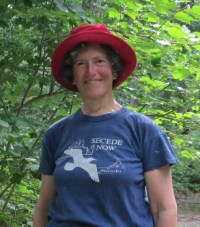
Yours truly wearing the T-shirt of the SECEDE NOW movement that protested the Vineyard's loss of its very own representative.

Yours truly wearing the T-shirt of the SECEDE NOW movement that protested the Vineyard’s loss of its very own representative.

Of the five candidates for state rep, however, one lives on the Vineyard, one lives on Nantucket, and the other three live in Falmouth. This is why in the course of the campaign I frequently heard the argument that only someone who lives on the Vineyard can adequately represent the Vineyard.

Once upon a time, the Vineyard had its own representative in the state house of representatives and so did Nantucket. That ended in the late 1970s when the house shrunk from 240 members to 160 and the Vineyard, Nantucket, and part of Falmouth were bound together in what is now the Barnstable Dukes Nantucket house district. This district, like all the other house districts, comprises about 40,000 people. Unlike all the other house districts, you cannot get around Barnstable Dukes Nantucket by car. It poses, to put it mildly, a logistical challenge.

Since the house was shrunk, I don’t believe the district has ever been represented by a Vineyarder, but at least since the early 1990s the rep from this district has had a legislative liaison on the Vineyard to help keep him (it’s always been a “him”) current on Vineyard issues. Once someone is elected, they tend to get re-elected barring conspicuous incompetence, which has not happened in the three decades I’ve lived here.

This year the incumbent, Tim Madden (of Nantucket), decided not to run again, so we had a real horse race to succeed him. One of the hopefuls, a genial, articulate fellow, was from the Vineyard. For many people that settled it: The best person to represent the Vineyard is the one who lives on the Vineyard, QED, vote for this guy.

I do believe that long residence on the Vineyard can make a difference. If a candidate from, say, Falmouth and one from the Vineyard seem equally qualified, I will go for the Vineyarder, the same way I’ll go for the woman, or the person of color, when otherwise it’s six of one, half dozen the other. Because a certain expertise, a certain potential, comes with who one is in the world. (This gets into the huge, and hugely contested, issue of identity politics.)

Seen from a slightly different vantage point, however — well, Barnstable Dukes Nantucket may be logistically challenging, but the issues confronting Barnstable, Dukes, and Nantucket counties are remarkably similar: an economy based on tourism and the second-home market has made housing unaffordable for many working year-rounders, leading to an emigration that threatens the fabric of our communities; the heroin-opioid epidemic; the fisheries and shellfisheries; and environmental challenges, including those related to climate change. Someone who grasps how these issues affect, say, Nantucket is well on the way to grasping how they affect Martha’s Vineyard and Falmouth.

The remaining question for each candidate: How do you propose to keep in touch with — listen to — your constituents in the parts of the district where you do not live?

Dylan Fernandes impressed the hell out of quite a few Vineyarders by knocking on their doors down long dirt roads, handing out leaflets and listening to their concerns. No candidate had ever called on them before. The fact that the guy lived across the water was not going to keep him from representing Martha’s Vineyard. The Vineyard guy, however, lacked Fernandes’s energy and Fernandes’s experience. For this voter, Vineyard exceptionalism went out the window.

Dylan Fernandes, Democratic nominee for Mass. state house of representatives

Dylan Fernandes, Democratic nominee for the Mass. state house of representatives

Julian Cyr, Democratic nominee for the Mass. state senate

Julian Cyr, Democratic nominee for the Mass. state senate

Posted in musing, public life | Tagged , , , , | 2 Comments