G is for Grapevine #AtoZChallenge

The Grapevine was the name of a Vineyard weekly that preceded the 1984 birth of the Martha’s Vineyard Times. There was no official connection between the two, but into the 1990s people sometimes referred to the Times as the Grapevine. The connection was Gerry Kelly, the editor of the Grapevine who went on to become the lead reporter for the Times.

Come to think of it, G is for Gerry as well as Grapevine. The late Robert Potts, a journalist himself, called Gerry “the greatest one-man band in the history of journalism.” Not only was Gerry an investigative reporter of a kind not seen on the Vineyard since, he also turned out book, restaurant, and art reviews almost every week.

When I was features editor, he saved my butt regularly: if a stringer didn’t come through with a piece or an ad was pulled at the last minute, Gerry could fill the space with less than half an hour’s notice. He could turn out prose like yard goods — and I say that with huge admiration because I can’t. Yes, his prose generally needed editing, but that’s what I was there for. I can edit on the fly, but I still can’t write that way, at least not on the computer. This is why I do my first-drafting in longhand, with fountain pens.

A Google search just turned up this New York Times story from January 17, 1982, that refers to both Gerry and the Grapevine. The firing of Edward Hanify as administrator of the Martha’s Vineyard Hospital and its aftermath were still being discussed when I became Gerry’s colleague several years later, and if you dip into either island paper in 2018 you’ll notice that the administration of M.V. Hospital is still somewhat tumultuous.

Gerry died in 1996. He was originally from Wisconsin, though he had no love for it, and had no biological family he would lay claim to. The M.V. Times staff was his real family, and his ashes took up residence at the Times office. One afternoon, IIRC in early 1997 but don’t quote me on that, several of us were sitting around the newsroom and someone came up with the idea of taking Gerry’s ashes to the places he loved best. A supply of pill vials was quickly procured and Gerry’s ashes decanted into them, and over the following months vials of Gerry made their way to Mexico (probably his favorite place of all), Spain, and other locations I can’t recall now.

Since in those years I was a regular at WisCon, the feminist fantasy/science fiction convention, I took Gerry to Madison. One vial of ashes I scattered on Lake Mendota and the other I buried in the dirt under a hedge near the state capitol. Gerry did not love Wisconsin, but he did love politics and rooting out scandals, so I think he would have approved. He would have had a field day with current governor Scott Walker.

Anyway, the Grapevine was well named, and not primarily because of the Vineyard’s obvious association with grapes. The masthead depicted one head speaking into the ear of the next with several more waiting eagerly down the line to hear the news. As a summer visitor I acquired an orange Grapevine T-shirt with this design, and one of my great regrets is that around the time I moved here year-round it went missing, never to be seen again.

Then as now, news got around the island before it appeared in print. Only recent arrivals got their news from the newspapers or the radio. After you’d been here a while, you got it from the grapevine, and if you were reasonably discerning you developed a feel for who was reliable and who wasn’t, and which stories smelled of haste or old grudges. Now much of it happens on Facebook, specifically the Islanders Talk group, which has more than 11,000 members. I refer to it as “the grapevine on steroids.”

My own initiation into how news travels on Martha’s Vineyard was greatly accelerated once I went to work for the M.V. Times. Of course several tendrils from the grapevine ran through the Times office: both reporters and editors depend on tips, and tips generally come from the grapevine. Before long, I knew a lot more than ever got into the paper, and I was incurably fascinated by how word gets around — and doesn’t.

This fascination plays out in both Mud of the Place and Wolfie, though in different ways. Reporter Leslie Benaron is a point-of-view character in Mud. She works for the Martha’s Vineyard Chronicle, whose first-floor layout looks a lot like what the M.V. Times office did in the late 1990s. (The upper floor is very different, and there’s no overlap between the staff of one and the staff of the other, but when readers praise the newspaper scenes for their authenticity I’m very happy.) The story she’s chasing is also developing just out of her reach, in part because she’s not well connected to the grapevine and doesn’t know what to look for.

No reporters or newspapers appear in Wolfie. Here the challenge for the characters is to figure out what’s going on with the Smith family when no one’s talking and what clues there are, are few, ambiguous, and inconclusive. You’ll sometimes hear Vineyard people say that everyone knows everything about everybody, but it’s not true.

Note: Here’s the obituary Gerry Kelly wrote for his good friend and frequent source Betty Ann Bryant, who died only a year and a half before he did. Betty Ann was as well connected to the grapevine as anyone I ever knew, and I dedicated Mud of the Place to her for “showing me where to look.”

Posted in Martha's Vineyard, public life, writing | Tagged , , , , , | 3 Comments

F is for Family #AtoZChallenge

In my D.C. days, most of us came from somewhere else. Many of us had left — maybe “fled” would be a better word — small cities, smaller towns, and rural areas that were incongenial at best to lesbians, feminists, artists, and/or those with an intellectual bent; where the options for women in the 1970s were few.

We didn’t bring families with us, and if parents came to visit, we didn’t go out of our way to introduce them to our friends. (Brothers and sisters fared somewhat better.) Most of us fell within a narrow age range, say 25 to 40. Not coincidentally, women’s history and lesbian history were among our preoccupations, discovering, uncovering, recovering the stories of those who had come before.

Yes, on Martha’s Vineyard there were plenty of incomers — “wash-ashores” is the common term, often used defensively or derogatorily — and people passing through, but underneath all the coming and going was something steady that changed very slowly, like the seabed.

Family.

Families who’ve lived on the Vineyard for generations, even centuries, are mostly interrelated. The same names recur over and over again. The Mayhews all trace their lineage back to the first Anglo settlers in the mid seventeenth century, but the family tree has so many branches that some Mayhews are only distantly related to others.

I quickly learned to be careful what I said about whom to whom. Surnames tell only part of the story. Small wonder that in many Vineyard conversations some time is spent establishing who is connected to whom, by blood, marriage, divorce, work history, neighborhood, or anything else likely to create a bond worth knowing about if you don’t want to step on a landmine.

Mud really is going to be available as an ebook one of these days. I know I’ve been saying that for at least three years, but it’s true.

Family is all over The Mud of the Place. Nearly all the main characters are single, but family is rarely far from the foreground. All the short-sighted and downright stupid things Jay Segredo does are because he’s afraid to come out to his family. The prospect is terrifying because over the generations survival on Martha’s Vineyard and in plenty of other places has depended on family, unless one is wealthy enough to go it alone, which the Segredo family isn’t.

Ever since Mud came out, people have been asking me “That couldn’t happen now, could it?” They assume it’s all about some abstraction like homophobia, but it’s not: it’s about the fear of being ostracized from the hearth, warmth, the source of life and strength. With so much at stake, one does not take big risks. Once something is said, it can’t be unsaid.

For me, and many of my D.C. friends (quite a few of my Vineyard friends too, come to think of it), survival meant jumping clear of the family and running like hell for safer ground. So it took a long time and a lot of listening to understand what was going on here. Shannon Merrick’s background is more like mine, only much worse: as a teenager she ran away from her violent, alcoholic family and never went back.

In Wolfie, the novel in progress, Shannon’s reunion with her long-estranged sister Jackie is a major subplot. See “A is for Aquinnah” and “B is for Beach” for more about that.

Here, in Mud, Jay, the youth services director at a Vineyard social service agency, reflects on the different situations of his sister Janice (“Janny”) and Alice Chase, both of whom are part of Mud‘s supporting cast. Lenny, Alice’s ex, has been blocking her every attempt to change the custody agreement to allow her and her son to rejoin her family off-island.

But not even the most persuasive orator would ever convince, say, Alice Chase that this was a good place to raise kids. Jay reflected, not for the first time, on the similarity between Alice’s situation and that of his sister Janny. Both had grown up in tight-knit families. Neither one had been to college. Both got trapped in miserable marriages to abusive, alcoholic men. Janny had three kids; Alice had one, about the same age as Janny’s youngest. But Janny had a home and Alice didn’t; Janny was doing fine and Alice wasn’t. As far as Jay could tell, the biggest difference between the two was that Janny’s family was here and Alice’s was across the water.

Come to think of it, Lenny Chase’s family was here, and even he was doing pretty well, considering he was a ne’er-do-well drunk who couldn’t hold a job for three consecutive weeks.

Posted in Martha's Vineyard, writing | Tagged , , , , , | 1 Comment

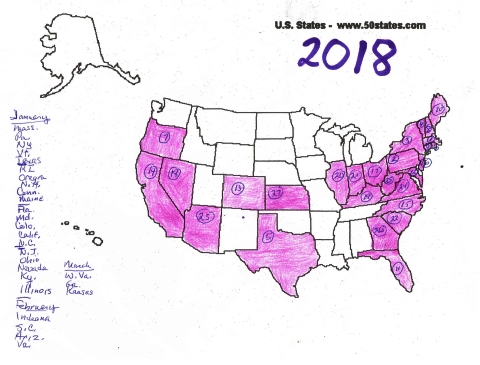
March License Plate Report

With all this A to Z Challenge excitement, the March License Plate Report is late late late, but here it is at last.

A short list but a good ‘un. Georgia isn’t a big deal, but the East Coast is now complete except for the usual holdout, Delaware. West Virginia I spotted while cruising through the hospital parking lot — always worth a detour, even in the off-season — and Kansas?

Toward the end of the month I took Malvina Forester to Up-Island Automotive for her annual inspection. Inspections are done in a single bay behind the shop. There are loads of cars, vans, and pickups back there, nearly all of them sporting Massachusetts plates, some with registration stickers that expired a few years ago. But right in front, impossible to miss as I waited for Malvina to pass her tests, was KANSAS.

It was like spotting Nevada off Lagoon Pond Road in Vineyard Haven the day of the Women’s March in January. Martha’s Vineyard Hospital may be good hunting ground, but you never know what will turn up in out-of-the-way places.

Posted in license plates | Tagged , , , | 1 Comment

E is for Editing #AtoZChallenge

Editing is not a particularly well-paid trade, although it requires considerable aptitude, expertise, and education to do it well. Some freelance editors of my acquaintance regularly rail against the complaints, expectations, and demands of clients and prospective clients, saying things like “They wouldn’t ask a plumber to wait 60 days for payment” and “A lawyer charges four times the hourly rate that I do!”

What it comes down to is value. Worker and client have to agree on the value of the work. If your pipes burst or your sink backs up, the value of the plumber’s work is clear. If you need to draft or even review a complicated contract, you probably need a lawyer.

Lawyers write contracts and laws so that only other lawyers can interpret them, which pretty much guarantees that lawyers will be indispensable for some time to come. Editors are not so lucky. Come to think of it, editors are in the business of making language more intelligible to more people. We may be cutting our own throats.

What Martha’s Vineyard has taught me, and keeps teaching me, is that editing doesn’t become valuable solely because I do it well and enjoy doing it; it becomes valuable because other people are willing to pay me to do it.

On Martha’s Vineyard editing is way down the list of things people need and are willing to pay for. Most people have only the foggiest idea of what an editor does. (Keep in mind that I didn’t either until I got my first editorial job.) Put it this way: Editing is not on the psychic map of most Vineyarders, except writers and people who work for one of the newspapers.

In my first years here most of my editing was done under the guise of typing. I was a pretty good typist, but my forte was never my speed; it was that I corrected spelling, grammar, and punctuation on the fly and made everybody look good.

As a result of a classified ad I was running in the Martha’s Vineyard Times, the Times‘ features editor, whom I’d never met, turned to me at a West Tisbury town meeting and asked if I might be able to fill in for the paper’s editorial typesetter, who was about to go on sick leave. With some trepidation I said yes.

The Times was then located in a building that no longer exists behind Woodland Market. It had once been the home of the Spaghetti Pot restaurant, and the carpet indeed looked as if it had been dyed in spaghetti sauce. The editorial typesetter, who was older then than I am now, returned from leave but had to leave again when her husband got sick, so I got a second several-week temp gig — and maybe a third, I forget.

Checking the boards on my last day as M.V. Times features editor, October 1993. Back in the Pleistocene, all copy was cut with Xacto knives and pasted up with wax. By the end of the decade everything was digital.

In any case, the Times realized I could be useful so they hired me as a part-time proofreader who wrote theater reviews and occasional features on the side.

At that time I was also working as a chambermaid at the Lambert’s Cove Inn. When I proofread at the paper, I was looking for typos and literary infelicities; at the inn I was looking for hairs in the shower. The two jobs did have a lot in common.

I eventually became the paper’s second-ever features editor. I loved the job, but it was demanding and I finally burned out. This was at least partly my fault: when you can write, edit, proofread, and type pretty well and you’ve got barely controlled perfectionist tendencies, it’s hard to find anyone who can do any of it as well as you can. After I left, my job was split into two and a half pieces.

Unsuccessful attempt to drum up freelance editorial work on Martha’s Vineyard, mid-1990s.

By the time I left the Times in October 1993, I was already freelancing as proofreader and copyeditor for a guy running a small book-packaging company, making use of the desktop publishing technology that was just coming into its own.

I made a serious attempt to drum up other editorial business on the Vineyard, but I quickly learned that though plenty of organizations and businesses needed an editor or proofreader, they didn’t know it, weren’t willing to pay for it, or both.

At least 90% of my income was coming from that one book-packaging company, so when the proprietor decided to close up shop, I was back in the job market. I worked the last couple of seasons at the old Webb’s Camping Area (more proofreading, this time outdoors), then persuaded the Martha’s Vineyard Times to create a copy desk position and hire me to fill it.

By the time I left that job, in May 1999, I’d acquired enough publisher clients to freelance full-time, and that’s what I’ve been doing ever since.

There’s more freelance editorial work on the Vineyard now than there used to be — a lot more, but it still doesn’t amount to more than a modest fraction of my modest income. Editing still isn’t on the psychic map of most Vineyarders. This has led to a weird split: thanks to the rise of the internet and more recently social media, nearly all my clients and editorial colleagues live somewhere else. Some people I’ve known or worked with for 20 years but have never met in person.

Most of the people I know on Martha’s Vineyard make things or fix things or grow things, for a living or an avocation or, in some cases, both. I can’t make much of anything that doesn’t involve words, and next to the ability to say, build a shed, rig a boat, wire a house, or make a quilt, that seems pretty feeble. True, I’m grateful that some people value my skills enough to pay me for my time, but still — I get why a good plumber is paid better.

Posted in Martha's Vineyard, work | Tagged , , , , | 4 Comments

D is for Dogs #AtoZChallenge

I grew up with dogs (and cats, and a couple of horses), but as a grownup I never had one of my own, mainly because I was afraid I didn’t know enough to take care of one.

I had the same problem with cars. As I was settling into my first winter rental, a summer resident friend of the family lent me her island car to use whenever her family didn’t need it. The car, a 1980 Subaru, taught me many lessons, starting when I came down the very first morning and discovered it had a flat tire. My first impulse was to leave the car there for the winter and rely on my bike and my feet to get around. But Courtesy Motors was right across the street, and true to their name they did not treat me like an idiot female who couldn’t deal with cars. They lent me an air can and showed me how to use it. I crossed the street, inflated the tire, and drove round to the back of the shop, where they changed the tire and told me where to get the flat fixed. They’ve been my mechanics ever since.

With dogs — well, some people walk because they have a dog, but I attracted dogs because I like to walk. The Vineyard, then as now, has great places to walk: beaches, ancient ways, dirt roads, the state forest, and especially the properties of the M.V. Land Bank, which was established the year after I moved here after long negotiations that I learned about only later. People who worked regular hours or just didn’t have time lent me their dogs to go walking with.

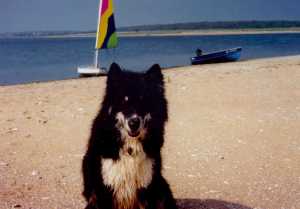
Tigger at Big Sandy, Sunfish in the background, probably summer 1994

One of my foster dogs was Tigger. Tigger’s dad was a malamute, his mom a Samoyed–border collie mix. Not only did Tigger come for walks with me, he sometimes stayed overnight.

Dogs, I learned, were not all that hard to look after. With dogs, as with cars, you did what you had to do, and if you didn’t know how, you learned and/or asked somebody to help.

In the fall of 1994 Tigger’s mom again got pregnant by Tigger’s dad. The first time was planned, this one wasn’t, but no one was unhappy about it. I got in line for a puppy.

On December 17, 1994, I saw the puppies whelped, five boys and three girls, and since I was unemployed at the time, I spent many, many hours watching them grow. The boys all got Star Wars names, as did one of the girls; there being only one female in Star Wars, the other two girls were out of luck.

Susanna and puppy

Susanna and puppy Rhodry, January 1995

Which one would become my puppy? The pups weren’t quite three weeks old when little Han Solo came toddle-trotting toward me with determination. My heart opened and there was no more question which one was my puppy. I named him Rhodry, after the lead character in Katharine (Kit) Kerr’s Deverry novels.

Rhodry was drop-dead gorgeous, and being half-malamute he also had a sense of humor. For more photos, see his photo gallery on my old website. In true island fashion, Rhodry had four homes in his 13 years. He took it in stride when I added a horse to the family; he was a remarkably good barn dog and a great trail-riding companion, apart from his penchant for rolling in whatever deer carcass he came across.

Rhodry (1994-2008) and Susanna. Photo by Betsy Corsiglia.

Pixel in The Mud of the Place is based on Rhodry, though she looks more like his littermate sister Lakota, who was about 25 pounds lighter and female. Mud‘s back-cover photo was taken the day after I learned that Rhodry had cancer. You’d never know it, would you? He died a month later, age 13, on February 26, 2008.

Travvy was born the day after Rhodry died, but I didn’t know that till two months later, when I drove to Canandaigua, New York, to meet a bunch of malamute puppies at Masasyu Alaskan Malamutes kennel. Trav isn’t Rhodry reincarnated. Nowhere close. Rhodry was easy. Travvy was not, especially when he hit adolescence. One afternoon, when I left him alone in my Mazda pickup for less than 10 minutes, he ripped the upholstery and seatbelt to shreds trying to get at some hens outside the truck. I couldn’t trail-ride with him because he’d run off and come back when he felt like it, plus he had a stronger prey drive than Rhodry had and there were more free-range chickens around than there had been when Rhodry was a pup.

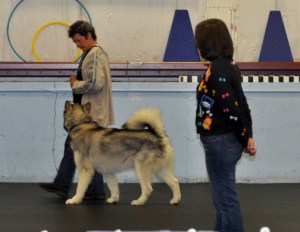
Travvy and Susanna at a Pam Dennison Rally Obedience clinic in 2011

I got out of horses and into dog training. To the total astonishment of everyone who saw Trav in his early obedience classes, we competed successfully in Rally Obedience: he’s now officially ARCHX Masasyu’s Fellow Traveller P-CRO-CH, RL3, R1X, RA, CGC.

Trav has his own Facebook account, by the way, and a photo gallery as well.

Wolfie, my novel in progress, evolved out of another fiction project that sprawled and sprawled without moving forward. Shannon, of Mud of the Place, and Glory, her 11-year-old neighbor and protégée, are driving back from a long walk with Pixel when they see a dog running through the woods. Shannon recognizes it as the mismanaged malamute who has almost certainly been hassling and probably killing chickens in the area. They follow, and save the dog from being shot by the farmer whose sheep he wants for supper.

Yep, Wolfie, the dog, is based on Travvy, but with a more checkered past. Since Trav was born the day after Rhodry died, the two never met, but their fictional alter egos do. As you might guess, Pixel reads Wolfie the riot act, and Wolfie falls in line.

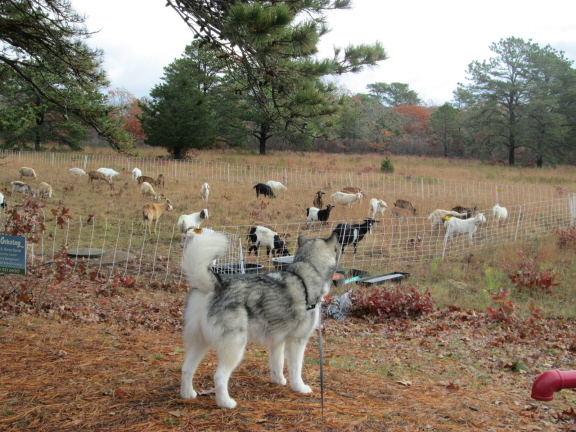
Trav watches goats from a safe distance

Posted in dogs, Martha's Vineyard, writing | Tagged , , , , , , , , | 5 Comments

C is for Class #AtoZChallenge

Class is a shifty thing on Martha’s Vineyard. It’s a shifty thing in a lot of places, but is anyone still claiming that the U.S. is a classless society?

Class grabbed me as an issue long before I knew what it was. Many Sundays when I was growing up, my family went to my paternal grandmother’s house for dinner. Outside, the house had an imposing brick façade, its elegant door flanked by columns looking out over lawn and field to the main road. Inside, accessed by a narrow stairway from the big country kitchen, were servants’ quarters, with a bath and two very small bedrooms. The house I grew up in and the houses of my friends looked nothing like this.

My grandmother was no cook. Sunday and holiday dinners were prepared and served by Jessie, wearing a white uniform. I never had to ask for more water or another roll; they just appeared. Hanging out with Jessie in the kitchen was more fun than hanging out with the adults. Sometimes Jessie’s husband, Frank, would be there too. He was in the merchant marine and was the first guy I ever saw with tattoos.

My grandmother didn’t have much maternal instinct either. Jessie had pretty much raised my father and his two brothers, living much of the time in the servants’ quarters. If any of my friends’ parents had been raised by a housekeeper-nanny, I didn’t know it. In the more formal era of the 1950s and early ’60s, Jessie was also the only adult I was allowed — expected, even — to call by her first name.

Sorting all this out took years. My own upbringing was middle/upper-middle class in most ways, but it made a difference that both sides of my family had been sliding downward from the WASP gentry, New England on my father’s side, Virginia on my mother’s. When I started studying U.S. history, quite a few of the names belonged to my ancestors. U.S. history was my history — until the women’s liberation movement called my attention to the absence of women, and I started identifying with others who had also been left out.

I came to the Vineyard in 1985 from the highly politicized women’s (read: lesbian, feminist, and often lesbian-feminist) community of Washington, D.C. Years before the word “intersectional” was coined, we read and talked a lot about the interactions of sex, race, class, sexuality, age, and disability. On the Vineyard at the time hardly anyone was talking about any of it, so I started looking for clues.

Class, I knew by then, was not just a matter of money, though money did count, nor of what one did for a living. As an ice-breaker question “What do you do?” was frowned upon. The carpenter might have a Harvard degree, the line cook might front a rock band, the cleaning lady might be famous for her quilts. People seemed quite proud that “we” didn’t pigeonhole people by their occupation.

Summer people tended to be richer and more professionally accomplished than year-rounders, but that distinction got downright blurry once you realized that plenty of longtime year-rounders were the offspring of summer people, often working as, well, carpenters, line cooks, and cleaning ladies. That was my story too, after all.

Race made a difference too. The island’s African-American summer community dates back to before the First World War, but as an occasional summer visitor in the late 1960s and most of the ’70s I knew nothing about it. My introduction was Dorothy West’s 1948 novel The Living Is Easy, which was reprinted by the Feminist Press during my D.C. days. To my astonishment, this Dorothy West turned out to be the same Dorothy West who wrote the Oak Bluffs column for the Vineyard Gazette.

I’d loved my job as book buyer for D.C.’s feminist bookstore, so once my savings started to run out, I applied for a job at Bunch of Grapes bookstore and was offered one, but it paid considerably less than my D.C. job and didn’t include health insurance. I’m pretty frugal, but I was going to need a car if I stayed on the Vineyard and I couldn’t see pulling that off at what the bookstore was paying.

Eventually I wound up at the Martha’s Vineyard Times, which paid better than the bookstore but where hardly anyone on the editorial or production side was living on what the paper paid: most of them had access to another source of income through spouse and/or family.  I learned to pay attention to who could afford to do what jobs and under what conditions.

When I moved to the Vineyard, it was to work on a novel I’d started a couple years before, working title Coming Around, about — wait for it — a 30-something woman who chucks her publishing job to move to the Vineyard and manage a small horse farm. I quickly realized that I didn’t know half enough about the Vineyard to set a novel on it. What I wrote was poetry, and press releases for a local theater group, and reviews and features for the Martha’s Vineyard Times.

When I finally did get down to working on what became The Mud of the Place, I’d been living here, listening and observing year-round island life, for about 12 years. I was more than half convinced that I’d never be able to complete anything more than 40 pages long, but I surprised myself. I’m still pretty pleased with it, not least because it pays attention to the economic challenges of living here, and the variety of people who manage to make it work, at least for a while.

Posted in Martha's Vineyard, musing, writing | Tagged , , , , , , , , , , | 14 Comments

B is for Beach #AtoZChallenge

See here for more about the Blogging A to Z Challenge.

B is for Beach — it’s a no-brainer, right? Martha’s Vineyard is an island. Its whole perimeter is beach of one kind of another, and much of it is the sandy kind that swimmers and  sunbathers love. In summer people come here primarily for the beaches. Vineyarders have figured out plenty of ways to keep them entertained (and part them from their money) at night and when the weather doesn’t cooperate.

Year-rounders know that in summer it’s best to do grocery shopping and run other down-island errands on good beach days. When it’s rainy and/or chilly, the roads and shops of the down-island towns are mobbed with bored summer visitors looking for something to do.

Summer visitors tend to assume that the Vineyard winks out of existence as soon as they leave; hence the perennial question “What do you do in winter?” (Sometimes the first “do” is emphasized, other times the second.)

I knew the Vineyard existed in the winter because I’d been down here a few times with my father, camping out at the family camp, pumping water from the well because the pipes had been drained, drawing close to the fireplace at night. Still, during my first full winter here I was fascinated by snow on the sand, opposites not only attracting but flowing one into the other like it was no big deal.

In the winter of 1985/86 I wrote this poem about walking on South Beach near Quansoo:

I don’t go to the beach very often these days, and almost never in summer, except for special events, like the annual reading of Frederick Douglass’s Fourth of July speech at the Inkwell. In summer you’re much more likely to find me and Travvy in the woods, where there are far fewer people.

Abigail McGrath and the Frederick Douglass readers at the Inkwell, Oak Bluffs, July 2014

But I can’t help noticing that in both my first novel and the one in progress crucial conversations tend to happen on beaches. The Mud of the Place pivots on a conversation Shannon has with Rainey Silvia while walking on Lambert’s Cove Beach. Mud was shaping up to be a tragedy till Rainey said what she had to say. What she said told Shannon she had an ally, and that changed everything. (Moral of the story: Listen to your characters, even, or maybe especially, the ones you think are just extras.)

In Wolfie, on the day before Shannon and Jackie go to Moshup’s Beach as recounted in “A is for Aquinnah,” they stop at State Beach, which runs next to the road from Edgartown to Oak Bluffs, partly because Jackie, a city girl, has never seen a beach with no people on it. Background: Shannon is an alcoholic with a long-established recovery. Jackie has been sober for five or six years. In their weekend visit they are feeling their way toward making amends to each other.

Your lead, Shannon told herself. Earlier she’d been thinking they were ready to open some closed doors. Out here on the beach there were no doors. Anything could dive-bomb you from anywhere. She took a deep breath. “I had a massive battle when I first got to the second step,” she said. “‘Came to believe that a Power greater than ourselves could restore us to sanity.’”

Jackie glanced at her sidelong with a little smile on her face. “Yeah?” she said.

“Yeah,” said Shannon. “The only greater power I knew was the one that had hold of my ankles and was trying to pull me under. It was a tug-of-war to the death and I was afraid I was losing. Turning it over meant giving up.”

“I thought Step 2 would be easy,” Jackie said after a long pause. “Wasn’t it all about God? I believed in God, right? Then I got that the God I believed in sounded a lot like Pop. I didn’t trust him at all.”

“Ha!” Shannon picked up a flat stone, studied it, and aimed it toward the water. It skipped twice and then sank. “I used to be better at that,” she said. “I never saw what had hold of my ankle. I just felt it pulling and tightening its grip and pulling some more. So my sponsor drove me to the beach. Not this beach — the one at Gay Head, where the clay cliffs are. Major island tourist attraction,” she interrupted herself. “I thought we’d drive up-island tomorrow.”

“Sounds like a plan,” said Jackie.

“So it was windy and gray that day and the surf was smashing on the rocks. Whoosh!” Shannon raised both arms as if she were about to get splashed. “We walked a while, then she touched me on the arm and pointed toward the ocean, which is crash-banging and getting closer and closer to our feet, and said ‘Make it stop.’”

Jackie clapped her hands together. “I love it!” she said.

“Of course I thought she was nuts,” Shannon went on. “But by that point I’d figured out that she was also pretty smart and that if I didn’t humor her when I didn’t get it, sooner or later I was going to look really dumb. Then I got it. In those days I was spending a lot of time on the water, scalloping in the off-season, crewing summers on fishing boats and charters. Every damn time you go out on the water you’re dealing with a power so great you have almost no power at all. And it was restoring me to sanity, I just didn’t realize it because I was drinking so much. Out on the water I was stone cold sober and so were the guys — most of ’em anyway, most of the time. We hardly ever said anything. We didn’t have to — we knew what to do and when and we just did it.”

They had stopped walking. Jackie gazed out over the water for a long time. Was she getting ready to say something? Shannon knew there was a time to push and a time to wait it out. This was one of the latter.

“It’s just so, so vast,” Jackie said at last. “Set off in a boat and what’s your next stop — France?”

“You’d have to get past Cape Poge first,” Shannon said, grinning and pointing off to the right, where the northernmost tip of Chappaquiddick vanished into the water. “Then, if you didn’t run aground in the Monomoy Wildlife Refuge — it drops down due south from Cape Cod’s elbow — and if the wind and current were right, you might wind up in Nova Scotia.”

Moshup’s Beach, Aquinnah

Sunset, Lambert’s Cove Beach, West Tisbury

Rocks on the beach at Great Rock Bight, Chilmark

Posted in Martha's Vineyard, outdoors, writing | Tagged , , , , , , , , , | 6 Comments

A is for Aquinnah #AtoZChallenge

A is the beginning but Aquinnah is the end, the equivalent of Land’s End on Martha’s Vineyard, as far as you can go before you fall into the ocean.

The Gay Head lighthouse, which in 2015 was moved back from cliff brink to keep it from tumbling into the ocean.

Of course much depends on where you live and where you’re standing at the moment. If you live in Aquinnah, it’s the beginning and the center. All of us on Martha’s Vineyard have our own psychic maps of the place. When I first wrote about “My Martha’s Vineyard,” when this blog was young, my psychic map of the Vineyard stopped at the West Tisbury–Chilmark line going southwest and about a half mile east of Barnes Road going east. Now it extends as far as Beetlebung Corner in Chilmark and some parts of Edgartown have come into focus, but Aquinnah still isn’t on it.

I do know how to get there, however. More about that in a bit.

If you live on Martha’s Vineyard, even if you aren’t a mariner or a fisherman or someone on first-name terms with the sea, you come to see water not as a barrier but as another kind of road. When I hadn’t been here long year-round, I heard the late Helen Manning, Wampanoag storyteller, talk about how when she was a girl, Gay Headers often did their shopping and other business in New Bedford: it was easier to get to New Bedford by boat than down-island by land because the roads were so bad. That swept my landbound assumptions out to sea and transformed the way I read maps.

Aside: From its incorporation in 1870 until 1997, the town was named Gay Head. Then it was changed back to Aquinnah. The town seal gives the year as 1998, which I think is when the change became official. The Gay Head Cliffs are still the Gay Head Cliffs, the Gay Head light is still the Gay Head light, the Gay Head Baptist Church is still the Gay Head Baptist Church, but almost everything else is Aquinnah. The Wampanoag Tribe of Gay Head is still so named, but “Aquinnah” appears on the tribal seal and is invariably included in references to the tribe: the Wampanoag Tribe of Gay Head (Aquinnah).

Aquinnah never appeared in my first novel, The Mud of the Place. I don’t believe it was even mentioned. (My characters seem to share my psychic map.) But it’s a significant setting in Wolfie, my novel in progress. It takes place maybe 10 or 12 years after Mud, and Shannon Merrick is once again a main character. Shannon’s long-estranged younger sister, Jackie, comes to visit on Thanksgiving weekend. Shannon gives sister Jackie the grand tour, starting in Edgartown, moving up Beach Road to State Beach, thence to the Campground in Oak Bluffs and eventually to Aquinnah and the Gay Head Cliffs.

Travvy, aka Wolfie, on the path to Moshup’s Beach

On the way they’re gingerly exploring memories of the violent alcoholic family that shaped them both and contributed to their long estrangement. The climactic revelation comes, of course, while the two women walk (with Wolfie, the book’s title character) along the beach near the Gay Head Cliffs.

On their way to the beach, Shannon takes Jackie to the lookout near the shops (which are closed and deserted, it being late November):

“Come see the real end of the island,” Shannon said, and led the way between the silent shops to the observation area. Wolfie sniffed at every rock, every clump of grass, until Shannon crinkled the string cheese wrapper in her pocket. That got his attention. After she bit off a chunk and fed it to him, he couldn’t take his eyes off her face.

The stolid cliffs jutted impressively into the water, but it seemed the tops of them were being pushed back by invisible hands. “It’s all clay,” Shannon said. “You’ll see the colors more clearly when we go down to the beach.” She pointed down toward where waves breaking on the rocky beach made a lacy necklace around the base of the cliffs. “That down there is Moshup’s Beach. Moshup was the legendary giant of the Wampanoags. He lived in the cliffs, caught whales one-handed, cooked them up here, and shared the meat with his people. Supposedly he had quite a temper, and when he got angry the weather got wild.”

“Maybe he’s still there,” Jackie said, pulling the edge of her knit cap closer to her ears. The wind was blowing strong off the water.

Shannon pointed toward the expanse of rippling ocean. “Out there is Devil’s Bridge. It’s built from the boulders Moshup hurled at the whales to knock them out.”

Shielding her eyes against the sun, Jackie gazed where Shannon was pointing. “I can’t see anything,” she said.

“Neither can the ships, till their hulls are on the rocks,” said Shannon. “That’s how it got its name.”

When the time came to write Shannon and Jackie’s sightseeing tour, in January 2016, I made my own trek to Aquinnah. This was a good thing, because my recollection of the lay of the land near the cliffs was not all that great. Of course I took Travvy, my malamute sidekick, on whom Wolfie is based, and of course I blogged about it, with photos, in “Trip to the Cliffs.”

So why did this intimate and difficult conversation happen on the beach at Aquinnah? Because this is a place of power, one where the constraints and inhibitions of more familiar places don’t apply. So Aquinnah may at the same time be the Vineyard’s equivalent of Land’s End and a place of beginning.

The road to Aquinnah, and the road back home

Posted in Martha's Vineyard, outdoors, writing | Tagged , , , , , , , | 7 Comments

A to Z Challenge 2018

Last April I did the A to Z Challenge in my other blog, Write Through It: On Writing, Editing, and How to Keep Going. What’s the challenge? Blog on your chosen theme every day for a month, with the post titles beginning with A, B, C, etc., in sequence. Since there are 30 days in April but only 26 letters in the alphabet, you get Sundays off — except when April 1 falls on a Sunday, as it does this year.

I’m here to tell you that blogging A to Z in one blog was a serious challenge, and one I’m pretty proud to have met, but when I briefly, very briefly, contemplated doing it in two blogs at once, I knew this was nuts.

Instead, I’m going to do the challenge right here, in From the Seasonally Occupied Territories, but to combine the theme of this blog (Martha’s Vineyard) with the theme of Write Through It (writing and editing): How living on Martha’s Vineyard has affected my writing. Both my first novel, The Mud of the Place, and the novel in progress, Wolfie, are set on the Vineyard, so I expect to be blogging about them, and maybe about my other big writing project: developing a script for 1854: A Folk Opera, conceived but not completed by the late Jack Schimmelman.

I also plan to blog occasionally about more general stuff, like how the Vineyard both encourages creative work and makes it difficult.

And it all starts tomorrow, right here!


Posted in Martha's Vineyard, writing | Tagged , , , , | 8 Comments

Nor’easter

We’re in the middle of one. Locally the term is often pronounced “no’theastah,” but I’m one of those rhotic New Englanders (meaning I pronounce my r’s, most of them), so I’ll spell it the way I say it. They’re also called “three-day blows,” with good reason.

Thursday morning I went out without longjohns, with my fleece vest hanging open over a sweatshirt, thinking, Guess March isn’t coming in like a lion this year.

Turns out the lion was just sleeping late. By Thursday evening, the wind was coming up, and yesterday was wild. Pouring down rain all day and wild, wild wind. Trav and I cut our morning walk a little short. Walking into the wind was hard work. He was drenched when we got home and I was pretty damp. (My slicker and rain pants are near the end of their useful life, and one of my boots leaks.)

Before sunset (sun? what sun?) we set out again. Trav thought I was nuts. I thought he’d need to pee. Plus I just wanted to check out the neighborhood.

Especially the Dr. Fisher Road. No, this is not typical of the Vineyard’s many dirt roads, but this particular stretch of it takes a good photograph.

The bare trees were swaying back and forth, limbs cross-crossing in an intense danse macabre, but I didn’t feel threatened. “Awed” was more like it.

Most of the fallen branches I saw were modest in size, till we got to the trail that strikes off from the Dr. Fisher Road and leads behind the West Tisbury School to Halcyon Way, the road I live on. There it looked like a full-size tree had maybe fallen across the road and been cut up already. Vineyarders tend to be handy with things like chainsaws.

That particular trail goes underwater with less rain than this, but there was enough high ground on either side that my leaky boot could stay out of the worst of it. (Those boots really do need to be replaced.)

If you want to see what yesterday looked like along the north shore, including the harbor towns of Vineyard Haven and Oak Bluffs, check out the Martha’s Vineyard Times website. At least a couple of moored sailboats blew onto the beach. Not good at all.

The M.V. Times office is a stone’s throw from Five Corners, which regularly goes underwater when heavy rain and high tide converge. I was the Times features editor when the paper moved from high ground (behind Woodland Market, in the old Spaghetti Pot building that no longer exists) to low. Scheduled moving day happened to coincide with the No-Name Nor’easter of October 1991. The floor had just been laid, the ground floor flooded, the floor had to be relaid, and moving day was postponed. Wisely, the electrical outlets were all positioned at least a foot above the floor.

After a few flickers and a less-than-five-minute interruption in phone and internet service, the power went out a little after 8. I lit a couple of candles and kept working on my laptop. Kore’s screen is bright enough, of course, but it doesn’t illuminate the keyboard, so I strapped on the battery-powered headlamp I use for walking at night. That helped, but without the stimulation of artificial light I was soon ready for bed. I have immense respect for anyone who in the pre-electric age managed to stay up studying or writing long after the sun went down.

The lights came back around 1:45 a.m. That’s a guess. I’d forgotten to flick the light switch off before climbing into bed, and I’m pretty sure the returning lights woke me up.

Things have settled down some. The wind’s still pretty strong, but the rain has stopped. Trav and I are going out to inspect the damage. The boats still aren’t running. We’re happy to be on the home side of Vineyard Sound.

Posted in home, Martha's Vineyard, outdoors | Tagged , , , , | 3 Comments