
A month or so I received an email from someone who was considering moving to the Vineyard year-round. She had liked my “10 Reasons Why I Like Living on Martha’s Vineyard” and wondered if we could meet for coffee when she was on the island the next week.
I emailed back:
Heh. I’ve been thinking about updating them. The creative
opportunities are fewer, the place is less friendly to dogs (or maybe
there are just more stupid dog people), but Facebook has added a
wonderful dimension (or maybe dementia) to island life. I call it the
grapevine on steroids.
Coffee is a definite possibility. As to moving here full-time — it’s
a HUGE leap. My advice is don’t even *think* about it unless you have
(1) either year-round housing or a solid place to live in the summer,
in which case winter rentals may work for you; (2) a job or jobs that
will cover housing and the very high cost of living, or another source
of income (e.g., family money or investments) that will do likewise;
and (3) family here, at least the beginnings of a support network. It
is possible to develop a network from scratch, but it helps if you’re
either working island jobs and/or have kids in the school system. Or
are very gregarious, which I’m not. 🙂
Lucky for me my correspondent wasn’t scared off by my email. A few days later we had a delightful conversation over coffee at the Black Dog Café. She had decided against moving here full-time, at least for now. My warning had made her think, she said, and there was something else: At present Martha’s Vineyard was a place she could come to for occasional respite. If she moved here year-round, that would no longer be an option.
Very perceptive, I thought, and as I mulled it over later something else occurred to me. For years I’ve been muttering about the “year-round summer people.” My one-line description: “They live here year-round but they think real life is happening somewhere else.”
What dawned on me was that — in general, mind you; I’m talking stereotypes here — the year-round summer people are here for respite from the “real world,” not occasional respite but permanent respite. And that would apply to those who retire here after spending their working lives somewhere else, maybe summering on the Vineyard.
Demographics are on everyone’s mind these days. The Vineyard population is aging, and not just because those of us who’ve been here a while are getting older. Not just because summer people and others are retiring here either: a big factor is that younger people, those between, say, 25 and 35, are leaving because they can’t afford to raise their families here.
So the other day at a social event I fell into conversation with a fellow who’s involved in the effort to solve, or at least ameliorate, the affordable housing crisis. (For more about this see “Housing 101,” my summary of an excellent talk given last May by David Vigneault, executive director of the Dukes County Regional Housing Authority.) I hadn’t met this guy before. I don’t know how long he’s been around. “This is a resort community,” he said. “Not everyone can afford to live here.”
I’d heard this line before. Once again it struck me as a cavalier way of telling working people who can’t find housing “Tough luck, bye-bye, have a nice life somewhere else.” As if the place had been turned into a “resort community” by an act of God or natural disaster and made uninhabitable for everyone else. But this was a social event and I didn’t know the guy, so I noted that when teachers, shopkeepers, tradespeople, and others essential to the functioning of the community can’t afford to live here, we have a problem.
More people will have to commute from off-island, he said, or so I understood him to say. This struck me as not only cavalier but as totally clueless about what makes Martha’s Vineyard a place worth living and, yes, a place that provides respite for those who come here seeking it: this isn’t a bedroom community or a gated community; it’s a place where most people live within a few miles of where they work, and vice versa.
And that’s what sent me back to “Ten Reasons Why I Like Living on Martha’s Vineyard.” It’s a good list but although other year-rounders relate to it it’s still my list. As a general list, it’s missing something big: family. My family isn’t here, and in any case I come from the kind of family that one’s better off keeping one’s distance from. I knew before I got here that other kinds of family existed, but I didn’t understand how crucial they were to the survival of individuals and the life of a community.
“Without family you’re nothing.” I was startled the first time I heard that. I’ve heard it, in different words, many times since, and more important, I’ve seen it in action. And I think of it every time I hear the statistics about young people who grew up here (and, often, whose parents and grandparents grew up here) but can’t afford to raise families here, every time I hear of a friend’s kids or grandkids leaving the island for good.
Because nearly all of my “10 Reasons” have been made possible by the tightly woven fabric of island life: from the grapevine (whose vines and tendrils now extend through the online world), to the informality, to our willingness to entertain ourselves, to the attentiveness needed to negotiate single-lane roads, to the ability to sleep soundly at night with all doors and windows open (or, in cold weather, at least unlocked).
That fabric is fraying, and along with it most of the things that have made this a good place to live — and more, I think: a place that has more to offer the rest of the country than pretty beaches and summer R&R.
But this country doesn’t know how to reckon value that can’t be measured in money. So if you can afford to live here, you’re in, and if you can’t it’s “Tough luck, bye-bye, good luck somewhere else.”
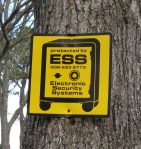 In my D.C. days, I packed ten keys on my keychain. After a few months on the Vineyard, I’d stopped locking my bike; the car keys stayed in the ignition, and the only lock on my apartment was a skinny sliding bolt whose main purpose was to keep the door closed when the wind came up. Like many Vineyarders, I still don’t lock, and the truck keys rarely leave the truck, but the times are surely changing. Expensive security systems and car alarms are more common than they were ten years ago. Used to be that when someone left their headlights on, you’d automatically open the door and turn them off. Then more people started locking their cars, and once I triggered someone’s car alarm. Now I restrain myself unless I recognize the car or the window’s open.



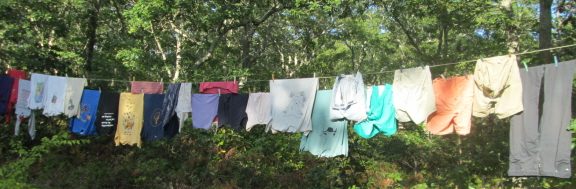
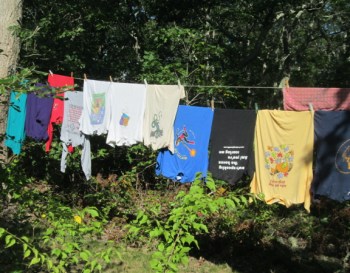
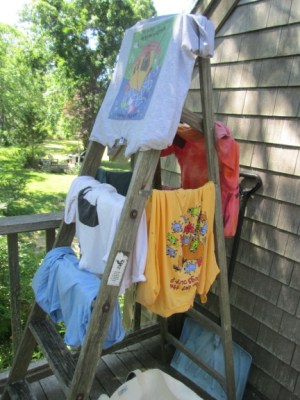 So how can you tell that the photo at left was from a summer laundry?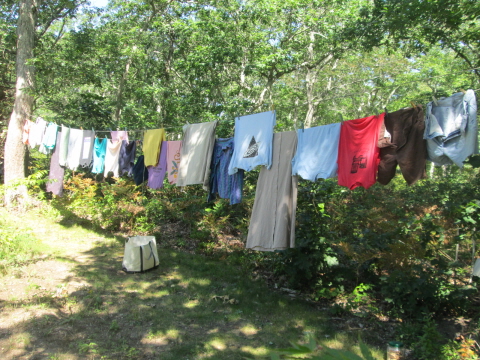



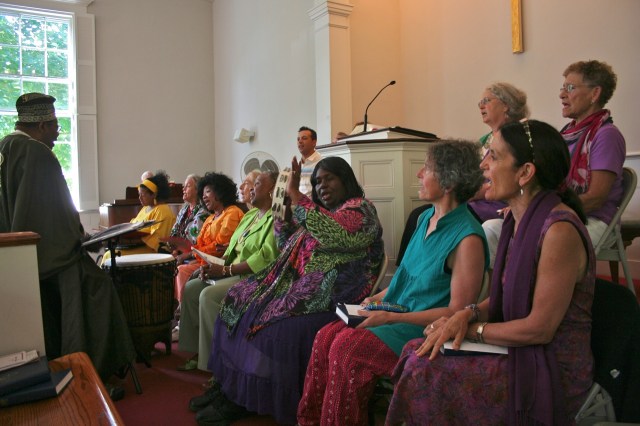


















 In the weeks preceding the sale, volunteers sort a year’s worth of donated books into categories: art books, kids’ books, biography & autobiography, history, military affairs, general fiction, romance, and so on. Fortunately the categories are general, and books that are both/and or neither/nor sometimes wind up in unexpected places. In this age of online ordering, browsing is an endangered pastime. The West Tisbury library book sale is a browser’s heaven.





 From the Seasonally Occupied Territories . . .