
Bountiful

The Fair (formally the Martha’s Vineyard Agricultural Society Livestock Show and Fair, the 151st of that name — well, not exactly that name, but close enough) opened Thursday and I still haven’t blogged about Bountiful, Susan Klein and Alan Brigish’s magnificent history of the MVAS and its marvelous offspring. The short version is this: If you’ve any interest in Martha’s Vineyard past, present, and future, you owe yourself a copy of this book. It can be bought at the Fair for $29.95 plus tax.

I’m told that after the Fair, it will be available elsewhere, including by mail order. Info should be posted shortly on the Ag Society website, but it’s not there yet so be patient.

As noted in “Editrix,” I helped edit Bountiful, but having read most of the text in (electronic) manuscript form didn’t prepare me for the wonder of the printed book. Yes, the photographs are glorious, both the color images captured by Alan Brigish and others at the 150th Fair last year and the historic black-and-whites gleaned from the collections of the Martha’s Vineyard Museum and many, many families and individuals. Likewise the letters, reports, and other documents from the Ag Society’s early decades, starting in 1858. The historical record owes a huge debt to archives of the Vineyard Gazette, which was founded in 1846.

But the real wonder is the synergy achieved by these diverse elements, thanks to the vision of Susan and Alan and the design genius of Jen Daddio, who also designed Susan and Alan’s previous collaboration, Martha’s Vineyard: Now and Zen. Here the present and the past talk to each other, sometimes in the sedate tones of scholars and elder statesmen, sometimes in a passionate cacophony. The changes are obvious, but so is the continuity: it’s not hard to imagine the Ag Society’s founders and the entrants of the earliest Fairs strolling through the 151st Fair, recognizing and admiring the produce, the needlework, the power of the draft horses. The farmers, gardeners, weavers, and bakers of 2012 and their counterparts of 1890 would have plenty to talk about.

Island names, past, present, and future

When I moved to the Vineyard year-round in 1985, I’d already been to many Fairs, ridden the carnival rides, dropped a ridiculous amount of money at the games of skill and chance (managing to win a few stuffed animals in the process), watched the horse show and the woodsmen’s contest, admired the exhibits in the hall . . . When the 1986 Fair rolled around, I felt powerfully moved to enter something. Useful skills I had (and still have) virtually none, but I had been baking all my own bread for 10 years. So I entered two yeast breads in the baking category — and was absurdly pleased when they both won blue ribbons.

I had declared my desire to be included, and an acceptance had been issued in return.

Over the years I’ve had enough conversations with newcomers and former newcomers to believe that this impulse is widespread, and that the Fair is the portal through which many of us have entered and become part of the Vineyard.

Bountiful expands this understanding in so many ways. For generations now, island kids have started out as helpers and as they grew in experience become responsible for one of the myriad tasks that makes the Fair happen. The surnames of many of today’s entrants and prize winners echo those of the 1860s, 1880s, 1920s, 1940s. And the newer names testify to the desire of many others, incomers and summer residents alike, to excel at the arts and skills that the Ag Society’s founders valued.

Those founders planted the seed of an institution that, probably more than any other, holds us together as an island, across the generations and across town lines. To browse through Bountiful is to be continually reminded of what a wondrous thing we’ve become part of, whether we were born into it or came from somewhere else.

Posted in Martha's Vineyard, public life | Tagged , , , , , , , , , | 3 Comments

Editrix

This started off as a brief intro to Bountiful, Susan Klein and Alan Brigish’s just-published and utterly wonderful history of the Martha’s Vineyard Agricultural Society and its annual fair (which starts Thursday!!). Bountiful is one of the few island-related editing gigs I’ve had over the years. But as I’ve said before, I don’t do “brief” — my little intro demanded a post of its own. Stay tuned for Bountiful . . .

Editor, Publications Services, American Red Cross national headquarters, ca. 1980. Note the IBM Executive typewriter with extra-long carriage in the foreground.

I work full-time as an editor, but I don’t blog much about my work because very little of it has anything to do with living on Martha’s Vineyard. If there were more job opportunities here for people in the word trades, I wouldn’t be freelancing full-time. I love working with capable, competent, interesting people. I’ve had three opportunities in my life to do exactly that — and get paid for it. On two of those jobs, though, I loved the work and my colleagues, but management was abysmal, and sooner or later piss-poor management undermines a team: good people get demoralized and either leave or stick around but pull back in other ways.

Checking the boards on my last day as M.V. Times features editor, October 1993. Back in the Pleistocene, all copy was cut with Xacto knives and pasted up with wax. Then the editor in chief made a headlong dash to get the boards on the 5 p.m. boat so the paper could be printed overnight and arrive back on MV first thing in the morning.

After several years of odd-jobbing on the Vineyard, I spent two and a half years as features editor of the Martha’s Vineyard Times. Great job, good people — but complete burnout city if you did the job right. Within a year of my departure in late 1993, there were two people doing what I’d done pretty much solo.

I then went to work almost full-time for a local book packager. Desktop publishing was coming into its own: this guy contracted with several academic publishers to produce their books, then subcontracted out the copyediting, proofreading, typesetting, illustrating, and indexing. He subcontracted most of the copyediting and proofreading to me. This fellow’s heart wasn’t in the business, though: what he longed to do was go off and philosophize in the woods, à la Thoreau. He was such a heavy smoker that the (paper) manuscripts I brought home radiated smoke stink. He dissolved the business abruptly, planning to move to New Hampshire, but within a couple of years he was dead of lung cancer that metastasized to his brain, age 51.

About three-quarters of my annual income disappeared with his business, but the idea of freelancing full-time had taken hold. While I tried to get my freelance foot in the door of various New York publishers (this took a long time), I created a little three-panel flyer advertising my services, gave copies to everyone I knew, and mailed it to every business, nonprofit, and government body on the island that might possibly need an editor.

I got plenty of good wishes but exactly zero gigs. Most people who could benefit from editorial services don’t know it. Editing is in essence about making the written word communicate more clearly and more effectively; this often involves clarifying and fine-tuning the thoughts behind the writing. But the idea prevails that it’s just about correcting typos and anyone can do that, right?

Every year, one of my M.V. Times colleagues would volunteer to proofread her town’s annual report for nothing. Every year town officials would say, Yes, yes, great idea, and every year they wouldn’t contact her and the town report would be published with errors. Occasionally a typo in a warrant article or budget item would be serious enough to require amendment at town meeting, but this didn’t bother anyone other than the professional editors and proofreaders among us, along with a handful of true believers who are sure that every typo and usage gaffe is a sign of the collapse of Western Civilization.

I could go on, but what matters is that I realized PDQ that I wasn’t going to support myself as a freelance editor if I depended on local jobs. So I went to work one summer at the old Webb’s Camping Area, then in the fall I persuaded the Martha’s Vineyard Times to create a copyeditor position and hire me to fill it.

Freelancers can work in bed if they feel like it. In 2006, when this photo was taken, about half my editing jobs were on paper. These days I do more than 90% of them on my laptop, sitting in an easy chair.

By mid-1999, I was getting enough work from publisher clients, both commercial and university presses, to freelance full-time so I left the Times again. In the years since, I’ve had a few island jobs, each of which introduced me to interesting stories and interesting people, but the income from all of them put together wouldn’t have bought me two years’ worth of groceries. Bountiful is hands-down the most handsome of the lot. More about that tomorrow.


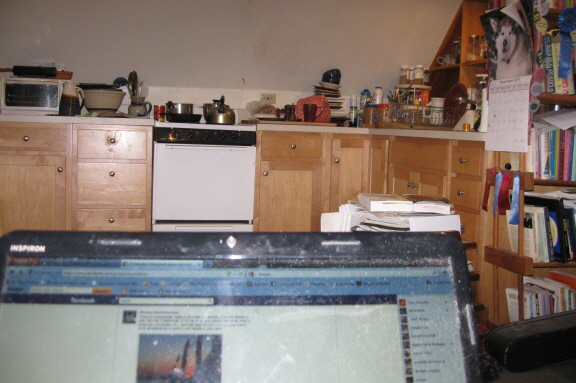
The view from my “desk”


Posted in Martha's Vineyard, work | Tagged , , , , , | 3 Comments

Politico

A few weeks ago, being in an electoral mood, I started to list the guys (with one exception, they are currently all guys) who are representing me at various levels of government.

  • President Barack Obama
  • Vice President Joe Biden
  • Senator John Kerry
  • Senator Scott Brown
  • Congressman ????

I drew a complete blank. So I went on:

  • Governor Deval Patrick
  • State Senator Dan Wolf
  • State Representative Tim Madden
  • Selectmen Richard Knabel, Cindy Mitchell, and Skipper Manter

Who the hell was representing the Massachusetts 10th Congressional District in Congress these days? I walked around a few days waiting for the name to come to me or jump out of a headline or something. Nope. Finally I looked it up: William Keating. Didn’t ring a bell. The only Keating I remembered was Kenneth, the moderate Republican senator from New York who was defeated by Robert F. Kennedy in 1964.

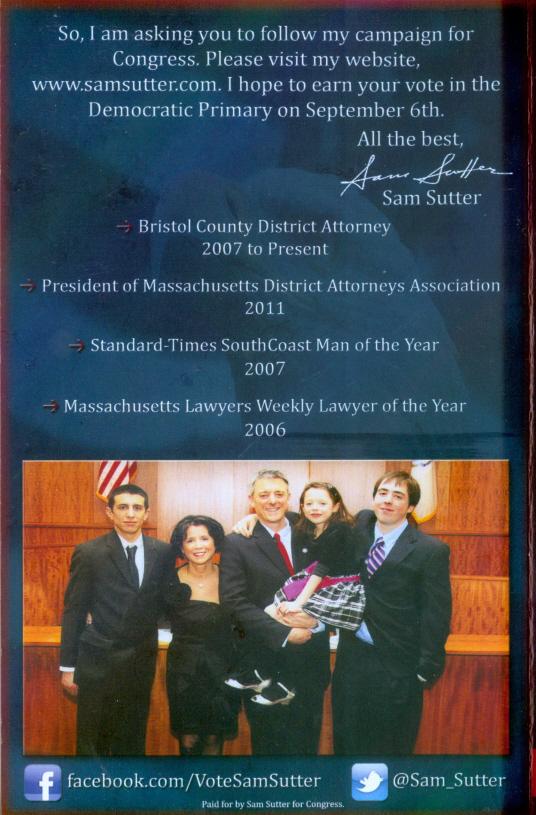
So a week ago I got an email from Richard K., West Tisbury selectman and a key player in the fight against the roundabout, inviting me to a meet-and-greet for one Sam Sutter, who is running against Bill Keating in the Democratic primary. Anyone Richard endorses is worth checking out, and besides, it really, really bugged me that I couldn’t remember the incumbent’s name. Late Friday afternoon, as desperately needed rain started to fall in earnest, I drove over to Richard’s house, bearing two plates of miniature cheesecakes as an offering for the refreshment table.

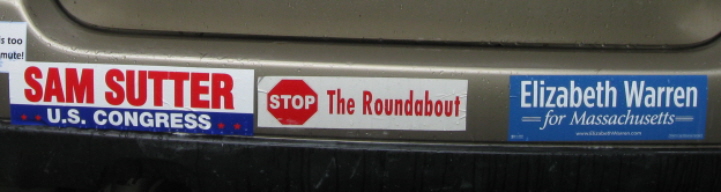
The short version is that Malvina Forester has now got a Sam Sutter for U.S. Congress sticker on her ever more crowded bumper, and it turns out there’s a reason I hadn’t heard of Bill Keating: he hasn’t done much. In particular, thanks to a long-running bureaucratic snafu, Vineyard vets can’t get the care they need at the Martha’s Vineyard Hospital but must travel to Providence or Hyannis instead. Apparent consensus among those working on the issue is that Gerry Studds or his successor, Bill Delahunt, would have solved this a long time ago.

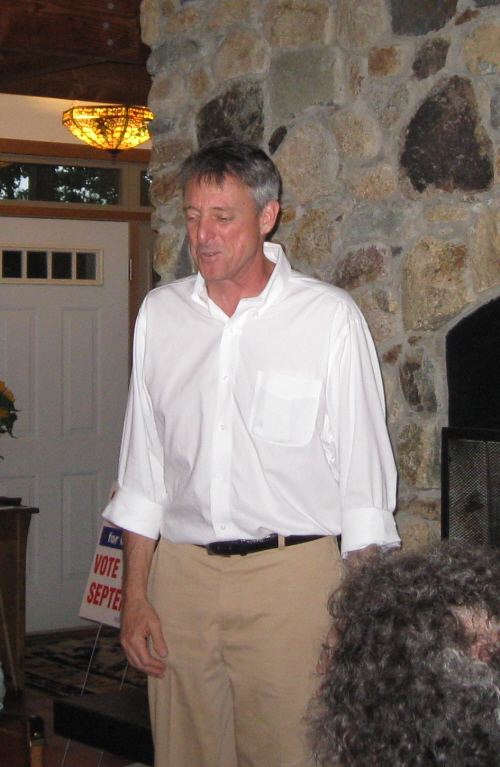
Sam Sutter at Richard K.’s

So Sam Sutter started off as a tennis pro, went to law school, became a trial lawyer, and in 2007 ran for and became district attorney of Bristol County. In the mid-2000s, Bristol County, which includes New Bedford and Fall River, had a serious drug-related gun crime problem. As DA, working with elected officials and local police departments, he has helped turn that around. The stats are impressive, but what impressed me most is the leadership he displayed to pull this off.

Leadership is so rare around here that I’ve almost forgotten what it looks like. Here it involved from-the-ground-up awareness of the problem, familiarity with the tools available, ability to adapt those tools to the situation, and the ability to motivate a team (he kept saying that he couldn’t have done any of this alone) and to work productively with the community, the police, the court system, and the mayors’ offices.

Asked what he thought he could accomplish in a U.S. Congress so polarized and gridlocked that it’s been called the worst in our history, Sutter pointed out that the Tea Party is a minority on the GOP side of the aisle. He invoked the not-so-bygone days when a Ted Kennedy and an Orrin Hatch could work together across the aisle to hammer out compromises and get important legislation passed.

Leadership is what wields many disparate parts into a whole that can accomplish more than any individual can accomplish alone. The leadership we’ve become accustomed to, in Congress and elsewhere, does this by appealing to our fears and resentments; what it accomplishes this way is mostly obstruction and destruction and the incorporation of those fears and resentments into public policy. Sam Sutter has demonstrated the other kind of leadership, the kind that motivates people to rise above their differences and accomplish something that they all say they want: to solve problems and move forward.

I believe this guy. I believe in this guy. I’m more than a little freaked that after years of watching mediocre candidates come, go, and get elected, Malvina Forester now has two candidates’ stickers on her bumper.

Yesterday morning, the M.V. Democrats held a forum for the two Democratic congressional candidates. I went. “Congressional Candidates Address Island Democrats; Mr. Keating Is Fleeting,” says the Vineyard Gazette headline on the story.

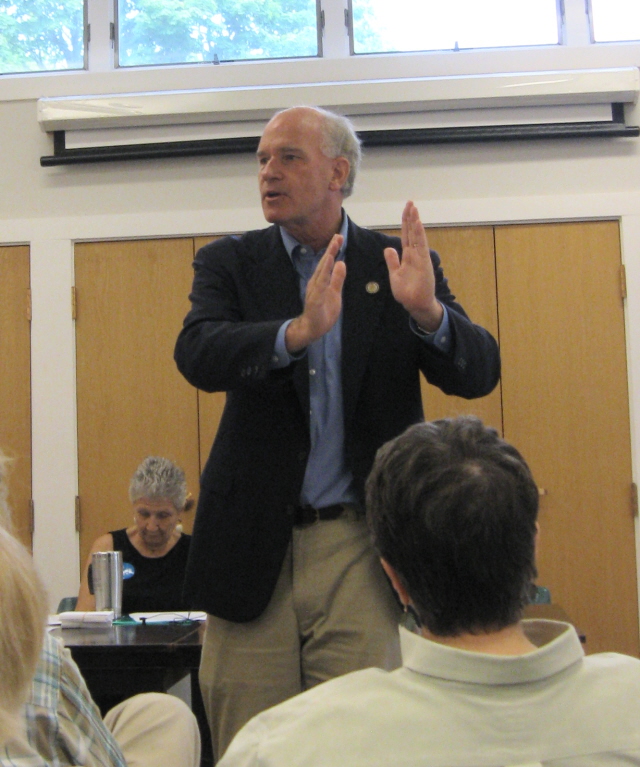
Representative Bill Keating at the Howes House

I’ll say. Mr. Keating had a boat to catch — classic island excuse for not sticking around — so he gave his spiel and left. His spiel was almost all partisan generalities. He said nothing about the 10th Congressional District that he currently represents or the new 9th (Massachusetts lost a seat in the last census, so we’ve been redistricted) in which he is running.

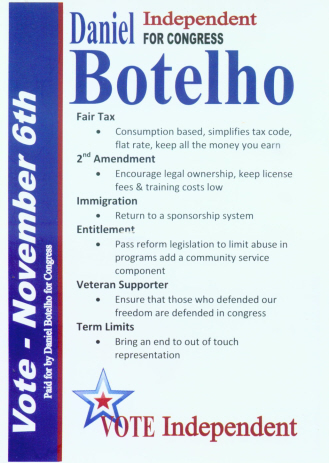
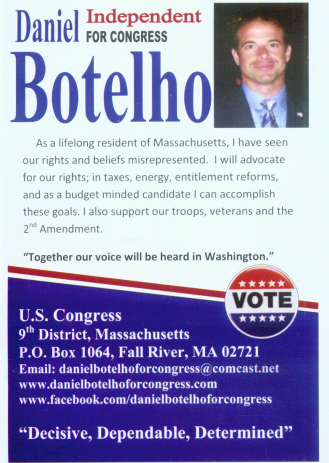
He also orchestrated his schedule to avoid both questions from the audience and any interaction with his Democratic opponent. This, I’m told, is part of his pattern: he does as little as possible to even acknowledge the existence of Sam Sutter or Dan Botelho of Fall River, who is running as an Independent — and who was sitting next to me. He has agreed to only one debate with Sutter, in the days before the September 6 primary.

Sutter, in contrast, believes in debates, forums, meet-and-greets, and other ways of getting his views across to the voters directly. Campaign ads are inadequate, he says. He promised that as the Democratic nominee, he’ll be willing to debate Botelho and the Republican nominee every week until the general election. He strenuously opposes the Supreme Court’s 5–4 Citizens United decision, but he’s not waiting for it to be overturned or a constitutional amendment to be passed or even for Congress to enact meaningful campaign finance reform (is this oxymoronic, and in how many ways?). He’s not accepting campaign contributions from PACs, Super PACs, or 501(c)(4)s — social-welfare nonprofits that can be used to funnel big money to candidates.

He’s so right about the one-on-one thing. Going to Friday afternoon’s meet-and-greet and Saturday morning’s forum makes me think of similar events going on across the commonwealth and the whole country, of citizens connecting with candidates directly, unmediated by either the news media or the advertising juggernaut. And as I blogged last month in “Elizabeth at the Library,” playing a bit part in the big drama makes a difference. When I tell people I’m running for the Martha’s Vineyard Commission, I get into conversations about the MVC, the roundabout, and the island in general. They make me think; I hope I make them think. The mere possibility is almost enough to make me giddy.

Posted in Martha's Vineyard, public life | Tagged , , , , , | Leave a comment

Home Improvements

When I go into Shirley’s Hardware for just one item, I invariably come out with four or five. Like any good hardware store, it’s full of charismatic shiny things that become totally indispensable as soon as you look at them. So I keep a running list of things I need, and when there are four or five items on it, into Shirley’s I go.

New laundry gizmo

Yesterday was the day. Car-washing soap and car wax had been on the list for a while; Malvina didn’t need washing and I waxed her a month ago, so they weren’t urgent. The lesser urgency was the plastic gizmo that holds the two strands of the clothesline together so the bottom one doesn’t sag. These tend to blow off the clothesline in high winds and disappear into the scrubby underbrush. Maybe the scrubby underbrush eats them? Plastic isn’t supposed to decompose that fast, but when these things blow away, they’re gone for good.

I was planning to do laundry today, so this moved up a notch on the “do it” scale.

The greater urgency was four new drip bowls for my stove. The old ones were unbelievably disgusting. They’d long since passed the point where steel wool could scrub them even passably clean. Had the board of health raided my apartment, I might have been banned from taking food to potlucks for the rest of my life.

The drip bowls were so gross that my whole kitchen seemed dingy.

The shininess of new drip bowls

For once I remembered to measure the burners before I went, so I came home with the right sizes: three six-inchers and one eight-.

Now the whole kitchen glows with possibilities. One distinct possibility is that I’ll scrub down the counters and the cupboards so the new drip bowls aren’t embarrassed by their surroundings.

Another formerly pristine thing had grown so grungy that even my cheapskate self thought it needed replacing: the baby gate at the top of my outside stairs that keeps Travvy on the deck when I’m not looking. After five-plus years, its white plastic was mostly gray with dirt, grime, and mildew. More important, it was starting to come apart. Trav has a lot of respect for that gate, but I wouldn’t bet my life savings, puny as they are, on his self-control under pressure.

Besides, I had a gift certificate for SBS, the feed and garden store, which is just up State Road from Shirley’s. I’d already scouted out their gates and spotted one that might do. Measurements in mind, I checked it out — and bought it. It’s classier than the old one, it fits securely, and Trav seems to think it’s solid. The instructions warn against setting it up at the top of any stairs, but I ignored them.

Will it last as long as the old one? Maybe not, but for now it’s looking good.

Looking at those blackened drip bowls and that broken, mildewy gate was bumming me out. I didn’t realize how demoralizing they were till I consigned them to the trash. And the cost of replacing them was way, way cheaper than therapy. Clean laundry doesn’t hurt either.


Posted in home | Tagged , , , , | 5 Comments

Edible Economics

When Edible Vineyard made its debut a few years back, I admired the design and the photographs but after an issue or two I got the distinct impression that it was trying to sell me something.

It was. It was trying to sell me an upscale version of Martha’s Vineyard, close cousin to the “Theme Park Farming” I blogged about last month. “Our Food, Our Stories, Our Community” it says in the top right corner of the cover. Warning, warning, warning! When first-person singulars start speaking in “we,” they’re usually trying to put something over on me, you, and everybody who isn’t them.

It’s called “the illusion of inclusion.” Confronted with their exclusionary practices, the gatekeepers say “Mea culpa, mea culpa” and start admitting some of the previously excluded through the gates. Progress is being made, everyone’s happy (or at least willing to keep their minds open), the rattling of the bars diminishes.

Until it turns out that the inclusion is limited, and conditional. Access is still controlled by the gatekeepers; it’s just that they’re letting a few more outsiders through the gates. Often these erstwhile outsiders, knowing who’s buttering their bread, start tsk-tsking at their brothers and sisters on the outside: “We made it, so you can too — if only you try harder, if only you stop being a victim.

The illusion of inclusion is a powerful strategy. It’s devilishly effective. Listen to five minutes’ worth of electoral campaign propaganda. The admeisters employ it because it works.

Edible Vineyard and other exponents of theme park farming (including the Island-Grown Initiative, which was started by the editor of Edible Vineyard) are selling us inclusion in a place that looks like, and indeed is called, Martha’s Vineyard. Farming! Living local! What could be more Vineyard than that?

The catch is that if you need to make a living on Martha’s Vineyard, farming is pretty much out of the question. So working people are de facto excluded by the illusion — and that includes many people who grew up here, whose parents grew up here, whose families have lived and worked here for generations. Would this ever be acknowledged in the pages of Edible Vineyard? I doubted it.

I was wrong.

I picked up the current issue of EV because its cover cracked me up:

If the secret to humor is surprise, here’s proof. What I expect from EV is page after page of nauseatingly healthy green stuff. I laughed out loud. I picked up the magazine. And I don’t even like doughnuts. (Laura Silber’s story about Pavlovas and especially Elizabeth Cecil’s photographs are the best food porn I’ve seen in a long time.)

What really grabbed me, though, was Emily Palmer’s “A Farmer Leaves the Land.” Emily Palmer is less than half my age. For the last several years she’s been a professional organic farmer. She’s done well, “managing more acreage, more sales, and more staff than ever before,” she writes. Her customers were happy. But she’s leaving farming, and she’s leaving farming because she’s done the math. To be sustainable, her farm needs to grow — but there’s nowhere to grow to. And she’s tired of being poor.

“Short of outright purchase of large property to the tune of millions of dollars,” she writes, “a mortgage that can never be repaid via farm income, new farmers on the Vineyard are not able to access property that has the potential to become a commercial working farm.”

She’s nailed it. Andrew Woodruff’s long-established community-supported agriculture (CSA) program at Thimble Farm was saved at the 11th hour by an influx of big money from very rich people. Earlier this year, experienced flower farmer Krishana Collins was awarded a long-term lease on the former Tea Lane Farm in Chilmark, now publicly owned. Another young farmer is able to lease 10 acres thanks to a promise requested by the late Craig Kingsbury and kept by his daughter Kristy. We’ll have enough farms to keep the theme park going, especially if a few millionaires show up who fancy farming, but sustainable? self-sufficient? I don’t think so.

At the beginning of her story, Ms. Palmer writes  that she fears “we are often having the wrong conversation.” At the end she urges island residents to “look around at the skilled and committed young people who are trying and failing to become professional farmers, and start having the right conversation.”

Are there any people around to have this conversation with? Working Vineyarders who’ve been here a while can do the math: absent a rich uncle or a big tract of land and the wherewithal to pay taxes on it, they aren’t encouraging their kids to take up farming. And the inclusion illusionists aren’t all that interested in anyone who has to work for a living.

Posted in Martha's Vineyard | Tagged , , , | 5 Comments

Down in the Dinghy

I’ve said it before, but I’ll say it again: I’m not a gardener. My paternal grandmother was a gardener. Not me.

I also hate fresh fruits and vegetables. I’ve said that before too. But I like getting dirty.

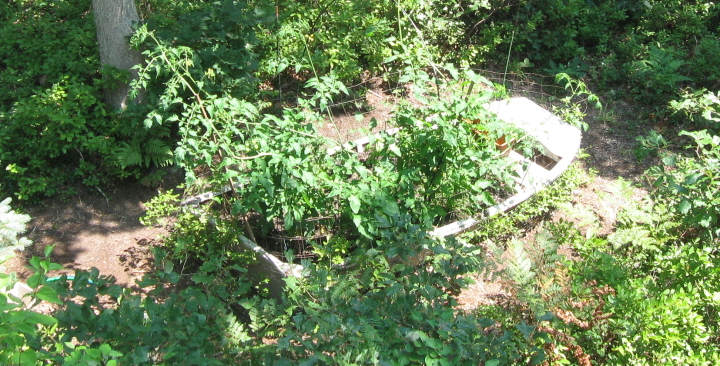
So I have a little garden. It’s in a beached dinghy out back; I lean out over my deck railing and there it is. My neighbor-landlady’s garden graduated to a bigger plot maybe 30 feet away. She asked if I wanted to use the dinghy. Why not? thought I.

This is my third year. Still, I’m not a gardener. I’ve got an ulterior motive: pesto. The pesto I froze at the end of last summer lasted me till the end of June. This in my book is success.

First Black Cherry tomatoes of 2012

I also grow tomatoes, mainly because who doesn’t? Unlike most people I know, I can take or leave tomatoes, but I do like the little cherries. In 2010, desperate to deal with a cherry tomato glut, I discovered the wonder of halved cherry tomatoes sprinkled with diced onions, drizzled with a little olive oil, and slow-baked for about two and a half hours. If you’d told me before then that I was capable of eating a dozen cherry tomatoes in 10 minutes, I would have said you lied.

In my studio apartment there’s no room to start anything from seed, so if I want to put seedlings in the ground before Memorial Day they have to come from somewhere else. This spring was so warm that the seedlings I bought in late May looked like gangly adolescents already. Now those four tomato plants look like the hedge round Sleeping Beauty’s castle. The basil plants were leggy and looked ready to flower already, so I only bought one. It didn’t thrive — I think I didn’t water it enough — and has since passed on. The basil I started from seed, however, is doing fine. My pesto hopes are high.

Growing lettuce

In late April someone gave me four little lettuces and assured me that it wasn’t too early to put them in the ground. I don’t buy lettuce because it goes gelatinous before I can use it up, but this spring I discovered the appeal of picking a few leaves whenever I needed them. By early July the lettuce had bolted, but I might try it again next year. I’ve even heard tell of a variety that likes hot weather and doesn’t bolt.

Someone else gave me parsley, which has done fine for me in the past. Not this year. It started off OK then got reedy and broke off at the stem. Maybe not enough water, maybe something else. I use parsley in my pesto, but luckily it’s cheap to buy at the grocery store.

Some of last year’s chives wintered over. When I transplanted out the chives that passed the winter in a plastic pot next to my sink, they looked spindly next to the hardy outdoor guys. Amazing what root room and fresh air will do: now you can’t tell the two clumps apart.

Ripehing tomatoes

I’ve already harvested a few Black Cherry tomatoes, and there are lots more to come: more Black Cherries and a slightly larger red variety whose name I’ve forgotten.

With growing season already in full swing, I started more tomato seeds up on the deck. They had grown into tall seedings when a high wind in mid-July blew their planter off the railing. Of course the planter landed upside down.

Two were pretty well broken, but the other two, though somewhat the worse for wear, seemed worth saving. I planted them where once the bolted lettuce grew. They’re doing fine, but even if they flower and fruit the tomatoes probably won’t have time to ripen before shorter, cooler days slow things down.

Fallen tomatoes

The basil I started from seed is doing nicely. In another week or so there should be leaves enough for a batch of pesto. I’ve got more seedlings going up on the deck, in the planter that survived the unfortunate plunge. At present they’re barely peering over the planter’s lip, so they could probably survive falling 15 feet and landing upside down. To be on the safe side, however, if high winds are forecast, I’ll take them off the railing.

There’s no such thing as too much basil. Note thriving chives and, behind them, the tomatoes that fell 15 feet and lived.

The tomato tangle as seen from my deck. The plants are all taller than any of my stakes. There are lots of green tomatoes in the thicket; you just can’t see them from here.

Posted in home, Martha's Vineyard, outdoors | Tagged , , , , | 3 Comments

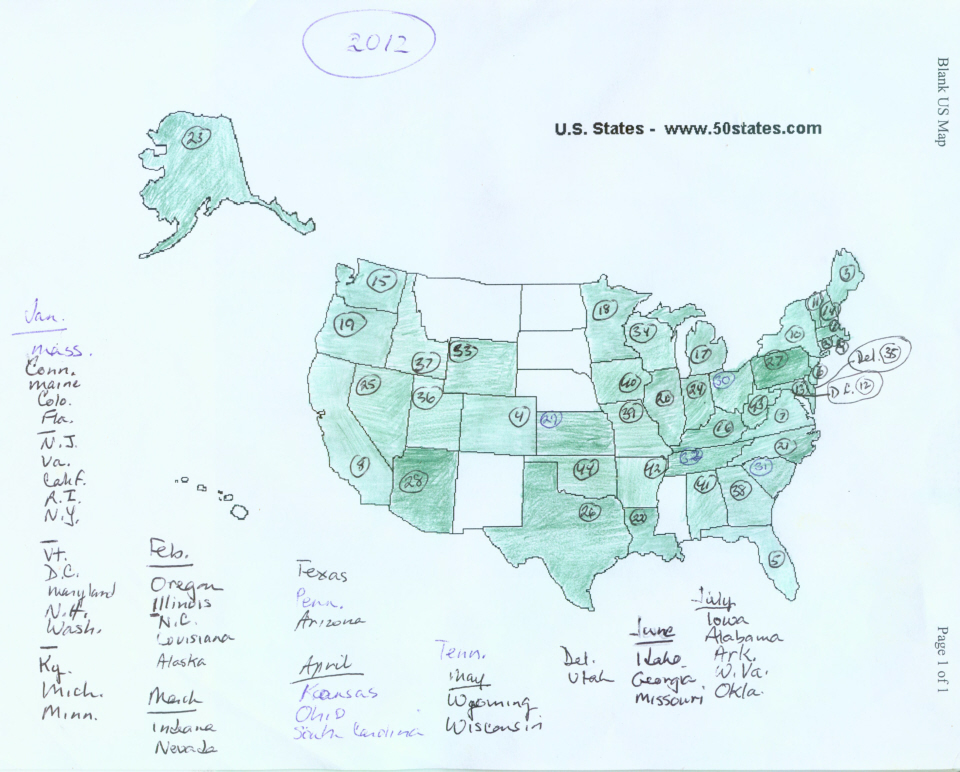
July License Plate Report

How ’bout that map, huh? July brought in several hard-to-get states. Iowa isn’t generally too tough, but Alabama, Arkansas, and Oklahoma are all good catches. West Virginia too: most years I’m SOL if I miss the family friend from Morgantown who’s usually gone by the end of June. This year I missed her but spotted another visitor from the “wild, wonderful” state.

Don Lyons, the guy who got me into this game, reports that he really and truly has seen North Dakota this year. Be still, my beating heart! For Don’s 85th birthday in the middle of the month, I made him a card with a North Dakota license plate on it. I also bought myself two items of hot-weather clothing from Deva Lifewear, which is located in North Dakota. Maybe these things will bring me luck?

A Hawaii plate passed me near the hospital the other day, but it was on the front end of the car. The rear plate, I’m pretty sure, was Massachusetts — sure enough that it wasn’t worth pulling a U-ie and chasing the car toward Oak Bluffs. For a while Massachusetts was a one-plate state, and if you got your current plate number in those years you can put anything you want on the front. I’ve seen this faux-Hawaii car before.

On to August!

Posted in license plates, Martha's Vineyard | Tagged | 2 Comments

The Personal Is Political

The personal is political.

That’s not the first thing that comes to most people’s minds when they hear the word “feminism.” They think equal rights, equal pay, and the right to choose.

“The personal is political” might be second-wave feminism’s most important contribution to contemporary political theory and community organizing. For sure it’s the most overlooked, and probably the most misunderstood. Plenty of people take it to mean that focusing on the personal is a substitute for political action. It doesn’t.

Women have always talked among ourselves. In the 1960s and 1970s, this talking became more widespread and more focused. We discovered that we weren’t the only ones dealing with job discrimination, harassment, abusive husbands, arrogant doctors, depression, etc., etc. These things weren’t talked about in public, never mind covered by the news media. In our isolation, we assumed the problems were ours alone. We had no idea how widespread they were. We discovered this by talking among ourselves.

We didn’t stop there. We organized, in small groups and large groups, to address these issues. It turned out that they were more widespread than we, sitting in our kitchens and living rooms, had ever believed. More than that: they were inextricably entwined with all the other challenges facing our own communities and the whole goddamn planet. It was, in a word, overwhelming.

Progress was made, though. Ideas considered outrageous in the early 1970s are now mainstream enough that it’s the attacks on them that seem outrageous, at least to some of us.

But by the end of the 1970s, “CR” — consciousness-raising — had pretty much died out. We didn’t realize what a powerful tool it was. We didn’t realize that consciousness-raising is a lifelong process, or that women start out from different places and at different times. Perhaps most important, we forgot how key it was to tell our own stories and make these connections for ourselves.

As a result we wound up with a generation gap. With a split between insiders and outsiders: those who’d made it up for themselves and those who read about it in books, those who recognized their own experiences in feminist theory and those who didn’t.

These days there’s a serious society-wide disconnect between our individual lives and what we call politics. We take it for granted that politicians are different from us — much wealthier, to start with — and that when they listen to us, it’s to placate us (and win our support), not to hear what we have to say. Most of us get most of our ideas prepackaged, from right-wing talk show hosts, liberal columnists, alternative news sources, and everything in between.

Much is made of the incivility of political discourse, on all levels, from Main Street to the halls of Congress. I suspect it has something to do with the fact that we’ve grown accustomed to not being heard, and when you’re accustomed to not being heard you often end up saying any damn thing that pops into your head, often at a high decibel level.

Or you grumble in private.

Or you just shut up.

What if we did more of our talking face-to-face? What if we focused on the details of our own lives, and pooled our experiences, and tested the words and deeds of politicians against what we know to be true? What if we built our theories from the ground up — and, along with them, the networks and organizations to make change happen?

The poet Muriel Rukeyser wrote, in “Käthe Kollwitz”:

What would happen if one woman told the truth about her life?
The world would split open

What if we told the truth about our lives, and listened to each other’s tellings? Would we still put up with “politics as usual”?

Posted in musing, public life | Tagged , , | 1 Comment

Too Much

Nikki Giovanni is reading at Ocean Park at 4. A memorial service for John Mayhew starts at the Ag Hall at 5, with potluck and musicale to follow at 6. A friend is hosting a dessert party/house concert for a visiting flutist at 7. Greg Brown is playing Katharine Cornell Theatre at 8.

And these are just the things I really want to go to. If I had time and energy and could split myself in three, I could also go to the Native American Artisans’ Festival in Aquinnah (11 a.m. to 4 p.m.); a minor league baseball game at the high school at 5; a performance of Twelfth Night at the Tisbury Amphitheater, also at 5; and a concert at the Pit Stop at 8.

Not to mention the several other music and dance performances going on around the island, and the artists’ receptions. Oh yeah, and the West Tisbury library’s annual book sale is on through Monday at the West Tisbury School, half a mile from where I sit.

This is summer on Martha’s Vineyard. It’s too much. I’m tempted to blow a (mental) gasket and not go anywhere, but I’ve never heard Greg Brown live (and I’ve already shelled out $27.50 —  big bucks in my budget — for a ticket), and I haven’t heard Nikki Giovanni in many years, and I really want to go to Johnny’s memorial because his widow’s my writing buddy and the stories people tell about his life are going to be wonderful . . .

Off-islanders routinely have at least this many options within driving distance on any day of the week, and probably twice as many on weekends. They deal with the daunting multiplicity of options by not-seeing the overwhelming majority of them, the ones of only peripheral interest or no interest at all.

On Martha’s Vineyard, “driving distance” is 20 miles max. If it’s farther away, you’ve got to take the boat. This changes the calculus significantly. It’s not that you can’t get there from here; it’s that the effort, and usually the expense, increases as soon as crossing the water is involved. So we often use Vineyard Sound as an excuse for not doing whatever we’re not all that excited about doing in the first place. If we ever had the ability to automatically screen out all the options we’re not interested in, it atrophies from lack of use and gradually disappears.

So summer comes as a shock to the system, like emerging from a dark room into glaring sunlight. So many choices, so little time, not enough money . . . Excuse me, I think I’ll go back to bed.

Sure, I sometimes grumble about the limited options of off-season Martha’s Vineyard, but you know what? It’s the limitations that make this a relatively livable place. With fewer options, it’s hard to specialize to the point where you cut yourself off from everyone not in the same specialty. Plenty of people engage in two or more apparently unrelated activities: the carpenter is a volunteer Big Brother, the nurse plays in a blues band . . . The singers in the spirituals choir I joined this year represent a variety of skills and experiences, musical and non-musical.

Our multitudinous, multifarious circles mix and mingle and suffuse each other and create what seems to be, for lack of a better word, a community. It’s not monolithic, it’s certainly not static, but there it is.

Meanwhile summer is here and I’ve got to deal with it. What am I going to do this afternoon?

Posted in Martha's Vineyard, public life | Tagged , , , | 4 Comments

Singing for Our Lives

We are a gentle, angry people
and we are singing, singing for our lives . . .
— Holly Near

The spirituals choir sang at Union Chapel Saturday night. I knew it was going to be a good night when Malvina Forester found herself a four-hour parking place on Ocean Park. It was.

I just joined the choir this year. This time last year I heard them sing at East Chop lighthouse. Wouldn’t it be cool, I thought, to sing those songs with those people?

So this year I’m doing it.

I’m not a musician. I’m barely a singer. But my life has had one hell of a soundtrack. I’ve learned almost as much history from songs as I have from books. And you can’t immerse yourself in the songs of a people without feeling something of the experience behind those songs.

The spirituals are slave songs, the songs of African slaves on the North American continent from about 1619 through Emancipation, news of which didn’t reach Texas till 1865. They weren’t composed: they evolved in true folk tradition. They were work songs, and at the same time they were songs of aspiration, celebration, and resistance. Some, like “Keep Your Lamp Trimmed and Burning,” “Wade in the Water,” and “Swing Low, Sweet Chariot,” referred specifically to the Underground Railroad, the clandestine network that helped southern slaves escape to the north.

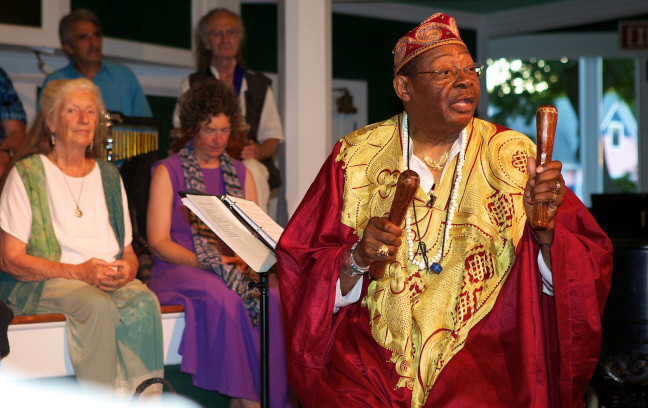
Jim Thomas at Union Chapel. Photo by Adrianne Ryan.

Jim Thomas, leader of the choir, founded the U.S. Slave Song Project in 2005 to educate the public about the songs. Jim has a powerful voice. He can speak, he can testify, he can preach, and damn can he sing! As a student at Fisk University, he sang with the Fisk Jubilee Singers — the group that in the late nineteenth century started bringing slave songs to a wider, and whiter, audience. Since then he’s sung with the Robert Shaw and Paul Hill Chorales and organized choirs in a variety of places. He talks about the history of the songs, and what they signify.

People who hear the songs learn a lot, but people who sing them learn even more. About yearning for a better world, where even slaves would live “In Bright Mansions Above.” About determination to keep moving forward, as in “Don’t You Let Nobody Turn You Round,” “Done Made My Vow to the Lord,” and “Woke Up This Morning (With My Mind Stayed on Freedom).” About the courage and sly humor it took to sing songs that meant one thing to the masters and something entirely different to the slaves.

Jim in another of his wonderful robes. That’s me in purple beside the pillar, Gail Tipton on my left, percussionist Bob Lee behind me, and Alex Palmer behind Gail. Photo by Adrianne Ryan.

We sang again at the Unitarian Universalist service on Sunday morning. Union Chapel and the UU meeting house are two of my favorite places on Martha’s Vineyard, and they’re great places to sing.

Sunday night I went to hear Holly Near at the Old Whaling Church, a performance produced by the UUs and the Vineyard Peace Council. Holly was big on the soundtrack of my D.C. days — I heard her live several times and sold her records at Lammas Bookstore. Ever since I left town, the recording made on her 1984 “Lifeline” tour with Ronnie Gilbert, once of the Weavers, has been high on my playlist.

The Weavers were slightly before my (conscious) time, but as a young antiwar activist I learned their story, how they were blacklisted during McCarthyism’s heyday. Turned out I already knew many of the songs the Weavers had helped make popular, like “Goodnight, Irene,” “Follow the Drinking Gourd” (which is identified with the Underground Railroad), “Pay Me My Money Down,” and “So Long, It’s Been Good to Know You.” And of course I knew of Pete Seeger, a key troubador of the antiwar movement who had strong ties to the civil rights movement too.

In Wasn’t That a Time (1982), the wonderful documentary about the Weavers, there’s a magical sequence where Ronnie Gilbert and Holly Near sing together. (That’s a link to this very scene, which I just discovered on YouTube.) Holly had been part of Ronnie’s tradition from an early age; as they talk and sing together, you see Ronnie becoming part of the tradition that Holly was helping to create. The song they sing is Holly’s “Hay Una Mujer Desaparacida,” memorializing women who were “disappeared” by the U.S.-backed junta in Chile — which draws another musical tradition into the great current, that of La Nueva Canción, the “New Song” movement that rose in Latin America in the early 1960s.

Songs can pull you into experiences you’ve never had and traditions you weren’t born into. Singing together raises power and spirits. As I drove home Sunday night (singing along with one of Springsteen’s Seeger Sessions CDs), planetary survival seemed possible and writing worth doing. Since then the usual doubts have returned, but their influence is muted.

I’m thinking about what we’ve been losing over the last generation or so, as we retreat to our CD players and home entertainment centers to listen to recorded music instead of making it with each other in public spaces. Churches are among the few places where communal singing happens regularly — and look at all the wonderful singers who’ve been trained up in a church!

There’s plenty of music making on Martha’s Vineyard, but not much of it happens at demonstrations and vigils and other places where we gather to make ourselves heard. Five Corners is a favorite place for protests because it’s so visible, but it’s a lousy place for singing. Could that be a big reason that so few people show up?

Posted in Martha's Vineyard, music | Tagged , , , , , , , , , | 5 Comments