Infested

You know those cartoon traffic jams where four cars are stuck in an intersection and none of them can move because each one is being blocked by another?

Five Corners looked like that a little after midday and I was in the middle of it.

Island Closed smI was coming from Beach Road heading toward Main Street. Another car was coming from Beach Street heading toward Oak Bluffs. The coast looked pretty clear apart from the monster SUV coming in from Lagoon Pond Road and the little sedan coming from the ferry dock, and they’d yield the right of way, wouldn’t they?

Nope. In the next instant the little sedan was blocking me, I was blocking the SUV, the SUV was blocking the car coming from Beach Street, and the car coming from Beach Street was blocking the little sedan. There was a pickup on my tail so I couldn’t back up. The only vehicle that wasn’t blocked fore and aft was the little sedan. She backed up. As I resumed forward motion, I noted the Connecticut plates on her car and vowed that I will make no snotty remarks about Connecticut drivers for the next week.

Since I’d just come from the dentist (the first of three appointments that will result in a new crown on a first molar and a gaping hole in my checkbook), I felt a hankering for ice cream and/or cookies so I stopped at down-island Cronig’s. The parking lot was jammed. I hardly recognized a soul in the store. One of the souls I did recognize was rolling her eyes. “They’ve just come out of nowhere,” she said.

Loose translation: Summer is upon us. So I told her my Five Corners gridlock story. She reciprocated with the story of a woman who called the shop where she works to ask what time they closed. “Five o’clock,” said my friend, which hour was fast approaching. “But I’m in Chilmark!” the caller wailed.

“I don’t care if you’re in Istanbul,” my friend thought but did not say. “We close at five o’clock.”

Martha's vineyardOh yeah, and the ticks are terrible too. They’re always terrible this time of year, the dog (wood) ticks especially, but several friends are swearing that this is the Worst. Year. Ever. Some express surprise that the cold winter we had didn’t do them in. I figured out a long time ago that there’s no such thing as a bad winter for ticks.

In the dentist’s office we talked mostly about ticks. The dentist is relatively new to the island. He doesn’t have a dog. His assistant and I have been here quite a while and both of us hang out with animals. The dentist got a crash course in tick behavior, tick-borne diseases, and tick-prevention products.

There’s more to summer on Martha’s Vineyard than ticks and traffic, but at the moment I can’t remember what.


Posted in Martha's Vineyard | Tagged , , , | 6 Comments

Stunned

I got the news via Facebook early last evening. There in my news feed was the genial, instantly recognizable face of Pat Gregory moderating a West Tisbury town meeting, and next to it the ungraspable Martha’s Vineyard Times headline: “Pat Gregory murdered while hiking in California.”

According to the Vineyard Gazette, “Authorities said between 11:30 am and noon [Friday, May 16], Mr. Gregory and his companion encountered a man who produced a firearm and demanded money and personal effects from the victims. ‘After the robbery was completed, the suspect then shot the victims and left them in the remote area about 100 yards from the trail head,’ the release said.”

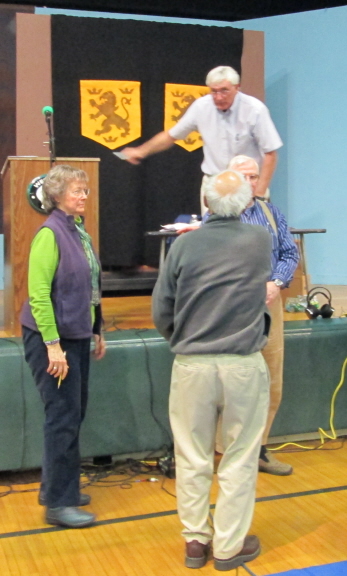
Moderator Pat gives instructions to the volunteer vote counters at last month's annual town meeting.

Moderator Pat gives instructions to the volunteer vote counters at last month’s annual town meeting.

If you’ve read my blog posts about West Tisbury town meetings, you’ve seen Pat’s photo. Since 1991 he’d been our town moderator.

In the 1970s and early ’80s, Pat taught middle school math at the West Tisbury School. In 1985 he and his wife, Dorothy, started Edu Comp, which sells computers and art and office supplies at the head of Main Street, Vineyard Haven.

Pat became West Tisbury’s moderator in 1991. His kids went to school here. His grandkids are in school here now.

So many of us knew Pat in one way or another, and often in several ways. As it has in the past, Facebook has become an ongoing wake. Friends, acquaintances, and relatives are posting memories of Pat and responses to his death. Pat’s FB timeline reads like the guest book at a memorial service. “Stunned” and “shocked” have come up a lot.

After “stunned” and “OMG,” my reaction was “I hope they catch that guy and fry him.” It passed, but there it was. I get it. After a senseless, inexplicable, irrevocable act that deprives a family of a loved one, a community of a deeply loved and respected and irreplaceable member, I wanted to strike back at fate. I wanted someone to pay, even if Pat won’t come back no matter what price is paid.

What kind of person would rob two men and then shoot them? Could whatever valuables they were carrying possibly have been worth the risk of being caught and charged with (most likely) first-degree murder? Reason doesn’t apply here. This act was, to use another word that’s come up often, “senseless.”

Which means unpredictable and hence unpreventable.

I just read two news accounts about the shooting from the Red Bluff Daily News. Red Bluff, it seems, like West Tisbury, is the kind of place where this kind of thing never happens. People hike the Iron Canyon Trail without thinking about the possibility of violence, the way I walk the dirt roads and footpaths of Martha’s Vineyard.

Or they did until last Friday afternoon.

Red Bluff, I’m guessing, is also like West Tisbury and Martha’s Vineyard in that a senseless death would affect, directly and indirectly, just about everybody who lives there. They know what we’re going through. We know what they’re going through. Or at least we have some idea. We can feel for people we’ve never seen and never will see.

The man who killed Pat Gregory and critically wounded his friend couldn’t feel for two men who were standing right in front of him. He’s inflicted grief and loss and anger on hundreds of people whose existence he probably can’t imagine.

I’m stunned.

The song that’s making its way into my brain is Holly Near’s “It Could Have Been Me but Instead It Was You.” She wrote it in response to the shootings at Kent State (1970) and the murder of singer-songwriter Victor Jara by the Chilean junta (1973), but it travels well. Here it is.


Posted in Martha's Vineyard, public life | Tagged , , , , , , | 5 Comments

Spring on the Line

How do I know it’s really spring?

Early spring culminates in yellow season. In mid-spring yellow starts yielding to purple and green conquers (almost) all. The shade to the left of my work chair is pulled all the way down during my writing hours, roughly 7 to 9 a.m., because the early morning sun has moved north enough to glare off either laptop screen or paper. Winter sun rises without peeking in the window.

Hell with all that. All I need to tell me it’s really spring, mid-spring in particular, is my clothesline.

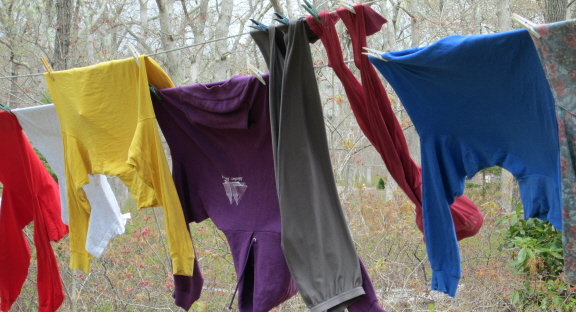
20140515 line 1

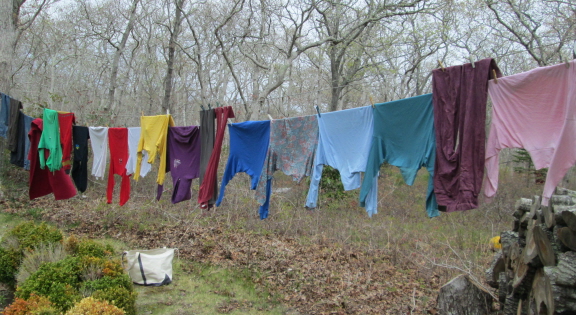
Spring laundry is more colorful than winter laundry. There’s also more of it. In cold weather I wear more clothes at one time, but I can wear the same turtleneck or jeans for days before it starts to feel grubby. I’m changing my socks more often these days. In hot weather the mere thought of pulling socks back on after I’ve taken them off is, well, gross.

Of course I change my underwear every day, 24/7/365. If I didn’t, I could go more than three weeks without doing laundry.

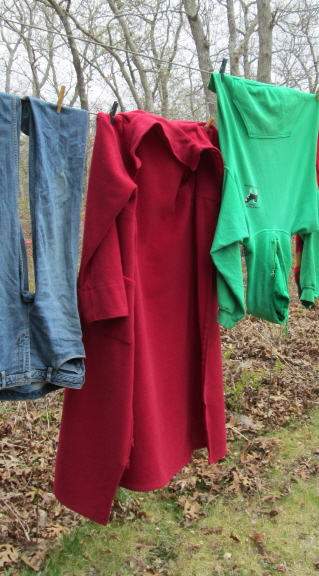
20140515 bathrobeNow look more closely. My wonderful fleece bathrobe only gets washed once a year: when it’s about to get put away for the summer. I only wear it in the morning, when I get up and pad downstairs to the bathroom. I could pad downstairs to the bathroom in the non-garments I sleep in, but (1) it’s chilly, and (2) the bathroom is part of my neighbor’s studio and sometimes she likes to get some work in before her kids go to school.

All through the cold season, my fleece bathrobe was cozy and warm, but a week ago it started to feel itchy and hot. To pad down to the bathroom, I’m now wearing a knee-length T-shirt. Spring is here.

20140515 t-shirts

There are four — count ’em, four — T-shirts on the line. Two long-sleeve (WUMB-FM and AMRONE, Alaskan Malamute Rescue of New England) and two short (Wintertide Coffeehouse 1992 and Reliable Market).

There are also two sweatshirts. The bit of green at the far left (above) is one, also from AMRONE. The other is purple and actually says Martha’s Vineyard on it. You can see them both below. Long-sleeve Ts and sweatshirts are quintessential mid-spring and mid-fall garb around here.

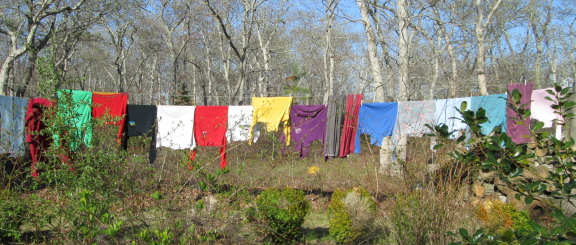
20140515 line 2

Only two pairs of long underwear! See them, just to the right of the purple sweatshirt? One’s my only pair of silkies — not serious cold-weather wear. I haven’t had long undies on in at least two weeks.

There are lots of turtlenecks, however, and the only pair of jeans that isn’t on the line is the one I was wearing. And no shorts. That will change in the weeks to come, but turtlenecks, jeans, and the absence of shorts are significant clues to the season.

20140515 blowing

The trees are greening up for sure, but no oak pollen fell on this laundry line. It’s not late spring (quite) yet.

20140515 line with trees

Posted in home | Tagged , | 2 Comments

Not-So-Mellow Yellow

Mid-April ice disk

Mid-April ice disk

Yellow season was well under way before I noticed it this year, probably because April was cool and everyone was bitching about how winter would never end. True, there was enough ice in Travvy’s outdoor water dish to make an ice disk on April 21, but by 8:30, when we set out for our morning walk, the temp was in the high fifties (F) and all that remained was a wet spot on the deck.

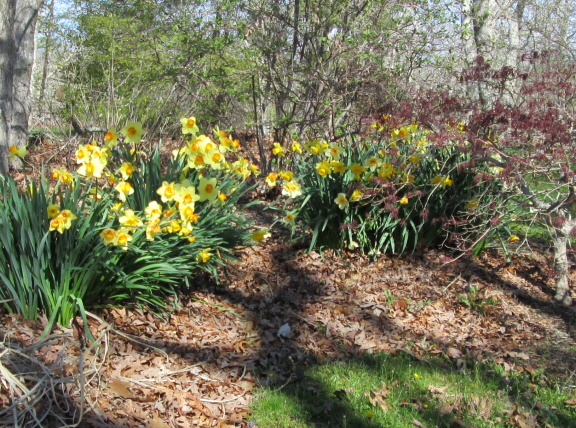
Mid-spring is yellow season on Martha’s Vineyard. Daffodils, dandelions, forsythia, and buttercups. After months of subdued winter colors, yellow is startling. Vibrant. Here’s some of this spring’s yellow.

daffodils

daffy travvy

The daffodils have mostly gone by, but Trav still has a few to hang out with. Trav also hangs out with dandelions.

dandy travvy

Forsythia is everywhere, close up . . .

forsythia

In my neighbors’ yard

. . . and at a distance.

A house that Trav and I often walk by

A house that Trav and I often walk by

Yellow has been there all winter. Each bus in the West Tisbury School parking lot has a number: 121, 123, 124, and 117H. When one of the four is missing, I know which one it is.

yellow buses

yellow line sign

Yellow, yellow everywhere . . .

This two-tone fir is in at the edge of a summer neighbor’s yard. New growth is lighter than old growth, but it isn’t usually this yellow. I’m going to keep my eye on it and see if it turns green.

new growth fir 2

The heap under my outside stairs is probably the closest I’ll ever come to having a proper Vineyard yard. Note that there’s yellow in it. I’m not sure where that bucket came from.

bucket
My new theory is that the green gets greener because it leaches all the yellow out of the landscape. My yellow turtleneck is about to get put away for the summer with all my fleecies and woollies and other warm clothing. It’ll be back in the fall.

yellow selfie


Posted in outdoors | Tagged , , , , | 3 Comments

Whose Story Is It?

I’m posting this to both my writing blog, Write Through It; and my Vineyard blog, From the Seasonally Occupied Territories. I love it when the two converge like this.

Earlier this week I read a blog post on “What Makes Cultural Appropriation Offensive?” Both the post, by blogger TK, and the ensuing comments are well worth reading. “Cultural appropriation” is hard to pin down. Cultural borrowing happens all the time. The only way to stop it is to shut everybody into a room with people who are culturally just like them. I hope we can all agree that this is (a) impossible, and (b) undesirable. So when does cultural borrowing become cultural appropriation? And why does it matter?

My enduring lesson in why it matters came in the early 1980s. I was just starting to publish my reviews and essays. I was also the book buyer for Lammas, the feminist bookstore in Washington, D.C. As both writer and bookseller I thought a lot about ethics and politics and especially the often shifty terrain where the two converge.

What brought cultural appropriation into sharp focus for me was Medicine Woman, a book by Lynn V. Andrews. Andrews, a white woman, claimed to have studied with “Native American” shamans and been initiated into their spiritual tradition. Medicine Woman was popular with white women, including white feminists, including customers of the bookstore where I worked.

Soon after it was published, Andrews’s claims were challenged by people intimately familiar with tribal spiritual traditions. These challenges, at least at first, were published primarily in the alternative press and journals of limited circulation. Andrews’s book was published by a big-name trade publisher. It sold very well. It won Andrews more book contracts and eager attendees for her workshops and lectures. Her audience comprised primarily white women who had no experience of “Native American spirituality” — a misleading phrase because this continent is home to many indigenous spiritual traditions — and in most cases didn’t know anyone who did.

Andrews had access to a mass audience in part because of her own color and class privilege, in part because her big-name publisher thought — correctly — that her book would sell, and in part because her followers didn’t really care if her tales were authentic or not. The aura of authenticity was enough. Medicine Woman would not have had the same cachet had it been published as fiction, which it most likely was. (For a thoughtful and well-documented discussion of this case and cultural appropriation in general, see The Skeptic’s Dictionary.)

Cultural appropriation often involves racism, implicit or explicit, but not always. It does always involve an imbalance of power, but the imbalance can be based on race, sex, class, region, nationality, religion, or other factors. Here’s an example of appropriation, or mis-appropriation, in which the people doing the appropriating look a lot like the people whose stories they’re presuming to tell. Maybe it will shine a little light on the whole contested matter of cultural appropriation or, as I like to think of it, “whose story is it?”

In the summer of 1993, President Bill Clinton vacationed on Martha’s Vineyard. I’d been a year-round resident for eight years at that point, long enough to know that the year-round island and the summer island occupy the same hundred square miles of land but are not the same place. He was accompanied not only by his family but what seemed like the entire national and regional press corps. The first family made some public appearances, but most of the time they hung out on a hard-to-reach estate near the south shore. They were here for three weeks.

This left all those reporters with a lot of downtime. To justify their salaries and expense accounts, they had to file stories, so they swarmed all around the island, seeing the sights, buttonholing everyone who didn’t look too touristy, and writing about The Vineyard. I saw some of what they wrote because friends around the country sent me clippings — this was before the World Wide Web, never mind Facebook and Twitter. Often a single story would be syndicated and wind up in several newspapers.
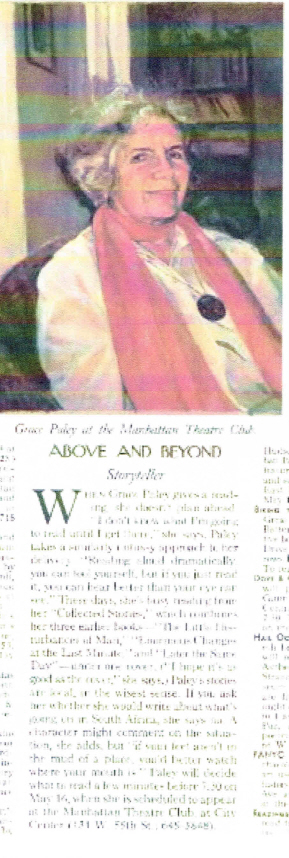
From The New Yorker for May 16, 1994

From The New Yorker for May 16, 1994

This wasn’t exactly going viral, but it did mean that stories written by reporters who’d been here for a week or so reached many, many more thousands of people than anything that appeared in either of the Vineyard’s two weekly newspapers. At the time I was working for one of them, the Martha’s Vineyard Times. I was doing what most year-round working Vineyarders do in the throes of August: trying to keep my act together and praying for September to come PDQ. In a summer resort, September means sanity, or at least the semblance thereof. But in the national press the Vineyard was all about lolling on the beach; hobnobbing with the rich, famous, and influential at cocktail parties; and seeing the sights.

The following May, still fuming, I happened upon a small item in The New Yorker about Grace Paley, a poet, writer, and activist I much admired. It said, in part:

“Paley’s stories are local, in the wisest sense. If you ask her about whether she would write about what’s going on in South Africa, she says no. A character might comment on the situation, she adds, but ‘if your feet aren’t in the mud of a place, you’d better watch where your mouth is.'”

Grace Paley nailed it: “If your feet aren’t in the mud of a place, you’d better watch where your mouth is.” Not only did that become the epigraph of my first novel, it gave me its title and sustained me in the writing of it. It sustains me to this day: my feet are in the mud of this particular place, about which so much has been written by people who only skim the surface, so what the hell else should I be writing about?

And that, in a nutshell, is why appropriation, cultural and otherwise, is a problem. Stories have power. Stories told by those with access to education and, especially, to the mass media circulate far more widely than stories told by those who lack such access. Stories that the mass audience wants to hear, or what the editors and publishers in charge think they want to hear, circulate more widely than stories that make us uneasy. Stories told by those whose feet aren’t in the mud of the place all too often come to be seen as authentic, as more real than the real thing.

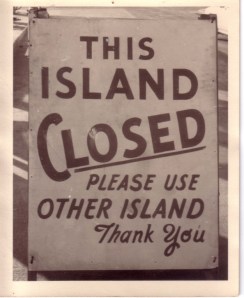
Posted in Martha's Vineyard, musing, writing | Tagged , , , , , , | 4 Comments

Scorched

Travvy and I walk the path behind the West Tisbury School at least once most days. Some days it’s two or three times. It doesn’t change much. The four school buses disappear from the parking lot to pick kids up in the morning and take them home in the afternoon. Soccer balls that go AWOL from practice aren’t always retrieved when practice is over. Travvy likes to check out each new bit of food-related trash, but that’s about it.

Until yesterday.

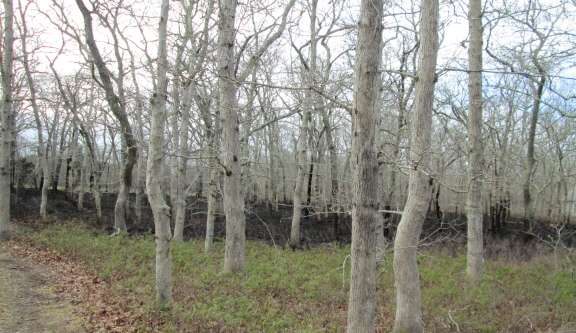
Late yesterday afternoon this is what I saw up ahead:

approach

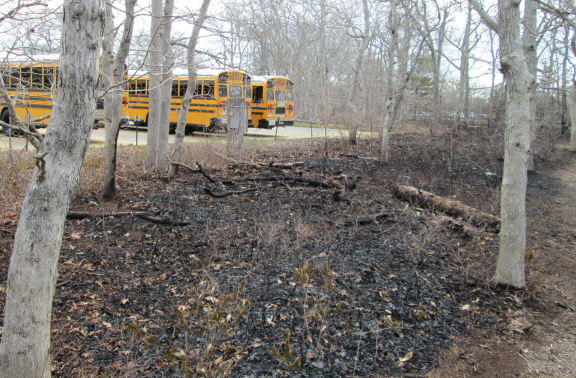
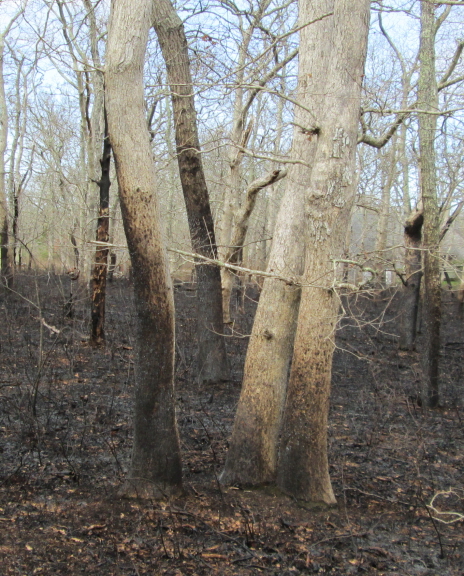
The air smelled charred. The buses were where they always are on a Sunday afternoon. The ground was scorched almost up to the parking lot, but not quite.

buses

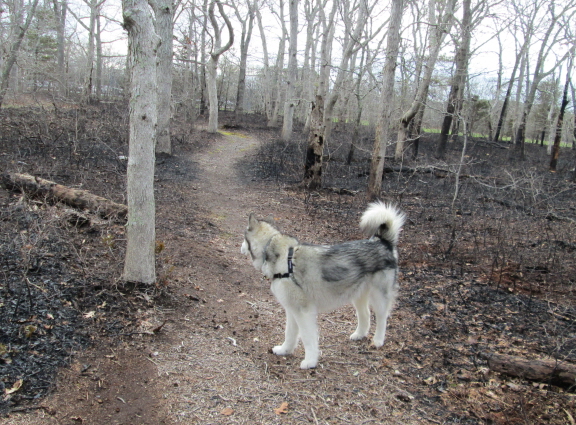
The path was a pale ribbon through the scorch. The fire had passed over it: nothing to feed on.

trav on path

Fire had been here. Controlled burn, was my first thought, but why here? Why on a very windy Sunday afternoon? Why hadn’t the buses been moved out of range? Controlled burns are sometimes done on fallow fields overgrown with combustible scrub. This reduces the risk of wildfire and also enriches the soil.

Or perhaps this was going to be a house lot? Highly unlikely, thought I. There’s no access now, or likely to be in the future.

My neighbor was out doing yardwork when Trav and I got home. The fire was news to him. No, he confirmed: no house lot there. If it was a controlled burn, he added, the abutters would have been notified. My neighbor works for the county housing office, which manages one of the two nearest buildings. They hadn’t heard anything. (The other building is a nursery school.)

If you hear anything, let me know, I said.

As it turned out, I heard first. My writers’ group meets on Sunday nights. One member uses a wheelchair. The guy who helps him get around is a volunteer firefighter in Tisbury. Sure enough, he’d been called out to fight two fires yesterday afternoon. One of them was behind the West Tisbury School. A pile of mulch had overheated and spontaneously combusted.

In my horsegirl years fire was the #1 danger that was never far from anyone’s mind. Hay baled damp will mold, molding generates heat, and when bales of hay are packed tight in a loft there’s nowhere for the heat to go. I hadn’t realized that mulch could burst into flame.

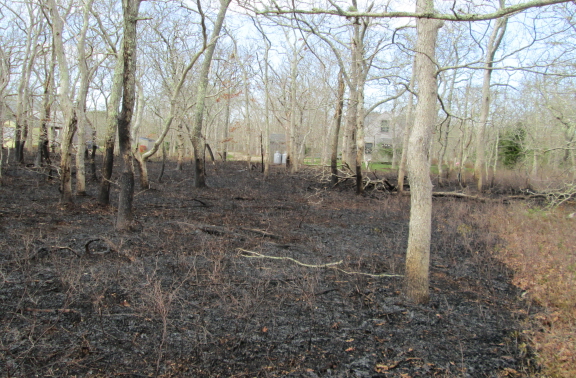
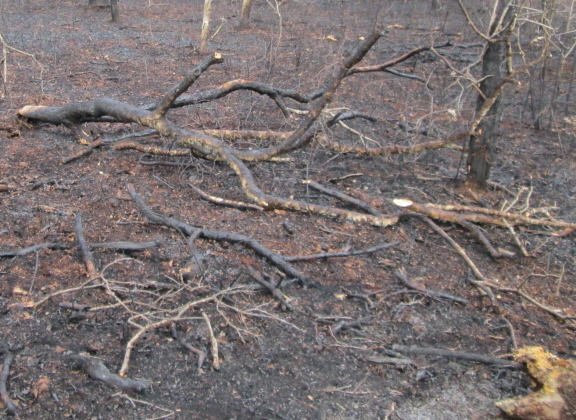
This morning I walked the path with renewed appreciation for the island’s volunteer firefighters. The line between charred and uncharred could have been drawn with a ruler. The fire was put out before it could climb up the trees. And neither my neighbors nor I heard a thing, though we’re less than half a mile away.

The firefighters held the line. At the far left through the trees is the nursery school. The house to the right belongs to the housing authority.

The firefighters held the line. At the far left through the trees is the nursery school. The house to the right belongs to the housing authority.

scorched trees

scorched branches

tire tracks

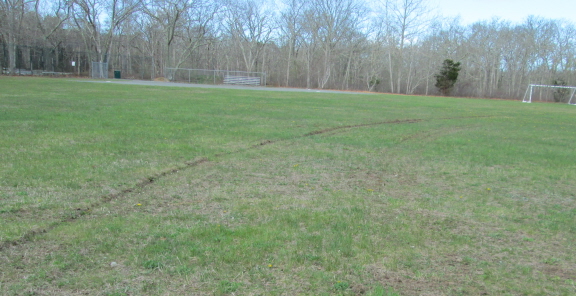
The only clue outside the burned area: tire tracks on the soccer field that weren’t there Sunday morning


Posted in outdoors | Tagged , , , , | 5 Comments

Taking Stock

Dear From the Seasonally Occupied Territories:

You’ve probably noticed that I haven’t been around much lately.

It’s not that I don’t love you, or think of you often. It’s just that I’ve, well, sort of opened the relationship.

Back in February, I started another blog: Write Through It: On Writing, Editing, and How to Keep Going. In March one of my posts, “Like Driving,” was featured in Freshly Pressed — an ongoing “Best of WordPress.” This was a thrill, one, because there’s a scary number of really excellent blogs out there, and two, because it attracted lots more readers and comments to Write Through It. Some of them even came over here to check you out.

signOver the winter I wrote an essay. “Make Room for the Wild Card: On Art in Public Places” is a response to the controversy over the installation of the Sleepwalker statue at Wellesley College. It came out pretty well. It also reminded me what it’s like to actually look forward to writing every morning. I had not felt that way about Squatters’ Speakeasy for quite some time. It wasn’t coalescing. It wasn’t moving forward.
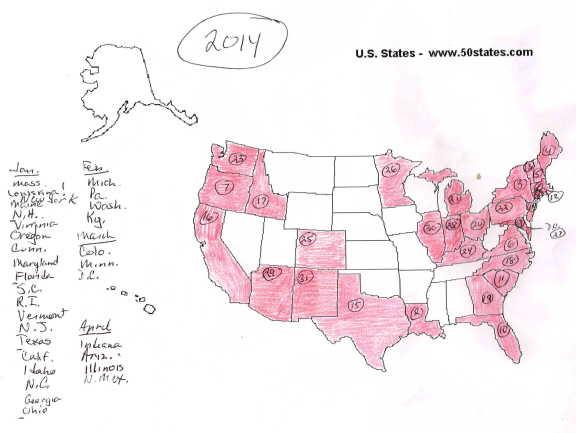
So about a month ago I pulled my other novel in progress off the back burner and turned up the heat. Wow. It’s on fire. It’s cooking. Like The Mud of the Place and Squatters’ Speakeasy, it’s also set on Martha’s Vineyard — big surprise there, eh? For several weeks now it’s been absorbing most of my write-about-the-Vineyard energy.

Between that and Write Through It — well, that’s why I haven’t been over here much.

I thought — briefly, very briefly, but I did think of shutting you down. You kept me going through some very discouraging times, when I thought that writing about Martha’s Vineyard was just about the stupidest, most useless thing I could do with my time, but maybe you’d done your job and it was time to retire?

Immediately my mind filled with half a dozen things I still want to write about. If this blog were more bloggish and less essayish, I could write about life in the Seasonally Occupied Territories and still keep the novel and Write Through It going. There are also other people out there writing about and photographing and otherwise telling stories about the year-round Vineyard. I’d love to feature their work in this blog.

So let’s keep going, OK? I’ll be back.

Soon.


Posted in writing | Tagged , , | 4 Comments

April License Plate Report

2014 apr license plate

Indiana and Illinois, Arizona and New Mexico. This wasn’t the order I spotted them in, quite, but — probably because I’m a chronic East Coast girl — I think of Indiana and Illinois as a couple, and Arizona and New Mexico likewise.

Both Arizona and New Mexico appeared in the spring last year. In 2012 New Mexico didn’t appear at all. And there it was on Main Street when I drove to Edgartown earlier this week.

Posted in license plates | Tagged | 1 Comment

Swans a-Swimming

When we drive, walk, or bike past the Mill Pond, most of us slow down and glance sideways to see what’s happening. Something always is, though it’s easy to miss if one cruises through at 35 miles an hour — which is way over the speed limit. The return of the swans promises that spring is here to stay, and reminds us that, as Tennyson wrote, “Tho’ much is taken, much abides.”

Last year Bob and Bobette, as the swans are widely known, raised a family. We watched in fascination. We worried when they vanished to parts unknown (possibly nearby Tisbury Great Pond) and rejoiced when they came back. We grieved when a young swan fell victim to one of the snapping turtles that lives in the pond, despite the heroic efforts of our animal control officer to save it.

These photos of 2013’s swan family were taken by Martina Mastromonaco, Chilmark beach superintendent, dedicated Dumptique volunteer, and a wonderful photographer. She moderates three groups on Facebook: “Martha’s Vineyard where are you,” “Where am I on Martha’s Vineyard,” and “Martha’s Vineyard were was I?” Even if you know the Vineyard well, her photos and those of other regular contributors will show you the island from new angles, in different lights.

State Road passes close to the Mill Pond.

State Road passes close to the Mill Pond.

gliding

taking off

Note Vineyard Transit Authority bus passing in the background.

Bobette and her brood pay less attention to passersby than passersby pay to them.

Bobette and her brood pay less attention to passersby than passersby pay to them.

family

swan & cygs 2

cygnet face

swan head

All photographs © 2014 by Martina Mastromonaco

Posted in outdoors | Tagged , , , | 8 Comments

Beyond Dredgery

I just posted this in reply to a comment to my most recent post, “To Dredge or Not to Dredge.” In that post I quoted William Blake’s line about “seeing the world in a grain of sand.” When we talk about the Mill Pond, or West Tisbury, or Martha’s Vineyard, we’re talking about other things as well. Here’s some of what this particular grain of sand can tell us about being politically effective in the wider world.

From where I sat, the ATM vote looked less like a vote against dredging and more like a vote of no-confidence in the Mill Pond Committee’s recommendation. The fact that a respected and knowledgeable member of the committee strenuously disagreed with the recommendation was certainly a factor, but it wasn’t the only one.

1. If the MPC’s goal was to encourage further study, then the article was poorly framed, perhaps fatally so. The words “in preparation for dredging” suggested to me and others that dredging was already a foregone conclusion. Had we voted for it, this would have been used as evidence that the town had already taken a step toward dredging, so let’s take another. This is why Kent Healy’s points resonated: he created doubt in our minds that dredging should be a foregone conclusion right now.

2. It’s no secret that some people strongly support dismantling the dam and turning the Mill Pond back into Mill Brook. Others are strenuously opposed to the idea. This is probably why the dam kept coming up in the discussion, even though it wasn’t mentioned in Article 32. The MPC could have acknowledged the issue and made clear that it’s separate from dredging, or preparation for dredging — if indeed it is. They didn’t. I suspect they lost some support as a result.

3. The discussion between Kent and Bob Woodruff wasn’t especially productive, but it was informative. It informed many of us that those closest to the issue didn’t agree on what should be done. That’s important information. It’s not a good sign when the committee that brings a warrant article to town meeting is so deeply divided.

4. Town meeting floor is not the best place to work out serious differences. This is related to (3). One citizen commented that those working on the town hall renovation and the library expansion had raised the benchmark for town boards and committees. I agree. The consensus that emerged on those projects didn’t come out of nowhere. Those people worked their butts off. The library trustees and friends in particular continually solicited feedback during the planning process. The plans evolved as a result. People who had reservations at the beginning came on board, or at least didn’t get in the way. The MPC can profit from these examples.

5. The MPC majority kept crying “Emergency! Emergency!” without providing convincing evidence that an emergency exists. Kent Healy’s comments strongly suggested that it doesn’t — that we don’t have to act in haste in order to head off calamity. From the local level to the national, “Emergency! Emergency!” is used to head off, curtail, and even stifle discussion. I’m deeply suspicious of anyone who uses it, no matter what their motives, and when they haven’t got the facts to back up their fearmongering — forget it. I’m proud of the ATM for resisting the urge to stampede, but somewhat dismayed that the vote was so close.

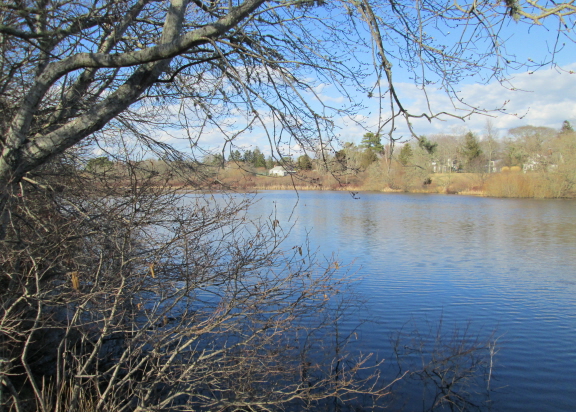
The Mill Pond

The Mill Pond

Posted in public life | Tagged , , , , | 2 Comments