Public Hearing

Early in August the Martha’s Vineyard Commission (MVC) did the right thing, albeit much belatedly, and voted to accept the roundabout project as a development of regional impact (DRI). I discussed the issue and reported my impressions of the August 4 public hearing on the subject in “Roundabout.”

Well, tonight (for the record that’s Thursday, September 1: the clock’s about to toll midnight and I may turn into a pumpkin when it does) I attended another MVC public hearing. This public hearing was about the DRI. This public hearing was a lot like the last one: the public got precious little time to speak. First the commissioners turned the floor over to Mr. Diaz, the representative of Greenman-Pedersen, Inc. (GPI), the engineering contractor. Mr. Diaz, we were told, and his buddy Tom Currier from the state Department of Transportation (MassDOT), had to catch the 9:30 boat. Mr. Diaz proceeded to deliver an extended version of the presentation he gave last time, jam-packed with statistics that have little to do with us. It was even more boring the second time around.

Then the commissioners asked Mr. Diaz questions. I wanted to jump up and say, “Wait, am I in the wrong place? Wasn’t this supposed to be a public hearing? Like isn’t it supposed to be about input from the public?”

With one or two exceptions (thank you, Lenny Jason), the commissioners asked Mr. Diaz embarrassingly insipid questions. For their sake I wished the meeting were taking place in executive session, behind closed doors with no visitors allowed. Couldn’t they have done all this at the MVC office?

Once again I was reminded of the student government meetings of my youth, when elected 19-, 20-, and 22-year-olds pontificated ineffectually on the issues of the day and were raptly recorded by reporters for the college newspaper. Some 40 years have gone by, all the participants are powdered with time, and their energy has drained away. They reminded me of wind-up dolls going through the motions without remembering the reason why — if there ever was one.

Finally the fidgety public got to speak. At first we could only ask questions of Mr. Diaz, technical questions. This posed a challenge, because here’s a classic case of a question becoming an engineering matter before its political underpinnings were addressed. When this happens, you’ve supposed to stick to the technical stuff, which means the reasons why never get addressed. We asked some good questions. Mr. Diaz, apparatchik, got flustered a couple of times.

Mr. Diaz and Mr. Currier left for their boat. I gave Mr. Currier a STOP THE ROUNDABOUT bumper sticker as he left.

The public finally got to speak. First we had to hear from “the applicant,” which is to say the town of Oak Bluffs. Of course they’re all gung-ho roundabout because it was their sleazy dealings that got us into this mess. Then we had a couple of overwrought mothers of teenage drivers going on about how confusing their kids found the four-way stop because people don’t follow the rules! Oh horrors. Learning to drive involves learning that many drivers don’t follow the rules. Some drivers make it from one end of Old County to the other with their left turn signal flashing. Others hang a sharp right without signaling at all.

One woman got all emotional and asked, “What if it’s your relative who gets killed in that intersection?” Then, she thought, you’d think it was worth $1.2 million. No, sorry, I wouldn’t, the same way I don’t think suspending the Constitution is a good idea just to prevent one terrorist from slipping across the border. I wanted to lean over and ask, “What if your town had to pay for this boondoggle? Would Oak Bluffs town meeting spend $1.2 million to save one hypothetical relative? Don’t think so.”

A brilliant move was made by those who managed to sever support for the project from the obligation to pay for it. Oak Bluffs town government is the laughing-stock of the island. They’re so broke they can’t afford an animal control officer, but they wax eloquent in support of an unnecessary project that the state and the feds are paying for. Do we think the OB board of selectmen alone did the conniving and wheeler-dealing to get that state and federal funding? We do not.

The hearing’s been continued for three weeks. This is good. What’s not so good is that I don’t believe these gutless wonders have the nerve to pull the plug on the project. The reason has virtually nothing to do with the (de)merits of the project. The reason is that the MVC and the Oak Bluffs board of selectmen have snuck this project through with zero regard for the rest of the island, and to pull the plug on it now would be to acknowledge that they’d pulled a fast one on the rest of us and regretted it, a little bit at least. Ain’t gonna happen.

Posted in Martha's Vineyard | Tagged , , | 3 Comments

In Irene’s Wake

Martha’s Vineyard got off easy. The wind blew hard for hours and hours. Some trees fell. Some trees fell on power lines, but NStar, the electric company, was on the ball, cutting power before fires could get started.

My power went off at 1:30 p.m. Till then I was checking Facebook regularly to get storm reports and photos from friends around the island. Oaks dancing wildly above my roof weren’t quite as dramatic as waves crashing over the seawall on Beach Road, but they were still a good show.

I kept working on Hekate the laptop till her battery gave out then switched to paper. Electricity was restored about 6:47 p.m., just when the natural light through my east-facing window had faded enough to make editing impossible. Others went without for longer. I remember those nine days without power after Hurricane Bob and consider myself lucky.

The good news is that I managed to survive almost five and a half hours without internet access. The not-so-good news is that without it I got more work done than I would have otherwise.

Storm damage

The only storm damage at my house was one broken flowerpot. I left it on the deck railing because I didn’t want to crush the downward-reaching morning glory tendrils. When it thudded to the deck, I realized this hadn’t been a good idea. Fortunately morning glory seems to have survived and will soon be repotted.

Irene brought little rain to Martha’s Vineyard, and what we got came in short downpours. The salt carried on the wind hasn’t washed away; a friend says if you lick your car it will taste like a saltine. If I’d licked Malvina Forester before the storm, she would have tasted like the dirt road I live on, so I’ll take his word for it. Malvina gets a bath later today. Around my house the leaves are still green. I’m told that as you get closer to South Beach, they’re browner and browner. After Bob, the salt-blasted leaves made it look as though November had arrived abruptly in the middle of August.

The Vineyard was on the dry side of Irene. Vermont wasn’t. Off-islanders often assume that an island is especially vulnerable to coastal storms: much of Martha’s Vineyard (maximum elevation about 311 feet) is close to sea level, and we’re surrounded by water. To be sure, the lowest-lying areas, like Five Corners in Vineyard Haven, flood regularly when hard rain combines with rising tides, and the erosion along the long southern shore has been fierce. But the photos and videos from Vermont, of flooding, bridge washouts, and the devastation wrought by moving water, show that water channeled by rivers, valleys, and mountains can wreak even more havoc.

Posted in home | Tagged , , | 3 Comments

Has SMF Lost the Plot?

Tom Counter.

Tom Counter submitted the following letter to both island newspapers. The Martha’s Vineyard Times declined to print it. The Vineyard Gazette has said it was going to print it, but as of last Friday’s paper, it hadn’t appeared. I’m honored to make it available here not only because of its relevance to the struggle now under way between Sheriff’s Meadow Foundation (SMF) and Ben Ramsey and Nisa Counter, but also because of its recounting of an earlier struggle: to fend off overdevelopment on Martha’s Vineyard, and to make it possible for young islanders to buy land, build houses, and raise families here. Tom Counter played a key role in that struggle. He is also Nisa Counter’s father.

The Counters. Nisa, center; Tom, right; Jane (mom), left.

On July 4, 1974, I arrived on Martha’s Vineyard. My daughter, Nisa Counter, was three. MV became her longterm home. She has a fitness business there and has had for many years. She met, fell in love with, and married another longterm resident, Ben Ramsey. Ben is a nephew of the late former Chilmark selectman and land use champion Herb Hancock. Hancock supported and helped to create the “youth lot” requirements in Chilmark. Ben and his family have been Vineyard residents for Ben’s entire life, not only summer.

In 1974 the Island was beautiful and unspoiled. Having grown up in California in the ’50s, I could see what might happen to MV if poorly planned development got out of hand. And it had already begun to. Due to my experience with land planning, engineering, and architecture, I was interviewed by Mary Wakeman for the position of executive director of the Vineyard Open Land Foundation.  I took the job even though the foundation was broke.

VOLF did have a development named Sweetened Water in Edgartown, which included the first-ever “youth lots” on the Vineyard. These five lots, 30% of the project, sold for about 10% of the market-value lots and they were integrated with them. Why? Because that is how the Vineyard tradition existed. My first job was to sell the other lots. The first non–“youth lot” was purchased by Island resident and attorney Ivo Meisner, who believed in the Island concept and years later became the chairman of the VOLF trustees.  Ivo, his family, and the other lot owners lived there for many years adjacent to these “Youth Lots people” with no apparent side effects. The foundation’s philosophy was strongly supported by Henry Beetle Hough, the longtime editor of the Vineyard Gazette and founder of the Sheriff’s Meadow Foundation. Sweetened Water became a successful example.

As director of VOLF I planned, built, and sold (with help) the second VOLF land use project on the Vineyard, which contained another five “youth lots”: Pilot Hill Farm on Lambert’s Cove Road. These lots were also integrated with the market-value lots for the same reason.  Five of the twenty-six lots created equaled about 20% of the lots. Tisbury zoning would have allowed 150 lots with no youth lots. We saved the pastures, meadows, and roadside views and set back houses from the bluff over the beach for the public interest.

These two projects, along with other VOLF projects and planning, helped to set the standards that the Martha’s Vineyard Commission uses today. I understand the MVC requires 10% Island resident lots for land developments now. This reflects the summer/winter population proportions.

Also, as executive director of VOLF for four years and later executive director of the Vineyard Conservation Society for four years, I went with the Dukes County Commissioners to all the town boards of selectmen and planners in the towns in order to help convince them to join forces in creating the Martha’s Vineyard Commission, and later helped with the new planning group.

We supported Henry Hough and later Tom Mendenhall as Sheriff’s Meadow Foundation chairmen because it was and remains a useful tool in the conservation landscape. By plan SMF would accept not-so-perfect titles for land which needed to be preserved, and there were many such lands on MV. Thanks to these early SMF chairmen, much was achieved. Of course, some landowners would get a handsome tax benefit for the gift of these lands with questionable titles, because that issue would not be discussed.

Apparently, now Sheriff’s Meadow wants it discussed. Sounds like a real IRS picnic. It may be time for SMF to prove what they own that would have value in a market where cloudy titles don’t fly. Perhaps SMF should Land Court all their holdings. That should delight their lawyers.

Just last year my daughter Nisa and Ben purchased a parcel of the traditional Hancock family lands in Chilmark from Ben’s aunt, wife of the late Herbert Hancock, in order to finally build a home. For many years Nisa and Ben have been renting substandard rental houses for very high summer prices, which they really can’t afford. The lot they purchased happens to abut Sheriff’s Meadow land, which is not defined by survey, and the house of a “summer resident.”

I went with my daughter to meet the neighboring landowners [Bob and Rona Kiley] to explain that their driveway, which crosses Nisa and Ben’s lot, would not be threatened as good neighbors and that Nisa and Ben’s home would be planned so as to not interfere with their enjoyment of their property. It was a mistake. Instead of offering us a cup of tea, they immediately began a battle by canvassing the neighboring landowners to resist the “youth lot.” This has ended up with Sheriff’s Meadow Foundation bringing suit against Nisa and Ben and an order to not enter their land.

By the way, SMF has offered nothing but threats of suit to Nisa and Ben, unlike what is claimed by SMF executive director Moore. I don’t know who is paying for this, but I believe it to be a misuse of donations for conservation.

In past days, we as conservationists respected Island tradition and would have first looked at the aggregate density of houses in the area to see if it approached zoning of one house per three acres. It appears a good deal less than that in the area. Then we would have looked at the title from all points of view and the “youth lot” tradition in Chilmark. But a lawsuit would not have been our way. In my view it is a device used, in this case, to bully non-wealthy folks. If I were an island attorney I would not touch it, but one has. As an executive director of SMF I would tell the truth and as one on the SMF board I would be ashamed to so abuse the public trust and Island ways.  It appears that all the best intentions of Henry Beetle Hough are being violated by folks who didn’t even know him.

SMF has certainly changed since the early days in which we conservationists worked with and respected Island traditions. In the old days we would have worked out some satisfactory solution with Nisa and Ben, because they do have an interest in the land.  They bought it and have a deed. The year-round Island residents, after all, are the ones that repair, paint, and provide hundreds of services for the summer residents. I think SMF should serve the entire public as a public charity, not just the privileged owners of second or third homes.

Yes, I know that they are expected to protect the conservation lands that they own, but they will have to prove that Herb Hancock, who paid taxes on this land and used it for decades as a wood lot, did not own it. Of course, their bank account will outweigh that of any aspiring “youth lot” owner, but for me and many others who have not yet spoken up, historic and current Vineyard residents, SMF credibility wears thin. Not a very good tribute to Mary Wakeman, Henry Beetle Hough, Herb Hancock, nor Tom Mendenhall or any of the other protectors of the Vineyard way of life. All of this could have been avoided with a little common sense and some kind hearts.

Tom Counter
Boquete, the free Republic of Panama

Posted in Martha's Vineyard | Tagged , , , , , | 3 Comments

Weather

If you’ve lived in a place for a while, you have a pretty good idea what its weather looks like. On Martha’s Vineyard you can count on summers being very warm and often humid, with some crystal-clear sunny days and several good thunderstorms. Some years are drier than others, but that summer in the early 2000s when it didn’t rain from June 1 to September 1 and the brown grass crunched underfoot was unusual. Three consecutive weeks with the temps above 90 is unusual, and so was the summer that didn’t happen three or four years ago: memory says the temps never got out of the 60s, but memory probably exaggerates.

In winter we get enough snow to shovel and complain about, but the year in the mid-2000s that two and a half feet fell in one weekend was unusual, and so was Travvy’s first full winter, 2008/09, when the road I live on was glare ice for six consecutive weeks and horses couldn’t be turned out in their paddocks for fear they would fall.

So with Hurricane Irene meandering in this general direction and “The sky is falling! The sky is falling!” heard on every airwave, I’ve been thinking about hurricanes I have known. Gloria in 1985, the summer I moved here, was a bust.

Bob six years later, in 1991, certainly was not. Bob arrived in mid-August, when the summer crowds were still here. Panic seems to increase exponentially with the size of the population, and it was compounded by the fact that I was then features editor at the Martha’s Vineyard Times. I filed seven stories that week (OK, a couple of them were mostly pictures, like the one about the fair), a personal record.

Until Bob showed up, the Vineyard hadn’t had a really big blow since Carol in ’54. What this meant was that lots of weak or dead trees were ripe for the falling, and fall they did, blocking roads and taking down electric lines everywhere. Enough trees came down that the landscape was transformed. Because Bob was a high-wind-very-little-rain storm, salt blasted the surviving deciduous trees. Almost overnight their leaves went from mid-August green to late-November brown.

I was living on a very minor dirt road off State Road near the West Tisbury–Chilmark line. A couple of huge and several not-so-huge trees fell across the road, but a nurse at the hospital lived off the same road, so a volunteer team of firefighters and other townsfolk came out with chain saws to clear the road. She got to her next shift on time, and all her neighbors got out a day or so before we would have otherwise.

We didn’t have electricity, however, for almost ten days. The stretch of State Road near us got it back in five. Bob taught me a lot about the island’s electric grid. The Times, then located at Woodland Marketplace about a mile outside of Vineyard Haven, was on the same trunk line as M.V. Hospital almost two miles away. So the paper had its power back PDQ and its production schedule wasn’t seriously affected.

I also washed my hair in the MVT sink a few times before power was restored at my house. If I drove two miles down a dirt road to my family’s off-the-grid camp, I could shower under propane-heated water. This was good. The fire station on the Edgartown Road made water available by hose. Schlepping down there once or twice a day made me think about the many women of the world whose daily chores revolve around carrying water. My pickup carried the containers; all I had to do was drive. And I knew that one of these days we’d have power back.

Within a few weeks, forsythia, lilacs, and other spring shrubs were flowering again. Salt-blasted trees, waning light — and bright yellow, purple, and pink everywhere you looked? We had several seasons going on at once that fall.

The end of October brought what’s known locally as the “no-name nor’easter,” which in some ways was more disruptive than Bob. The M. V. Times was about to move into the building it now occupies at Five Corners, on Vineyard Haven harbor. The water rose several inches up the walls on the first floor, and our move had to be postponed till the wood floor was replaced.

I’ve done storm prep plenty of times since then, while living and working in a variety of places. I never know what exactly is going to happen, but I do have a pretty good idea of what to expect, and absolute certainty that I can’t control the storm.

Stop your squawking, Chicken Little. I want to listen to the rain.

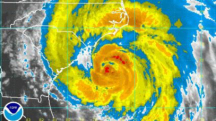
Hurricane Irene as seen from space. Image on loan from NASA.

Posted in Martha's Vineyard | Tagged , , , | 2 Comments

I got home from dinner last night to learn that not only could I not post to the Martha’s Vineyard Times website, all my earlier comments had been removed from the Sheriff’s Meadow story. This is flattering, sure — it’s nice to know that one’s writing is having an effect — but it’s bewildering too. My posts have been mostly about facts: refuting errors, clarifying points, and adding significant details. This is so threatening they have to remove the comments from public view? Usually when comments are removed, “comment removed” or something similar is left in its place. Mine are gone without trace. Wow.

Posted on by Susanna J. Sturgis | 3 Comments

I’ve been blocked from posting new comments to the M. V. Times website. Last straw seems to have been my posting a link to “So Long, Tent,” which demonstrated in words and photos that the structure Ben Ramsey built really was temporary, and it didn’t look much like a shed either.

Posted on by Susanna J. Sturgis | 3 Comments

So Long, Tent

For background info, see “Land Grab” (Aug. 17, 2011) and “What’s Up with the M.V. Times?,” published earlier today.

Much ado has been made about the little structure that Ben Ramsey and Nisa Counter built on their land in Chilmark.

Did they have a permit?
Yes, they did: They explained what they were planning to the Chilmark board of health, and the board of health issued them a permit to operate a tent. Tents don’t require septic systems, but you do have to present a plan for dealing with human waste. Their plan was a composting toilet.

C’mon, is that thing a tent?
It’s called a carpenter’s tent. No, it’s not made of canvas, but it isn’t wired or plumbed either — and it’s removable. Some people have had a real hard time getting their heads around this, so on the theory that a picture is worth a thousand words, I’m going to post six pictures and save me writing, and you reading, six thousand words. With the winds rising and Hurricane Irene contemplating a summer visit, Ben took the tent down this afternoon in about three hours.

The nearly completed tent, at whose appearance the Sheriff's Meadow Foundation freaked out.

The first step was to remove the roof framing.

One person can move a panel. It helps if it's a strong person.

One end is disappearing.

The panels can be stacked in neat piles.

Tent? What tent?


Posted in Martha's Vineyard | Tagged , , , , | 4 Comments

What’s Up with the M.V. Times?

For the background to this post, see “Land Grab,” Aug. 17, 2011.

The story in today’s Martha’s Vineyard Times, posted to the paper’s website yesterday and dated Aug. 24, opens with this sentence: “Massachusetts Land Court Associate Justice Alexander H. Sands Friday granted the Sheriff’s Meadow Foundation (SMF) a preliminary injunction that directs an Island couple to refrain from any further construction activity on property they and the private, nonprofit conservation organization claim to own in the Quenames section of Chilmark.”

Sounds like SMF won one, doesn’t it? What actually happened goes something like this: SMF went into the Land Court hearing with two attorneys, a pile of documentation, and the intent to keep Ben Ramsey and Nisa Counter off the land, period. Ben and Nisa represented themselves, armed only with two affidavits, a deed, and their knowledge of the land. SMF did not get what it wanted. The message I hear loud and clear in the judge’s ruling is “SMF, your claim to this property is not as certain as you think it is.”

In his order, Judge Sands also wrote: “Finally, both Plaintiff and Defendants shall refrain from arguing this case in the press.” His footnote referred specifically to the Martha’s Vineyard Times and the island’s other weekly (semi-weekly in summer), the Vineyard Gazette. Nevertheless, one of SMF’s attorneys, Diane Tillotson, is quoted at some length in the Aug. 24 story. What part of “refrain” don’t these people understand?

And how about “arguing”? What I’ve seen in the island papers so far, particularly in the Times, looks less like an argument and more like the product of SMF’s public relations office. Rather than acknowledge that Ben and Nisa in effect won this round — without lawyers — reporter (and managing editor) Nelson Sigelman, meanders on and on about peripheral issues. Is he in SMF’s pocket? Does he just want to make Ben and Nisa look bad?

I don’t know, and I don’t care. What bugs me — and it bugs me a lot — is that one of our two island newspapers is doing such an abysmal job of reporting the facts in a very important story.

At the same time Sigelman and his editor, Doug Cabral, miss no opportunity to slam Nisa and Ben for using social media to get the word out about their case. When the most widely read newspaper on the island is printing only one side of the story, what are they supposed to do?

#   #   #

The letter you won’t read in today’s Martha’s Vineyard Times:

I’ve long adhered to the maxim “Don’t attribute to malice what can be easily explained by stupidity” — or incompetence — so I’m not going to speculate about why the letter to the editor I submitted to the Times on Monday didn’t get into today’s paper. I am going to print it here, however.

To the Editor:

When I first got wind of what Sheriff’s Meadow Foundation (SMF) was trying to do to Ben Ramsey and Nisa Counter, neither of whom I knew, I couldn’t believe it. I read all the documents I could get my hands on and had a long phone conversation with Nisa. After stuffing my head with facts and mulling them over, I distilled them down to two key points:

(1) Over the last year, Ben and Nisa have tried accommodation, negotiation, and formal mediation to work this out with SMF. SMF has stonewalled their every attempt.

(2) SMF has announced that it has no choice but to pursue the matter in Land Court — the one option that Nisa and Ben cannot possibly afford, but SMF, with its $5.8 million in the bank and its affluent donor base, can.

This struck me as high-handed bullying of the worst kind. Have we on Martha’s Vineyard sunk so low that expensive court battles are seen as the best way to work out our disagreements?

How could Nelson Sigelman have missed this in “SMF goes to Land Court to fight couple’s claim to a lot” (Aug. 18) and the online update, “Sheriff’s Meadow counters couple’s claim to Chilmark lot”?

Last Thursday it seems a judge in Boston reviewed SMF’s own voluminous documentation — and came to the conclusion that ownership is not nearly as clear as SMF claims, hence he would not issue an injunction to keep Ben Ramsey and Nisa Counter off the property that they believe, with good reason, is theirs. Good for him.

In his Aug. 18 editorial, Doug Cabral writes of social media that “it can enhance reputations and damage them.” So can the traditional news media. That’s exactly what the Times is doing: enhancing SMF’s reputation while damaging those of Ben Ramsey and Nisa Counter, with precious little regard for the facts in the case or the general interests of Martha’s Vineyard. Faced with the inadequacy of Times reporting, what are we supposed to do? Shut up?

Of course not. So we’re doing what people invariably do to get the word out when official channels prove inadequate: using the grapevine. The grapevine now includes the internet as well as word of mouth and the telephone: e-mail, blogs, Facebook, and the like. The grapevine now has a reach comparable to that of the official channels. The official channels aren’t comfortable with this. It’s OK with them when Egyptian and Chinese dissidents use the internet to confront those in power, but it’s not OK when we on Martha’s Vineyard use the internet to confront those in power — meaning you. This grapevine is making you look bad, true, but the best way to fix that is to clean up your act.

Susanna J. Sturgis
West Tisbury

Posted in Martha's Vineyard, writing | Tagged , , , , , , , , | 5 Comments

My Tomatoes Are Staring at Me

So I made gazpacho — very good — but the big tomatoes kept coming. Spaghetti sauce, I thought. Almost two weeks ago I laid in the ingredients I didn’t already have on hand: mushrooms, a long coil of hot Italian sausage, a can of tomato purée. I entered “spaghetti sauce” on the week’s to-do list, which I keep in a spiral-bound day book.

I accomplished many things that week, but spaghetti sauce was not one of them. Spaghetti sauce takes time, I told myself. I am too busy. Tomatoes kept coming from the garden, but the old ones were developing black spots on top and squishy patches on the sides. I didn’t dare think what was happening to the mushrooms. I wrote “spaghetti sauce” at the top of the new week’s to-do list.

Twice I cut a lengthy section off the sausage and cooked it up for supper. If I ate all the sausage, I couldn’t make spaghetti sauce and it would then be OK to chuck the tomatoes and the mushrooms into the compost.

The tomatoes kept staring at me. They stared at me while I stood at the counter making tea or buttering toast or stirring my oatmeal. They stared at me while I sat across the room, typing away at my laptop. They knew when I wasn’t working. They knew when I was playing Spider solitaire. You don’t ever want a boss as psychic as those tomatoes.

Having been brought up Low Church Episcopalian and jumped ship by the time I was 13, I often claim to be immune to guilt. This is not true. Those tomatoes were making me feel guilty. You are letting us rot, they said. It wasn’t about children starving in Africa, Asia, or any other place. It was about waste, it was about neglect. Finally it dawned on me: I was afraid of my own tomatoes.

I was also afraid that the mushrooms had turned to black icky in the fridge. Black icky isn’t as bad as the gelatinous goo that long-neglected celery turns into, but it’s not pleasant either.

Last night I got brave. I rose from my computer and started pulling pots out of the cupboard: the big stock pot for the sauce, a smaller saucepan in which to boil water and peel the tomatoes. Once I got that far, the rest was easy. Time-consuming but easy. The mushrooms were way past their prime but still usable. The squishy places and black spots on the tomatoes could be cut away. I brought in basil and Greek oregano from the garden. A couple hours later I had some tasty sausage-mushroom spaghetti sauce and the apartment smelled great.

There are four big tomatoes on the counter. All were picked within the last three days. They are not staring at me.

Yet.

Posted in home | Tagged , , | 5 Comments

Dog Day at the Fair

The Fair is like a tiny town,
No sooner built than taken down.
Dan Waters, “Affair with a Fair”

The Agricultural Fair put on annually by the Martha’s Vineyard Agricultural Society (MVAS) has to be the big event on the island calendar. It lasts four days, always the third long weekend in August, and if there’s any Vineyarder it doesn’t touch in some way, it’s because that Vineyarder is working very hard to avoid it.

Proofreader wanted?

For years the fair was three days long. Some were always pushing to add a fourth day, but it wasn’t till the year that torrential rains cancelled Thursday by flooding the new fairgrounds on Panhandle Road that the fair was extended through Sunday. (Someone give me a date here — 1997, 1998?) Ever since, Sunday has been informally known as islanders’ day at the fair. You know or at least recognize almost everyone you see. It’s the day of the draft horse show, and the women’s skillet throw, and the huge AKC-unrecognized all-breed dog show. For island dog people, Sunday is dog day at the fair.

HQ tent at the Positive Rewards booth

This is the third year that Trav and I have helped our instructor, Karen Ogden, with the Positive Rewards “booth” at the fair. (Trav is only three and a half; like many fairgoers, he started young.) This year we started setting up on Saturday evening, delineating our performance and chill-out areas with stakes, snow fencing, and lots of zip ties. Plenty remained to be done on Sunday morning, so we gathered at 7 and got to work erecting the little tent, hanging signs, and (big one) setting up the agility equipment. Agility equipment is bulky and heavy and includes myriad pieces of PVC pipe that fit together to form jumps and other obstacles. There is a reason that Karen not only drives around in a big Tacoma pickup but also hauls a good-sized utility trailer.

Dundee emerges from tunnel

Agility demonstrations — always a big crowd-pleaser — started at 10. Katy Upson and her Scottie, Dundee, who just started competing in agility this year, showed everyone how it’s done. Karen worked her Aussies, Austin and Nolan, and Julia Humphreys her Golden, Xochi. Willow, the agility star of our group, didn’t arrive till early afternoon, so we didn’t get to see him go.

Around 11:30, we removed some of the competition-caliber equipment and lowered heights on some of the rest, so novice teams could try it out. Karen coached and almost certainly attracted a few recruits for fall classes. Trav and I did an intro agility course over a year ago; there hasn’t been an intermediate class since then, and we aren’t ready for advanced. So we ran the beginner’s course a couple of times. Trav was focused and willing and apparently oblivious to the rotating, clutch-grinding Ferris wheel looming off to the right.

Trav hangs out in his crate

In the afternoon Karen set up a Rally Obedience course. This is Trav’s and my chosen sport and we work hard at it. In Rally, the first level is performed on leash, the upper two levels off. Trav and I are working off-leash, but the fair is a high-distraction environment, what with the Ferris wheel, passing kids, dogs, and golf carts, the draft horse show going on nearby, etc. I draped his leash over his back so I could grab it if need be. I didn’t have to. We ran the intricate course twice, and I was so proud of my puppy.

The first three days of the fair go till 10 p.m. Sunday ends at 6:30. It was hot, the dogs had had a long day — we started our “strike” around 4. (I took Trav home first.) What a wonder. We’ve done this together for several years now; we’re getting to be a real team.

Agility equipment, dismantled

Karen’s training facility, in the Woodland Marketplace off State Road in Vineyard Haven, isn’t big enough for agility, so she teaches in different places, like at the Ag Hall, and, in winter, in the indoor arena at Arrowhead Farm. Everything is portable. That doesn’t, however, mean that it’s light.

Nancy Rogers helps lower the tent.

Just about everything, from the tent to the dog walk to the ex-pens and crates, is waiting to pinch the fingers of the unwary. Nevertheless, this stuff is designed for sturdiness, ease of set-up, and packability.

See what I mean?

And when we finished, it was as though we’d never been there. Amazing. The whole fair is like that: Faery comes to rest on this magical parcel of land, where feasting and singing and dancing proceed for four days, then vanish into the ether. We all adjourned to Julia’s to celebrate the day with champagne, beer, wine, crackers and dip.

Posted in Martha's Vineyard | Tagged , , , , | 3 Comments