On Martha’s Vineyard “ATM” stands for “annual town meeting” at least as often as for “automated teller machine.” We have that kind of ATM too, but I deal with non-automated tellers whenever possible because the ATMs (1) don’t know my name, and (2) don’t dispense dog biscuits.

From left: executive secretary Jen Rand; selectmen Cindy Mitchell, Skipper Manter, and Richard Knabel; town counsel Ron Rappaport; and (standing) moderator Pat Gregory. Microphone in foreground is for citizens speaking from the floor.
In the town meeting form of government, the town’s voters function as a legislature. Each island town has a board of selectmen, a finance committee, a planning board, and various other boards and committees whose members are either elected or appointed by elected officials. These boards and committees do the heavy lifting, preparing budgets, drafting rules and regulations, etc., etc., but whatever they recommend has to be approved by town meeting before it goes into effect.
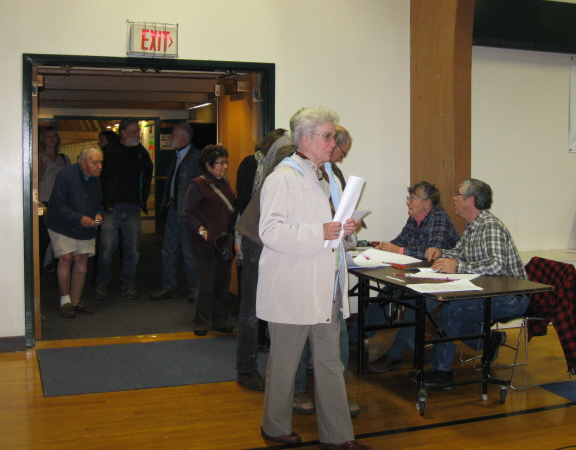
West Tisbury voters arrive for last night's special town meeting. Ginny Jones and Tony Rezendes check each one's name against the voter rolls.
Having grown up in Massachusetts, I’ve known about town meeting government all my life. My father and my grandmother were town meeting regulars. This may be one reason that for me voting is not the be-all and end-all of democracy. Going into a voting booth and making Xes — no hanging chads on Martha’s Vineyard; we vote on paper ballots — is a pale substitute for going to town meeting and listening to your fellow citizens orate for this or against that and occasionally get into rhetorical skirmishes with each other.
Not that I idealize town meetings, however. Not long after I moved to Martha’s Vineyard, maybe around 1988, I sat in West Tisbury’s ATM and listened to my fellow citizens go on for about 45 minutes about snowmobiles in Christiantown (a part of town with lots of woods). The school budget, in contrast, was approved in less than 15 minutes, with a few questions but almost no discussion. As a result I came up with “snowmobiles-in-Christiantown syndrome,” which holds that the amount of time and energy consumed by an issue is inversely proportional to its practical importance. To argue with the school budget, you have to know what you’re talking about: the school committee and the finance committee have been laboring on the thing for many weeks, and to take issue with their recommendation you have to know almost as much as they do. To rail against snowmobiles in Christiantown (or dirt bikers in the state forest), all you need is an opinion.
In the years since I have come to believe that snowmobiles-in-Christiantown syndrome is so common in human gatherings that it must have other names in other places. Nevertheless, that is what I call it.
So at West Tisbury’s special town meeting last night — spring is annual town meeting season in New England, but a town may call a special to deal with business that comes up between ATMs — the hot issue on the warrant was dog poop on Lambert’s Cove Beach. Between June 15 and September 15 (“the season”) dogs have been allowed on the beach before 10 a.m. and after 5 p.m. Article 2 on the warrant proposed that dogs and horses not be allowed on the beach at all during the summer months.
This is not the first time the issue has come up in town. The parks & recreation committee, under whose jurisdiction the matter falls, is clearly frazzled by years of attempting to balance the passionate desire of dog owners to run their dogs at the beach, and the equally passionate desire of other beachgoers not to step in dog shit, get knocked down by dogs, and/or have dogs scamper across their picnic blankets. I rarely go to the beach, and heavy-coated Travvy is not a beach dog, so I didn’t (so to speak) have a dog in this fight. I just listened.

West Tisbury voters in the West Tisbury School gym
Some people talked as if the beach was practically paved with dog droppings, and that a kid couldn’t dig in the sand without encountering a, uh, beach cruller. Others said that they knew families with children who no longer went to the beach because of the dogs and dog droppings. Oddly enough, or maybe not so oddly, these arguments made me think of pro-roundabout people who freak out at four-way stops and anti-roundabout people who freak out at roundabouts. This is shifty ground to build an argument on: What does the beach actually look like? I wondered. I wished I’d been there more recently to see for myself. I thought about asking if the number of beach stickers sold was down, but I was so sure the answer would be no that the question seemed rude.

Moderator Pat Gregory, master of parliamentary procedure
A motion was made to amend the article to allow dogs before 10 a.m. but not after 5 p.m. I voted for the amendment. It failed, 54 for, 80 against. The voice vote was close enough that moderator Pat Gregory called for a hand count. The next motion was to table the article till spring. I voted for that too. It failed, 63–66. Finally the article itself came up and was debated. It passed on another close vote, 64–61. I was one of the 61.
The other nine articles on the warrant combined took up less time than the beachgoing dogs. We voted to accept the gift of the Mill Pond dam from the M.V. Garden Club; the town has been maintaining it for years, and it only came to light recently that the Garden Club actually owned it. We moved some money from this line to that line and voted $10,000 to evaluate a contract “for the financing, construction and maintenance of a solar photovoltaic array at the Town landfill that will provide power to Town buildings.”
We agreed that on-call police officers should be paid $75 per shift and created the position of lieutenant in the WTPD, in part to assist the chief with administrative tasks and also to provide incentive for career-minded officers. And we approved the expenditure of $1,000 for maintenance of the Greenlands, a conservation property owned by the town at the edge of the state forest, and also to put up “No ATV” signs even though nobody expects these will do any good.













 From the Seasonally Occupied Territories . . .