Clueless in Candidateland

Classic story beginning: “Remember the night we all got drunk and . . .”

Followed by the often hilarious recounting of adventures that made perfect sense at the time but in retrospect look totally off-the-wall.

Way back last spring I decided to run for the Martha’s Vineyard Commission (MVC). I was stone-cold sober at the time. I was stone-cold sober when I collected my signatures, trotted them down to the town clerk’s office for certification, picked them up duly certified, mailed them to the secretary of state’s office, and received back a piece of paper assuring me that I was duly and truly on the ballot.

At that point “the season” was upon us. I’d think about the next step(s) when Labor Day rolled around.  Labor Day rolled around more than three weeks ago. I’ve been trying to talk myself into thinking about the next steps. It’s like dragging a horse toward a flapping tarp that she knows is trying to kill her.

So a few days ago I started taking those next steps. I want to print a postcard-size handout with my photo on one side and a few words about who I am and why I’m running on the other. Printing such a thing costs money. Spending money, even your own money, gets you into the realm of — eeek! — campaign finance. So I’m now staring at copies of Campaign Finance Guide: Candidates for Municipal Office and Form CPF M 102: Campaign Finance Report — Municipal Form.

Records to keep. Reports to file. Opaque lingo that takes a while to puzzle out. And frequent reminders that “violations of the law carry serious penalties of fines, imprisonment, or both.”

Political committees aren’t required — except for public employees, who “are prohibited by law from political fundraising, even for their own campaigns.” Should I have a committee? If so, is it enough to say “I dub thee My Committee,” name a treasurer, and file Form CPF M 101? Does the committee need a bank account? Should I have a separate bank account? What a hassle.

In my mind the phrase “campaign finance” is inevitably followed by the word “reform.” It being a presidential election year, millions upon millions of dollars are being poured into various campaigns. Word has it that the race for the U.S. Senate seat in my state is the second-most expensive in the country, with only the race for the Oval Office attracting more millions. So many of those millions are going to pay for lies and distortions, whitewash and evasions . . .

This is no secret. What hadn’t really dawned on me before is how the various attempts to make campaign finance more transparent complicate things for bit players like me, whose campaign budgets are reckoned in the hundreds, not millions, of dollars. And without fixing the mess at the state and national level: the serious players have legal and accounting teams devoted to making the system work for them, because they can’t afford to do otherwise.

On the whole, I’m glad I didn’t know about this before I decided to run for MVC.


Posted in public life | Tagged , | 4 Comments

The Key Sestina

This poem came back to me while I was writing yesterday’s blog. When I lived in D.C., my keys wore holes in the hip pocket of my jeans. On Martha’s Vineyard I carried no keys at all. This might have been the single biggest difference between here and there — along with the not-unrelated ability to walk wherever I wanted, whenever I wanted, without worrying about my personal safety. When I wrote “The Key Sestina,” I’d only been here a few months.

My city apartment needed four keys,
the mailbox a fifth. Two for each of two
jobs, and a tenth for my bicycle chain.
A fine rattle they made, a heavy weight
in my pocket. There was one key whose lock
I’d forgotten. I would not throw it out.

My island friend spends the whole day out,
leaves her door open, needs only the keys
to her car. My new apartment won’t lock
from the inside; I still sleep well. Here too
my ten-speed bike leans against the wall, wait-
ing for me, sheltered from rain, but not chained.

It’s strange at first, leaving padlock and chain
behind, stopping by my friend’s when she’s out
to use her phone. I miss the clanking weight
in my pack, the rattling of all those keys.
Each of them meant commitment, access to
home store, office, women’s center, all locked

against the untrusted. I knew that locks
won’t stop everybody. The severed chain
remains; the bike is gone. In less than two
months my house was robbed three times. We were out
at work, we’d locked the doors, we had our keys;
the burglar had none but he didn’t wait

for us. Perhaps it’s only custom’s weight
that makes a barrier of a door that’s locked.
When my mother drank, I’d hide her car keys,
not knowing she had a duplicate chain.
Once in a muted rage I put them out
in plain sight. Did I want her dead? or to

end my responsibility? These two
options nag twenty years later, their weight
unsettled. I visit, after years out
of New England, her house, whose door is locked
always. My mother from her extra chain
detaches and gives me a front door key.

Says the keeper’s jangling chain, “Just wait.
I can split the world in two: danger
locked out, comfort kept in — or vice versa.”

November (?) 1985

My current keychain. Car key, mailbox key, and I’m not sure what the key in the back is for. It took me a while to get used to the remote lock/unlock gizmo. #1 lesson: Make sure the keys are in your hand when you lock the car.

Posted in Martha's Vineyard, writing | Tagged , , | 4 Comments

Insularity

When I moved from Washington, D.C., to Martha’s Vineyard in 1985 — just for a year, mind you — I expected some culture shock. D.C. is a big city. In the mid-1980s, more than three-quarters of the population was black. I lived and worked in the women’s community and had infrequent dealings with men. I got around by bike and foot and public transportation; I didn’t own a car.

Sure enough, there were differences. To my newly arrived eye, nearly all the women on Martha’s Vineyard looked like dykes: they wore jeans, flannel shirts, and sensible shoes, just like me. My jaw dropped whenever someone asked if I was married. You don’t get questions like that when you work at a feminist bookstore. When I said, “No, I’m a lesbian,” then the questioner’s jaw would drop because in the mid to late 1980s on Martha’s Vineyard no one ever said “lesbian” in public.

The Bourne Bridge. We live on one side. They live on the other.

But the longer I was here, the more similarities I noticed. Vineyarders, like the women’s communitarians, liked to emphasize how different we were from everybody else. Run into another Vineyarder, say, at the Burger King in Falmouth and it was like greeting long-lost kin, even if you didn’t especially like each other. Ditto when one lesbian feminist encountered another at a suburban mall or a chamber music concert: “We are everywhere!” we’d chortle, feeling like comrade spies behind enemy lines.

Vineyarders and lesbians also shared a penchant for serious hair-splitting on the matter of who belonged and who didn’t, and what degree of belonging one was entitled to claim. On the Vineyard it was a matter of how long you’d been here, whether you’d grown up here and/or been born here, and how many generations of your family could say likewise. Among lesbians, it was when you’d come out and whether you’d ever slept with a man.

Insularity, I concluded, was not peculiar to islands.

This past weekend, Trav and I went off-island to compete in a Rally Obedience trial in Westford, Mass. Westford is on the northern arc of 495, not far from New Hampshire and almost a two-hour drive from Woods Hole. Vineyard people like to talk about how strange and even scary things can be off-island, so I was pleased to find that I can still cruise at 70 mph and merge into high-speed traffic on the interstate. For years I was intimidated by self-serve gas stations — we don’t have those on Martha’s Vineyard — but no longer. Did I stick out in any way because I’m a year-round Vineyarder?

Not that I noticed. My credit card was accepted by the Motel 6 credit-card swiper. I made myself understood to the desk clerk; she made herself understood to me. I managed to make the card key open my room door. Hitting the Wendy’s across the road for a spicy chicken fillet combo two nights in a row was a special treat, but I didn’t tell the cashier that.

Susanna in sensible clothes; Travvy dressed for success. Rally trial, Littleton, Mass., October 2011.

At the trial, there was nothing distinctive about my clothes, my shoes, my size, my hair. We didn’t all look alike, but I was firmly in the ballpark. Dog people, like Vineyard people, tend to dress practical. They dress more country than city. This was true of many urban women’s communitarians in the 1970s and ’80s. Nearly all my life I’ve gravitated to places where I can dress in barn clothes, which is to say jeans, sturdy shoes or boots, flannel shirts in season.

True, I was almost certainly the only one watching the clock late Sunday afternoon and hoping that my last class, the last class of the day, would be over by 6 p.m. so I could make the last boat, the 9:45, without having to break any land-speed records. It was, and I did; in fact, I made it onto the 8:30 even though I stopped to gas up in Falmouth. Gas costs at least 60 cents more per gallon on this side of the water, so I feel like I’m putting one over on the universe when I can fill a nearly empty tank on the other side.

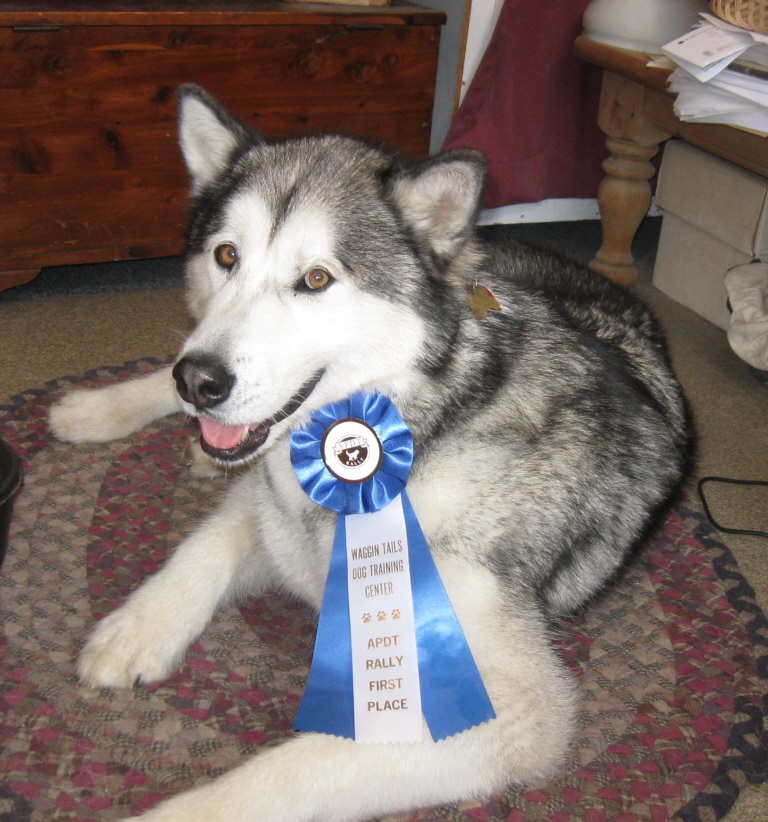
Travvy with the second leg on his Rally Level 3 title.

Come to think of it, Rally-O is something of an island within the larger world of dog sports, within the still larger world of dogs. I attended my first Rally trial, and my first dog show, a scant three years ago. I’m a novice, but I’ve picked up enough of the lingo to understand what people are talking about and even to make myself understood. “After three NQs, we finally got the second leg on our RL3 title”: that would make perfect sense to anyone at last weekend’s trial. People in other dog sports might not know that “RL3” means “Rally Level 3” but they’d know that an NQ is a non-qualifying run and that a leg is one step toward a title. (Three legs generally earn a title, which seems a little odd given that dogs have four legs and humans two; is three a compromise?) But to non-dog people that sentence would be incomprehensible. Four years ago I wouldn’t have understood it either.

Few of us, it seems, live on a single island. Rather we live on archipelagoes, paddling back and forth between islands. Most of us probably live on several islands at once.

Posted in dogs, Martha's Vineyard, musing | Tagged , , , , , | 6 Comments

In the Midst of Life

My blog posts usually start with a kernel, a seed, something nagging at the back of my mind. Words coalesce around the irritant, and though pearls rarely result, insight often does. At least the irritant becomes less irritating.

Since the primary election nothing has been coalescing. There’ve been few kernels for them to coalesce around. It’s not that nothing has happened. Plenty has happened, but it’s too big to chunk down to kernels and my personal connection with it is minimal. When I have no personal connection, I don’t have much to add. There are already so many words out there.

The U.S. ambassador to Libya was killed in an attack that may or may not have had something to do with a stupid film whose genesis still isn’t entirely clear. The incident has been drowned in words, and I’m not sure they’ve advanced our understanding much. I’m intensely irritated by the people who think that religion in general and Islam in particular are the problem. If these people had a clue about Europe’s imperial meddling in the Arab world, if they thought a moment of the consequences of the West’s lust for oil, they would realize that the touchiness of some Muslims about Islamophobic films is not entirely rooted in the Qur’an.

This, however, has nothing to do with year-round Martha’s Vineyard, about which I am blogging.

On second thought, maybe it does. From time to time, I dip into the comments on the Martha’s Vineyard Times website. Touchy? I’ll show you touchy. Some posters over there go off the wall at the drop of a hat, and they don’t bother to get their facts straight either. Few if any of them have even a passing acquaintance with the Qur’an. What they’ve learned on talk radio doesn’t count.

Travvy is very good at sleeping.

So Travvy and I are off-island at a Rally trial in Westford, Mass. I’ve seen a few political bumper stickers on the highway and passed a few lawn signs on the minor roads, but mostly I’m hanging out in a world where the politics being discussed have to do with various organizations devoted to dogs and dog sports, and there isn’t much of that either. Mostly we’re supporting each other and trying to learn from each other and sympathizing when one of us screws up.


Trav sacks out at the Motel 6. Hell with the beds: he likes the floor.

Trav and I NQed twice today at Level 3. NQ means “not qualified.” Both times we NQed on the same exercise, directed jumping. This was disappointing for sure, but otherwise our runs looked pretty good. This is encouraging, because Level 3 is hard. Once upon a time, Level 2 was hard, but now Level 2 looks — well, not exactly easy, but we’re pretty consistent at it. Other teams were NQing all over the place, often on the same exercise. Misery does love company, and no one threatened to blow anything up. I have no idea who anyone intends to vote for in November.

So I was away from the computer all day. Didn’t miss it. After I’d unpacked the car, fed Travvy, and hit the Wendy’s across the road for the second night in a row, I logged on and checked e-mail. Thus I learned that Todd Follansbee had died yesterday afternoon, suddenly, unexpectedly. He was exactly my age, 61. He was one of the key organizers of last year’s wonderful birthday bash at the Ag Hall for everyone who turned 60 last year. He’s been making other things happen too, usually with music involved. Of course I thought he’d be doing it for another two decades at least.

I’m at the Motel 6 in Leominster but very much caught up in the Vineyard web.

Media vita in morte sumus. In the midst of life we are in death. Don’t waste it, people.


Posted in dogs, Martha's Vineyard, musing | Tagged , , , , , | Leave a comment

Primary

That’s me, standing out at Five Corners last Saturday.

I’m sorry to report that Sam Sutter lost his Democratic primary race to represent the new Massachusetts 9th District in Congress. The upside is that Bristol County gets to keep its hardworking and effective district attorney.

I blogged last month about why I was supporting Sam. All of what I wrote then is still true.

In case anyone didn’t notice, the Democratic National Convention was going on in Charlotte, North Carolina, as the Massachusetts primary campaign headed into the homestretch. I don’t have a TV and so didn’t watch it unfold, but I have been catching up with the speeches. They’re rousing and inspiring, the way speeches should be. Comparing the faces in the crowd with the faces at last week’s Republican National Convention, I can’t help thinking: These are my people.

Watching those faces as former Arizona congresswoman Gabrielle Giffords took the stage to lead last night’s assembly in the Pledge of Allegiance — well, I had tears streaming down my own face. Giffords was nearly killed in a January 2011 assassination attempt. She’s had a hard, hard struggle back to life. Last night, crossing that huge stage in front of thousands of people, she was assisted by her friend, DNC chair Debbie Wasserman Schultz. What I saw in those faces was love and encouragement and identification. They were with her all the way.

Giffords’s life was changed forever, and nearly ended, by one crazy fanatic with a gun. The U.S. has been changed radically by a cabal of white guys with a lot of money. And for all of us the long, hard road to recovery has to be a collective effort. None of us got to where we are alone, and we can’t get out of the mess we’re in alone. (Note to John Donne: What you said about no man being an island? You were right.)

That was the message of speech after speech, and you have to know I’m 100% behind it because that was the message that made me an Elizabeth Warren supporter last fall. And yet, and yet —

Where my town votes: the Emergency Services building on State Road, West Tisbury.

“As above, so below”? Because I’ve been involved in the primary campaign, and because I’ve been involved in the struggle against the roundabout for the last umpteen months, I’m not getting too swept away by partisan rhetoric. I nearly always vote for Democratic candidates, but I don’t vote for anyone just because s/he’s a Democrat. Sam Sutter’s opponent, Bill Keating, looked mediocre to me before the primary. He still looks mediocre. The state party functionaries backed him. That makes them look mediocre. How to reconcile this with all the inspiring speeches I’ve heard this week?

I don’t think much of the state senator and representative representing Martha’s Vineyard on Beacon Hill either. They’re both Democrats. No one ran against either one of them in the primary.

West Tisbury poll workers

I was wholeheartedly for Sam Sutter. I’m wholeheartedly for Elizabeth Warren and President Obama. No, I don’t think they’re perfect. As Holly Near put it in her concert here in July, I don’t expect to find a candidate I can agree with 100%; I’m looking for one I’m willing to struggle with. But I am for them.

What I’m finding is that the experience of voting for someone I’m genuinely for has spoiled me. It’s raised my expectations. It’s made me even more reluctant to vote for mediocrities and hacks.

In a saner political world, there would be a choice other than Democrat, third party, write-in, and “none of the above.” Massachusetts is pretty much a one-party state. One-party states aren’t good for the state and they aren’t good for the party, which in this case is the Democrats. Hacks and mediocrities proliferate in one-party states. The electorate gets taken for granted.

Why not vote Republican? In a saner political world, that would be an option. The Massachusetts I grew up in was a saner political world: the state’s GOP ranks included Ed Brooke, Frank Sargent, John Volpe, Elliot Richardson . . . Even now, if I lived in the Mass. 6th Congressional District, I would probably vote for Richard Tisei, who is gay, pro-choice, pro-same-sex marriage — and Republican.

But the national Republican Party these days is a genuinely scary outfit. (Tisei is probably giving Grover Norquist, Karl Rove, John Boehner, et al. apoplexy: another reason to vote for him.) In local races, it might be possible to “vote for the individual,” but in statewide and/or high-profile races? No, it’s not. Individuals who get elected to a legislative body can buck their party only so far. Even more important, they’re beholden to their financial backers if they ever plan to run for reelection.

As above, so below? The last few decades have proven conclusively that wealth doesn’t trickle down, at least not very far. Having listened to the speeches at the Democratic National Convention, I hope inspiration and determination do a little better.

Poll workers keep an eye on The Box (right), into which all our ballots go. We vote on paper ballots in my town. No chads, hanging or otherwise.


Posted in Martha's Vineyard, public life | Tagged , , , , | 4 Comments

A Miracle

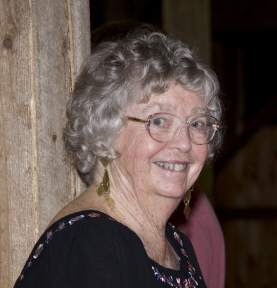
Shirley W. Mayhew

This guest blog is by Shirley W. Mayhew of West Tisbury. Shirley is, among other things, a wonderful writer and photographer whose work has appeared in Martha’s Vineyard Magazine and other publications. She brought “A Miracle” to Cynthia Riggs’s Sunday night writers’ group, which we’re both in. I loved it. I asked her if I could publish it here. She said yes — and found the photographs that appear with it. Thanks, Shirley! SJS

It seemed like a miracle. Well, maybe it was a miracle, but miracles are tricky and can be defined in many ways. Sometimes a miracle is described as astonishment at a thing we see as an effect without knowing the cause. Long ago people considered it a miracle when the sun disappeared during an eclipse. Now that we know the cause of an eclipse, we understand that it is not a miracle.

My miracle was a very small one, as miracles go. But it gained stature because a crowd of about 75 people witnessed it. It took place at the end of July in, of all places, a cemetery. A miracle in a cemetery? A dark and stormy night when bodies rise out of their graves? This wasn’t that kind of miracle.

Shirley and Johnny at their 60th anniversary celebration at the Ag Hall, September 2007

But my small miracle did take place in a cemetery, in broad daylight, at around four in the afternoon. My husband, Johnny, died in early January of this year. We decided to wait until summer to bury his ashes so that his granddaughters could all be here, as well as some summer friends who might not have been able to make it in winter. It wasn’t meant to be a funeral, a sad affair, but a celebration of his life — all 91 years of it.

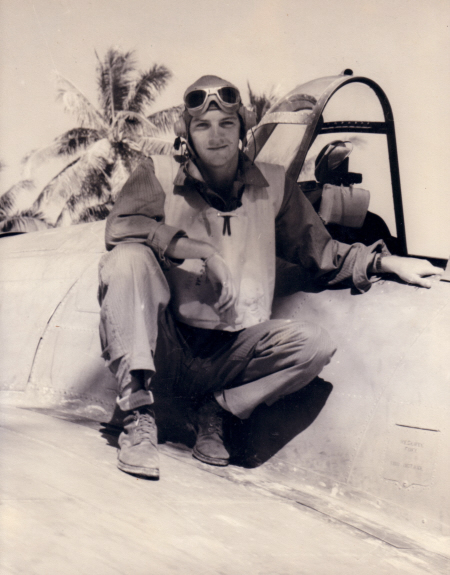
Johnny on the wing of his Corsair, 1942 or 1943

Johnny had led a rich and full life. After he spent his childhood and youth halfway around the world in Asia, and then spent three and a half years as a U.S. Navy fighter pilot in the South Pacific during World War II, he wanted nothing more than to live quietly on Martha’s Vineyard, the land of his forebears, for the rest of his life. I married him in 1947 and we celebrated 64 years together. We had a son and two daughters, and three granddaughters, and lived in a small town, in the same house for 55 of those years. He was 60 before I was able to get him off Martha’s Vineyard — to another small island in the Caribbean for a winter week.

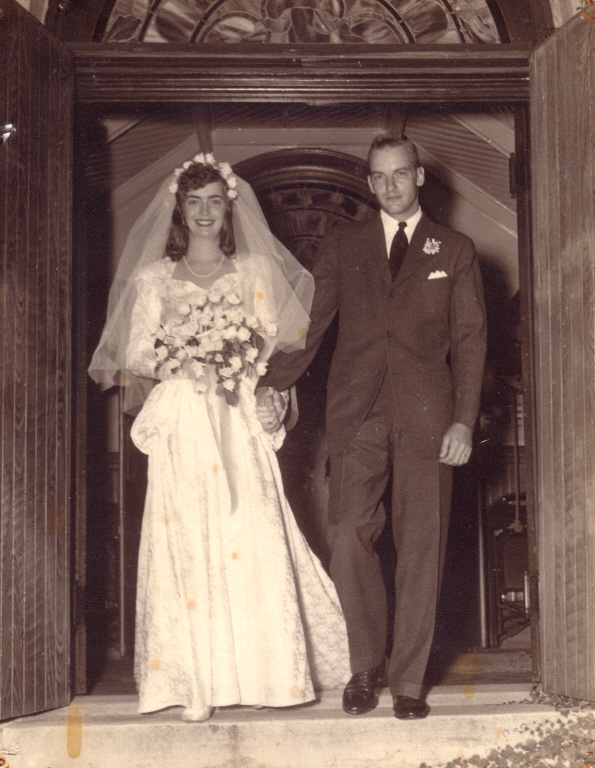
Shirley and Johnny on their wedding day, September 6, 1947

In the 1950s he worked for almost 10 years trying to grow oysters commercially in Tisbury Great Pond. Then, unable to see ahead to oysters paying for years of college expenses, he taught math in our regional high school for 27 years. During that time he served as a selectman in West Tisbury as well as on a number of town committees. Then he enjoyed more than 20 years of retirement.

During all these years he found relaxation and joy in being outdoors, fishing, hunting, scalloping, lobstering, oystering, clamming — and even chopping wood for our fireplace.

Look’s Pond, from the cover of Shirley Mayhew’s 1973 book about it

Our home bordered a small pond, and each spring and fall it was our great pleasure to hear the Canada geese approaching the water, cupping their wings and landing, with loud honking, on the smooth surface of the limpid pond. Although he enjoyed hunting ducks and geese with one of our resident golden retrievers, and we enjoyed many duck and goose dinners, the whole family revered the birds that chose our pond to feed or rest upon. There was no hunting around Look’s Pond. Several wintered over one year as they recovered from wounds suffered during the hunting season.

Back to my miracle. The Navy provided full military honors at Johnny’s graveside service. An honor guard stood at attention holding their flags high, there was a three-gun salute, and a bugler stood on a rise and played Taps. We had requested a flyover as Johnny had been a Navy fighter pilot, but found out that one got a flyover only if one was killed in action. The Navy also supplied a chaplain, and a large crowd of family and friends surrounded the gravesite.

As the chaplain prepared to say the first word, I heard honking coming from the direction of our pond and home. I looked up, and then everyone looked up as a perfect “V” formation of loudly honking Canada geese flew directly over us. A lone duck, flying with them, peeled off directly above us, and went off in another direction, as one of the flyover planes would have done, to represent the fallen serviceman. Everyone was silent, watching the geese above us, and then spontaneous applause erupted. When the clapping was over, the chaplain began the service.

Was it a miraculous event? I don’t know, but my belief system was seriously stirred up on that Saturday afternoon.

The Mayhews have been playing music together and with friends for many decades, so Johnny’s memorial service was followed by an old-style West Tisbury “musicale.” From left: Tom Hodgson, granddaughter Lucy Mayhew, son Jack Mayhew (Lucy’s dad), granddaughter Katie Mayhew, and Mark Mazer. Behind Mark is daughter Deb Mayhew (Katie’s mom).

Posted in Martha's Vineyard | Tagged , , , | 9 Comments

August License Plate Report

Nothing to report. No new plates, no new states. The map is no more green than it was at the end of July. It’s no less green either, true. This is good, but it’s also not surprising. Once a plate’s been spotted, it can’t be unspotted.

What’s done cannot be undone, said Lady Macbeth. Or something like that.

What does it mean? What it does not mean is that the island was not swarming with cars. (How’s that for a double negative?) It was, but of course. The month just past was August after all. What it means is that where I was, the cars were not; where the cars were, I was not. This is good.

This morning, however, I saw lots and lots of cars. I took my born-again politico self down to Five Corners, the veritable Heart of Traffic, for a standout on behalf of Sam Sutter, Democratic candidate for Congress from the brand-new 9th Massachusetts Congressional District.

Out of all those dozens and hundreds of cars and trucks, the most exotic plates I spotted were Illinois and Tennessee. Not exotic at all. Massachusetts dominated, and many, many of the Mass. plates were clearly local. After that it was the usual suspects: Connecticut, New York, and New Jersey, interspersed with Pennsylvania and the northern New England states.

Maybe all the hard-to-spot states really did vanish at the end of July.

ISO Mississippi, New Mexico, Nebraska, Montana, Hawaii, South Dakota, and North Dakota.

A new congressman would also be good. The primary’s next Thursday, September 6. If you’re taking a Democratic ballot, do consider voting for Sam Sutter.

And call me if you see any of those AWOL states.


Posted in license plates, Martha's Vineyard, public life | Tagged , , , | 2 Comments

Viva the Ape Woman

May Oskan’s rock opera The Ape Woman had its world premiere at the Pit Stop last night and all I can say is WOW. GO SEE IT.

No, I lied. That’s not all I can say. There’s only one more scheduled performance — tonight! — and though the word was last night that it might be held over, and last night’s performance was being recorded, not everybody is going to get to see it. So I want to say a couple of other things.

May Oskan, who grew up here and is currently living, clowning, and generally being creative in San Francisco, not only wrote and directed, she also sings the demanding lead vocal part. May has sung backup for her sister, the accomplished and celebrated Nina Violet, but her voice was a revelation: rich and expressive, both solo and in harmony.

And that’s where the wonder of The Ape Woman gets even more wondrous: singing harmony were Nina and younger sister Marciana Jones. Nina also (of course) played viola in the stellar Pit Orchestra, which was far more than a backup band. Marciana played autoharp, May played ukulele, and yes indeed, back there on guitar was Michele Jones, the mother of the three.

And presiding over the Pit Stop was Don Muckerheide, who happens to be May and Nina’s father. If you’re getting the impression that there’s some serious synergy going on here, you’re right — but it doesn’t stop there. In its incarnation as a community-based performance space, the Pit Stop is still a few months shy of its first birthday, but already it’s a cauldron for creative fermentation. Most (all?) of the performers have been involved with the Pit Stop in other ways: accomplished keyboardist Adam Lipsky organized the summer Sunday night jazz series, recording tech Anthony Esposito hosts the popular Monday night open mike, and Nina Violet both recorded and launched her wonderful 2011 CD, We’ll Be Alright, here. And so on.

Writing may be a solitary endeavor, but knowing she could tap into such a cauldron must have helped inspire May Oskan to push her material further and further, until it became the remarkable ensemble piece that is The Ape Woman.

Like I said before: WOW. GO SEE IT.


Posted in Martha's Vineyard, music | Tagged , , , , | Leave a comment

Laureation

I hoped I’d made that word up, but no such luck: poets can be laureated, making them poets laureate, and the act of doing so is laureation. The dictionary says so.

Laureation, specifically the laureation of poets, is enjoying a resurgence on Martha’s Vineyard these days. Well, more accurately it’s a surgence, since I don’t believe we’ve experienced one before. Aha! Merriam-Webster’s Unabridged (online) doesn’t list “surgence,” and “surgency” means something different: “a personality factor characterized by quickness and cleverness.” Maybe I’ve made up a word after all.

At any rate, I’ve been wondering what it all means.

Dan accepts the Creative Living Award, October 2011.

Some years ago West Tisbury named Dan Waters its poet laureate and all was right with the world. Dan was the town’s poet laureate before anyone thought of creating the position. The trouble came when it came time to name his successor. His successor was a fine poet, but West Tisbury’s poet laureate? I recognized her name but I couldn’t have quoted a line from one of her poems or even said anything intelligent about her work. It wasn’t, in other words, part of my Vineyard life.

The poet laureate thing has proliferated. Last December, Edgartown got a poet laureate, Steve Ewing. I like what I’ve seen of Steve Ewing’s poems, and I like his attitude even more. His reaction to his appointment? As quoted in the Vineyard Gazette, “I don’t know what to say,” said Mr. Ewing. “I’m really honored. Poet laureate is kind of a fancy term . . . I’m just a local kid who likes to write.”

Lee Mccormack reads at the Vineyard Haven Public Library.

Now Martha’s Vineyard has one too. I went to hear him read the other night. His name is Lee Mccormack. He’s a very good and dedicated poet. If Martha’s Vineyard has to have a poet laureate, Lee is at least as worthy as any. Besides, he’s one of the first poets I heard read after I moved here. Back then he was one of the Savage Poets of Martha’s Vineyard, along with the late George Mills and Michelle Gerhard, now Jasny, who is also Travvy’s vet and the author of the Visiting Veterinarian column in the Martha’s Vineyard Times.

Isn’t it cool, all this attention being paid to poets, and poetry? It must mean that poetry is alive and well on Martha’s Vineyard, right?

I don’t think so. I suspect that this poet laureate proliferation is a sign that poetry on Martha’s Vineyard is so feeble that it has to be propped up with titles. Unlike the poets laureate of West Tisbury and Edgartown, who have been quietly appointed by their respective boards of selectman, the selection of the whole island’s poet laureate was surrounded by considerable hoop-de-do. First, as I understand it, came the establishment of the Martha’s Vineyard Poetry Society. Then came appearances before various regional boards. Eventually judges were chosen, submissions solicited from aspiring laureates, and various stages gone through, leading eventually to Lee’s selection as Martha’s Vineyard’s first poet laureate.

Where will it all go from here? Will poetry become more visible in the island’s public life? Will more people be reading, listening to, and maybe even writing, poetry? That remains to be seen.

Once upon a time, I belonged to a community, a movement, where poetry was very much a part of public life: the grassroots feminist movement of the 1970s and 1980s. Poetry books were bought and read by non-poets and non-students. Many poets were household names: Judy Grahn, Pat Parker, Audre Lorde, Adrienne Rich, Marilyn Hacker, Ntozake Shange, Nikki Giovanni, Marge Piercy, Muriel Rukeyser — I could go on and on and on.  We called their poems “survival literature,” and we meant it literally.

Wrote the poet Marina Tsvetaeva in the mid-1930s: “From a world where my poems were as necessary as bread, I came into a world where no one needs poems, neither my poems nor any poems; where poems are needed like — dessert; as if anyone needs dessert.” The world she had left was Russia; the world she had come into was France. Tsvetaeva’s words were widely quoted in my old world. Were poems as “necessary as bread” in that world? Not all poems, and not all the time, but necessary enough that I know what that feels like.

Yesterday afternoon I participated in The World of Troubadours and Trobairitz, the third annual incarnation of a program dedicated to the poems, songs, and music of southern France in the 12th and 13th centuries. Though the program itself, like its predecessors, was much appreciated by those who attended, no one is likely to consider it “as necessary as bread”: given the bright weather, it’s not surprising that more people hungered for the beach than for an hour or so at Katharine Cornell Theatre. To their singers and composers, though, these songs and poems were sustenance indeed, expressions of grief or joy or triumph and often a medium for communicating and commenting on the news of the day.

Likewise the slave songs that I’ve been singing with Jim Thomas’s Spirituals Choir. Our audiences often find the program interesting, educational, and inspiring, but to the slaves who sang them in the decades and centuries before Emancipation they were “necessary as bread.”

So what’s “necessary as bread” to us? What are the arts — poetry? fiction? nonfiction? song? chamber or orchestral music? theater? film? TV? photography? painting? — that we can’t live without? Social media are indispensable to many of us; does that make them art forms? (Speaking of which, if you’re on Facebook, check out Laureate Lee Mccormack’s page. His running commentary on the world we live in may not be indispensable, but it’s definitely an aid to my survival.) What shapes our view of the world and the place we take up in it?

Posted in Martha's Vineyard, music, musing, writing | Tagged , , , , , , , | 2 Comments

Sourdough

Earlier this summer my sourdough starter croaked.

Again.

A jar of starter, loosely covered

The last time it happened, in the late winter of 2009, was traumatic. I’d brought that starter with me from Washington, D.C., in 1985; it was pretty much my last tangible link to my lesbian-feminist community days. In addition, I’d heard over and over again how hard it was to get a new starter going. Living starter-less was almost as unthinkable as living dog-less. What to do, what to do?

Starting a new starter turned out to be not hard at all, and out of that whole experience I wrote one of the best essays of my life, “And Will Rise? Notes on Lesbian Extinction,” which was published online in Trivia 10. 

So this time I didn’t panic, I just set about starting a new starter. The method that worked before worked again:

Pour a cup of skim milk (either reconstituted powdered or straight from the carton) into a bowl. Leave it out on the counter for a couple of days. When it starts to look like custard and smells a little sour, whisk in a cup of unbleached white flour and leave it out again. I leave it uncovered, on the theory that it’ll attract wild yeast and bacteria faster that way, but if you get squeamish at the thought of fishing drowned bugs out of the starter, by all means cover it loosely, e.g., with a towel or a piece of waxed paper.

Batter bubbles

After two days, the mixture should be showing some bubbles and looking a little spongy. The well-worn, greasy, and split-down-the-spine paperback from which I learned this method, Floss and Stan Dworkin’s Bake Your Own Bread, advises that if you’ve got no bubbling action by day 5, you should start over. Ditto if you get colored molds on top. This hasn’t happened to me, but the Dworkins say that it may mean that your medium is too dry — too much flour, not enough liquid.

Now you’ve got a cup of starter. Before you bake with it, double it: whisk in a cup or so of unbleached white flour and a cup of warm water (or milk, or a combination of both) and leave it out for about 12 hours. Then return a cup of starter to the fridge, loosely covered and in a non-metal container (glass and ceramic are fine), and use the other cup to leaven your bread or pancakes or whatever.

Kneaded and loafed, but will they rise? The moment of truth is at hand.

Both times, I mixed the defunct batter into the new starter, making the new at least a collateral descendant of the old. New starter usually takes a while to develop the distinctive sourdough tang, and so it was in 2009. This time the first bread and pancakes I made were unmistakably sourdough. Maybe the old starter wasn’t as dead as I thought?

Whatever the case, there’s a dog asleep at my feet and a jar of starter alive in the fridge. All may not be right with the world, but my little world is back on track.

The proof of the starter is in the rising. These loaves, like all my sourdough loaves, rose by starter alone. No tame yeast. No matter what the recipe writers say, you don’t need dry yeast. Unless you’re in a big hurry, that is — and you aren’t, are you?

Posted in home | Tagged , | 2 Comments