It Could Have Been Me

Rachel’s sky stone

Today would have been my friend Rachel’s 67th birthday. She stopped getting older when she died of cancer this past December, age 66. She so wanted to see Donald Trump impeached but she didn’t quite make it. She died on the 14th. He was impeached on the 18th. I hope against hope that she got the word.

Rachel and I were colleagues at the Martha’s Vineyard Times a few eons ago. She was in production, typesetting ads, and she was the first person I knew who was computer-adept enough to customize her terminal with sound effects. These included a one-liner from Baby Sinclair, of the early 1990s TV series Dinosaurs, that cracked me up every time I heard it: “Mama say don’t talk to fridge!”

Rachel left the Vineyard for Vermont long time ago, but thanks to Facebook we managed to keep in touch. It helped that we were in more or less the same racket, i.e., freelancing in the publishing world, she as an indexer, I as a copyeditor. She was also a therapist, and an avid crafter (more about that in a minute).

Last October she made her last trip to the Vineyard. We met for lunch at the Little House. I knew her prognosis was grim and was surprised by how Rachel she was. She said she felt pretty normal but tired very easily, which was why she was only seeing a few people while she was here. I was honored to be one of the few.

She was sorry that she wouldn’t get to meet Tam Lin in person, having watched him growing up on Facebook. When I remember Rachel, animals are always in the picture, especially cats, birds, hens, and horses. For a while on the Vineyard she was the live-in manager of a cat sanctuary in Chilmark. She was devoted to animals in general, and particularly to the ones she cared for. Not surprisingly, she was a longtime vegetarian.

Rachel’s necklace

When we met for lunch, she gave me a necklace she had made for me, and a “sky stone.” The necklace was for keeping, but the sky stone was to be passed on when I was ready to let it go, either by giving it to someone or by leaving it in a place where anyone could find it. For now I’m holding on to it.

It’s happening more and more often, that friends and acquaintances pass on before they reach the age that I’m at now, and not as a result of war or other violence but from illness. I’m not now, and never have been, likely to die in war, or even from other forms of violence. I’m very likely to die of illness or other physical infirmity, and the older I get, the more likely it is to happen.

And the luckier I feel that it hasn’t happened yet.

So on Rachel’s birthday I’ve been remembering, humming, and singing a song I’ve known for a very long time: Holly Near’s “It Could Have Been Me.” She wrote it for a commemoration of Kent State — May 4, 1970, which for me, a student activist of not quite 19, was an “it could have been me” moment. She’s added verses over the years, but this may be the first version I heard, in the mid to late 1970s. “It could have been me / But instead it was you / So I’ll keep doing the work you were doing / As if I were two . . .”

Rachel didn’t live to see Trump impeached, but I did. And the work continues.


Posted in musing | Tagged , , , , , , | 3 Comments

April License Plate Report

Fewer cars on the road, and I’ve been driving less than usual — in the age of COVID-19 I attend meetings without leaving home — but I still scored two plates: North Carolina near the beginning of the month and Alabama near the end. North Carolina played hard to get this year, but finally the East Coast is complete. Except for Delaware, of course. Delaware is almost always the last Atlantic coast state to show up. Alabama is always a welcome find.

The West Coast is taking longer than usual. Since it’s only three states, it usually fills in quickly, even though those states are a long way off. C’mon, Washington!

That makes 35 states for the year so far. Both March and April have been behind the usual pace, for obvious reasons, and I wouldn’t be surprised if 2020 turned out to be a less-than-impressive year in the license plate game.

The summer season is, as you might guess, completely up in the air. Many high-attendance events have already been cancelled, including the annual Ag Fair. No word yet on Edgartown’s Fourth of July parade, but I’d be very surprised if that went on as usual. The state’s stay-at-home advisories include a ban on short-term rentals that aren’t for urgent uses, like housing health-care workers. The standing guideline that incomers should self-quarantine for 14 days would seem to preclude visits of less than that, never mind day-trippers.

The island economy is so dependent on the short summer season that there’s huge and widespread trepidation about this. Plenty of people and businesses here are close to the edge even in good times, and these times are emphatically not good. I am grateful that my income as a freelance editor isn’t seasonal and that so far I’ve got work — and my non-work life is busier than ever.

Posted in license plates, public life | Tagged , , , | 1 Comment

Tam Goes AWOL

I knew I was pushing it. Malamutes are unreliable off-leash, or, as some veteran malamute owners put it, “They’re reliable — until they’re not.” But I don’t have easy access to an enclosed area where Tam can run, and he’s actually been pretty good playing soccer in the yard and chasing his squeaky ball in the yard or the driveway, or even on the dirt road we live on.

By late October, Tam was 8 months old, bigger than Ziggy but not as fast.

He had, however, interrupted a round of soccer (I kick, he chases) to bolt over to the neighbors’ when he heard his friend Ziggy outside. Tam and Ziggy play well together, though Tam is now more than twice Ziggy’s size. When they first met, this was not the case.

The problem at Ziggy’s house wasn’t Ziggy, it was the free-range chickens in and around the yard. Malamutes and livestock do not mix, and that includes fowl. It especially includes anything that runs. Chickens are not known for standing their ground when threatened. I caught up with Tam in time, but that was a warning. We played less soccer, and I paid closer attention to any sign that Ziggy was outside — all the while knowing that Tam can hear better and react a helluva lot faster than I can.

Still, our early morning routine didn’t change much. I get up, give Tam his breakfast, go downstairs to do my business, then come back upstairs to get dressed and take Tam out to do his business. This generally involves some playtime, with or without the squeaky ball. I run down the path. Tam chases me. Often he’ll get the zoomies and run in a big circle or figure 8 through the woods. In late January I was lucky enough to get a typical morning routine on video:

Watching him run, even on video, takes my breath away.

Even though I know: “They’re reliable — until they’re not.”

So last Wednesday morning we went out as usual. After a little playing around, Tam stood stock still, looked toward Pine Hill (the dirt road that runs behind the house), and took off. He did not run in a big circle and come up from behind me. He didn’t come back, and he didn’t come back, and he didn’t come back . . .

I jogged over to Ziggy’s house, though Tam had taken off in the opposite direction. No Tam, no nobody, and the hens weren’t out yet. I set out to drive around “the neighborhood.” On Pine Hill I met a guy walking who said Tam had taken off after a horseback rider. Aha. The horseback riders I meet around here mostly come from the Indian Hill/Christiantown area, on the other side of State Road. I continued my drive — up Pine Hill to the Dr. Fisher Road (including the godawful stretch with moguls that’ll destroy your undercarriage if you aren’t real careful), to Old County Road, and back on Halcyon Way, which is the (dirt) road I officially live on. As expected, no Tam.

Tam has very little car sense, but I was worried more about the damage he could do than the damage that might be done to him. I alerted the animal control officer (ACO), my closest neighbors, all of whom know Tam, and the MV Helping Animals Facebook group. Then I hit the road again, this time heading for Indian Hill Road and Christiantown.

The Dr. Fisher Road comes out next to the town dump on Old Stage Road, which is short — John Keene Excavation on one side, the back end of Vineyard Gardens on the other, and that’s it. I rolled to a halt at the State Road intersection — and what should I see across the street at Takemmy Farm, in a paddock with two ponies, but the AWOL Tam Lin. For a moment I thought I was hallucinating, or maybe this was some northern-breed look-alike who actually belonged there, but no: it was Tam. He looked like he was wondering Where am I? And where were you?

Tam, I should add, still has some of the separation anxiety he had when he was younger. When I go downstairs to the bathroom, he’s usually waiting at the top of the stairs for me to come back. But his disappearing out of my sight is not the same as my disappearing out of his. Until instinct-driven adrenaline wears off and I’m not there.

I drove through the intersection, parked on the shoulder, and went to rescue my dog. He was paying no attention to the ponies, and the ponies, peacefully grazing, were paying no attention to him. The rails of the post-and-rail fence were so close together that I couldn’t coax Tam between them, so I climbed over, attached leash to collar, and walked him out through the gate of the adjacent paddock, where a big gray Thoroughbred cross gazed at us and went on eating.

Back in the car, I called the ACO (I’d actually brought my cell phone with me) and left a message that Tam was found. I asked Tam how he’d managed to get into the paddock that he wasn’t able to squeeze out of, but he didn’t reply. Back at home, he hung out on the deck while I let everyone know he was OK and it was safe to let the chickens out.

Posted in dogs, home | Tagged , , , , | 4 Comments

About That Rally . . .

From a distance Martha’s Vineyard, like planet earth, looks like a tidy, cohesive whole. That’s the front side of the knitting. Since not long after I arrived on Martha’s Vineyard, I’ve found the backside more interesting. On the front the colors are distinct, the pattern clear. Only on the back do you see the connections, how each color gets from one place to another.

The backside of the Vineyard rose to prominence this past week, revealing mutual suspicions that ordinarily we submerge with mostly subconscious effort, all in the interest of the community we like to extol so highly. The Vineyard actually comprises multiple communities, some of which overlap a lot more than others, others of which are mutually suspicious, even hostile. Let’s have a closer look.

Starting last weekend, word went round that a “reopen” protest was planned for Five Corners on Wednesday afternoon, and that the Douglas family, owners of the Black Dog empire, were involved. Black Dog T-shirts and other swag have spread, dare I say, virally though not cheaply in recent decades, to the extent that many identify the Black Dog with the Vineyard, the Vineyard with the Black Dog. This drives at least some of us nuts. I like my breakfast burritos and peanut butter chocolate chip cookies but you won’t catch me dead in a Black Dog T-shirt.

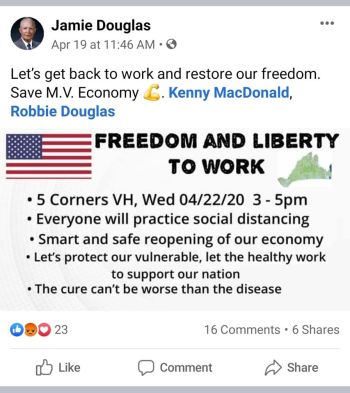
This Facebook post was taken down once pushback started, but not before screenshots of it were in circulation.

Sure enough, a post promoting the event had appeared on Jamie Douglas’s Facebook timeline.

Despite the reasonable precautions (“Everyone will practice social distancing”; “smart and safe reopening”), the rhetoric echoes that used to promote the rallies held around the country in recent days: “FREEDOM AND LIBERTY TO WORK” and “The cure can’t be worse than the disease.”

National reporting, from the New York Times and multiple other reliable outlets, strongly suggests that these protests have been strongly backed if not instigated by big right-wing money. So far, there’s no indication that this was true of the Vineyard protest, but the Douglas family easily qualifies for the local 1%. The Black Dog website makes founder and patriarch Captain Robert Douglas out to be a plucky visionary, never mentioning his good fortune to have been born into one of the families that founded Quaker Oats.

Jamie Douglas’s Facebook post prompted immediate pushback, which predictably included calls to boycott all Black Dog enterprises. Blaming the Black Dog and/or the Douglas family is so much easier than holding the current administration accountable, and of course it helps that the Douglases are widely believed to be not only Republicans but Trump-supporting Republicans. (The boycott-the-Black-Dog website reportedly put up by business consultant India Rose has since gone private.)

The Martha’s Vineyard Times reported that the rally was off. Robbie Douglas, brother of Jamie and Black Dog CEO, was interviewed: “Our idea was to have a gathering or a rally just to ask some questions, which we thought were important to address.”

Then the Times updated its story to say that the rally was on again. The Douglases stepped back and Kenny MacDonald and Ben Ferry became the rally spokesmen. MacDonald was not new to the effort. Not only is he tagged in Jamie Douglas’s April 19 Facebook post, on Tuesday morning, April 21, he emailed his Statement to Town Governments to Edgartown administrator James Hagerty, who forwarded it to the administrators of the other five island towns. Its opening paragraph concludes: “However, the state and local governments’ usurpation of power during this crisis has alarmed me enough to act. I will be organizing a small peaceful demonstration on Martha’s Vineyard this Wednesday, April 22.”

Its tone is reasonable enough, but like Jamie Douglas’s Facebook post it relies on right-wing talking points and makes no reference to either why so many scientists and public officials consider stay-at-home orders essential, or the dismal failure of the administration to take COVID-19 seriously from the get-go. It does not demand that Congress and the administration do a better job of alleviating the terrible burdens that COVID-19 mitigation is putting on so many working people, including those who don’t have the option of staying home.

The rally did indeed take place as scheduled on Wednesday afternoon. It was small. As a friend commented: “By the numbers: Six people. Five Corners. Four reporters. Three people honked.” To be fair, “crowd” estimates did range as high as 10.

In a post to the Islanders Talk Facebook group that of course set off a firestorm, Ben Ferry wrote: “This has never been about Black Dog nor will it be in the future.” Well, yes and no. It’s certainly not only about the Black Dog, though the Douglases’ role does invite comparison with that of well-funded right-wing groups in supporting the “back to work” protests in other places.

So once again I’m trying to learn what I can learn from the backside of the knitting, the latest evidence that though Martha’s Vineyard may look like a cohesive community from a distance, it’s got fault lines like every other place, and economic stress exposes and exacerbates them. What am I noticing here?

  • Class distinctions here are real and woefully underacknowledged, but when these protesters mutter about trustafarians and privileged liberals, it’s hard not to notice that they’ve made common cause with residents of the Vineyard’s economic upper crust. This mirrors what’s been happening on the national level since the Tea Party rose to prominence a decade ago. Hmmm . . .
  • It’s been a truism since before the Women’s March of 2017 that “the resistance is female,” and on the Vineyard that’s largely true, but the Five Corners rally was mostly male. Ditto the construction workers who’ve been pushing hardest for the right to waive the stay-at-home orders and go back to work. (This happens in a limited way tomorrow, April 27.)
  • In his “statement to town governments,” Kenny MacDonald’s third sentence is “I have never directly involved myself in local, state, or national politics.” He seems to be offering this as a credential, a reason that town officials (who are by definition very much involved in local politics) should take him seriously. I hear this a lot on the Vineyard, and indeed, until the 2016 campaign I kept my distance from local, state, and national politics because they seemed pretty hopeless. This turns out to be another area where the view from a safe distance is deceiving.
  • Something that does unite a lot of us, right, left, and center, is the instinctive grab for simple explanations and simple cures. “Boycott the Black Dog!” “Reopen the economy now!” “They’re just Trump supporters!”

A question presses at the back of my mind: Once the worst is over and we’ve reached some accommodation with COVID-19, will we remember the fault lines that the disease has revealed — fault lines that were already obvious to some but not enough of us? And will we be moved to act?

Posted in Martha's Vineyard, public life | Tagged , , , , , | 2 Comments

Around the World in 30 Years

looking backShirley Mayhew could have rested on her laurels after publishing Looking Back: My Long Life on Martha’s Vineyard in 2014. It’s a lovely collection of personal essays covering, well, Shirley’s long life on Martha’s Vineyard, from 1947, when she arrived as the young bride of Vineyard native Johnny Mayhew, through 2014, when the book came out. For anyone interested in how Vineyard life has evolved over the decades, Looking Back offers the experiences and insights of an extraordinary “ordinary” woman whose observational skills are equaled only by her ability to express them in writing.

Lucky for us, Shirley did not rest on her laurels. (If you know Shirley, you know this was never an option.) She has continued to publish Vineyard-related op-eds and other essays in island publications, notably the Vineyard Gazette and Martha’s Vineyard Magazine. All the while she was also honing her travel essays in Cynthia Riggs’s Sunday writers group, which is how I got to know her and her work. In the last year she has self-published three collections of those essays: Around the World in Thirty Years (one of my favorite titles of all time), Living Life with the Grace of a Butterfly: Vineyard Essays, and, most recently, Paucartambo: A Midlife Adventure from Martha’s Vineyard to Peru.

All are available in paperback from Amazon. So are her children’s book, Islander:
The Circus Comes to Martha’s Vineyard,
with illustrations by Vineyard artist Linda Carnegie, and Seasons of a Vineyard Pond, which grew out of a college research project when Shirley went back to school in the 1960s. (Choose Books from the dropdown on the Amazon site, then search on “Shirley Mayhew” and you’ll find them all.)

Cover photo of Shirley in Termessos, Turkey.

In the introduction to Around the World in Thirty Years Shirley writes: “In 1972 I was 46 years old and had never been out of the country.” In the next decades she made up for lost time. Her husband, having done much of his growing up abroad and then serving as a navy pilot in World War II, had no desire to leave the island, so Shirley traveled solo, or with a friend, or with one of her daughters or, later, her granddaughters. She managed to visit not only a roster of countries that would do credit to a diplomat or a foreign correspondent but also quite a few of these United States.

Around the World opens, however, with “The Summer Mouse,” a charming story about a summer spent in Chilmark, the next town over from West Tisbury, where Shirley lives. Longtime Vineyarders will immediately get how appropriate this is: West Tisburyites tend to speak of Edgartown as if it’s somewhere near Nebraska, Edgartonians reciprocate, and most of us down-island of the Chilmark line think Aquinnah is on another planet. From Chilmark, the book jets to Russia and Ukraine, then back to the U.S. for a horseback trek in Colorado, and on to England, Kenya for “Tea with a Baboon,” a climb up Kilimanjaro in Tanzania, a wedding in New Delhi . . .

Several Around the World essays document Shirley’s experiences in Paucartambo, a village high in the Peruvian Andes. Lucky for us, Shirley collected these and more into a book of their own: Paucartambo: A Midlife Adventure from Martha’s Vineyard to Peru, which has just been released. In the preface she writes: “After being a tourist in eleven countries, I grew tired of being a tourist and visiting monuments and museums and famous sites surrounded by other tourists — I wanted to stay put long enough in a country to see how the rest of the world lived.”

In five sojourns over several summers, between 1983 and 1991, Shirley became part of village life, even becoming godmother to two children and patroness of one of the dance groups in the village’s annual fiesta, which attracts visitors from all around Peru.

Shirley is matter-of-fact about her own courage and resourcefulness, but seriously: this woman who’d never lived alone before, who had spent most of the previous 35 years surrounded by family and community on self-contained Martha’s Vineyard, set out to live in a remote village where almost no one spoke any English, when she had only rudimentary Spanish and nonexistent Quechua?

Once or twice she might have wondered if she was going to make it out in one piece, as in the hair-raising “Trucking into Cusco” in Around the World in 30 Years (a version of which is part of chapter 7 in Paucartambo), about riding what serves as public transportation in the high Andes, but she’s resilient: she listens, she adapts, she goes on — and she takes excellent photos.

More, she brought Paucartambo home to her middle-school students, who became engaged in raising funds to buy desks and other supplies for the Paucartambo school. Perhaps the most poignant story in Paucartambo takes place at the Edgartown School, where one of Shirley’s most reticent students becomes the project’s star fundraiser.

With one exception, and as its subtitle suggests, Living Life with the Grace of a Butterfly: Vineyard Essays sticks close to home. Family and community loom large in these pieces, many of which were first published as op-eds in the Vineyard Gazette. Family is integral even to the one travel piece: in “Nanny Diaries Meets Kris Kringle,” Shirley accompanies daughter Deborah to Finland as nanny to her infant granddaughter, Katie Ann (who is now Siren Mayhew, a stunning vocalist with a daughter of her own).

Taken individually, these essays are, as expected, variously charming, insightful, and poignant. I do wish that they’d been arranged somewhat chronologically, according to Shirley’s age at the time of the incidents they describe. Instead they jump back and forth from her years as a young bride to her old age after the death of her husband, frequently alighting on points in between. Because Shirley does often mention her age or that of her kids, it’s possible to improvise some sort of time sequence, but only infrequently does one glimpse just how much Martha’s Vineyard has changed over the decades since Shirley came here in 1947.

At the same time — well, to me, who tends to focus on the changes and what drives them, it’s reassuring to be reminded of the things that don’t change. Four generations of Mayhews are currently living not only on the same island, but in the same town. This is rare, and becoming rarer. In 2014, Shirley decided to throw an 88th birthday party for herself. Since so many of her old friends had passed, she invited “16 of the children of my deceased friends. All had grown up on the Vineyard and still lived here, and most had been born on the Island.”

Here’s how it went:

The first year I made lobster salad and bought tiramisu for dessert; the guests brought appetizers and salads. It was a real West Tisbury potluck party. While we sat around drinking wine and munching bluefish pate, I told them each an anecdote about their parents as I knew them long ago. I have found throughout my long life that most children pay little attention to their parents’ activities or early life. It seems to not occur to them that their mothers and fathers had a life before they were born.

And the next year she did it again.

It doesn’t occur to most summer people that the Vineyard has a life when they’re not here, or to most who move here that it had a life before they arrived. That’s only one of the reasons that you owe it to yourself to spend time with these books, but it’s a big one. Shirley is passing on stories of what happened before we got here, or just out of our line of sight if we’ve been here all along. Listen, and pass them on.


Posted in Martha's Vineyard, tourism, writing | Tagged , , , , , , | 2 Comments

Shopping

Short version: It’s strange and (almost) normal at the same time.

We’ve been living with stay-at-home orders for more than a month now, and what I’ve realized is that I’m pretty much a stay-at-home person.

Except when I’m not.

I still work from home. I still take Tam out early so he can do his business (which usually includes racing through the woods several times in a big circle), go for a long walk in late morning, then stroll around the neighborhood in early evening, when it’s sometimes dark enough to wear my headlamp. I still do all my own cooking. Even in normal times, I rarely eat out. The only change there is that I no longer meet friends for the occasional breakfast, lunch, or coffee at the Black Dog Café.

Meetings of various kinds are still happening, but not the way they used to. More about that in a separate post. Suffice it to say here that I’m not yet a Zoom expert, but I’ve advanced well beyond the novice stage and now have my own paid Zoom account.

As discussed at some length in “Culinary Miscellany,” the big changes in my life have been around shopping, mostly but not entirely grocery shopping. Up-island Cronig’s, which I can walk to in 20 minutes, remains closed, so I’m not relying in it for fill-in-the-gap grocery runs. A few of my staples have grown scarce, like I haven’t seen long-grain brown rice on the shelves at either down-island Cronig’s or Reliable, and the co-op hasn’t had it either. The co-op does have short-grain brown rice, and a wild-and-brown-rice blend, so I’ve switched to those. The beans I use most often are hard to find too, in both their dried and canned forms, so when I do find them, into the cart they go.
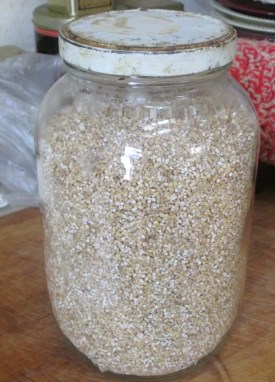
Oat groats in a 5-pound jar

For me at the moment, luxury is having 10 pounds of oat groats in the cupboard. Usually I buy one or two pounds at a time from the bulk bins at up-island Cronig’s, but up-island Cronig’s is closed and the bulk bins are gone from the down-island store. Oat groats — with which I make my morning oatmeal — aren’t especially popular at the co-op either, so when I had the opportunity to score 10 pounds at once, I grabbed it.

You now need to be wearing a mask, or at least a face covering, to go into down-island Cronig’s or the Stop & Shops in Vineyard Haven and Edgartown, per order of the boards of health in those two towns. I didn’t realize this when I last visited Cronig’s, but the health agent at the door let me in when I pulled my turtleneck up over my nose and mouth. Many more people are wearing non-medical masks than were two weeks ago.

I had mixed feelings about this, and about boards of health dictates in general, but the last time I went into Reliable, where masks are not required, I rigged up a face covering with a bandana folded around a doubled-over coffee filter. Non-medical face coverings may be of limited use, but if they make the store staff on the front lines of the pandemic more comfortable, that’s a big plus.

I have, however, been won over to mask wearing, because Crooked Media is now selling a three-pack of non-medical masks for $20 plus shipping. Each mask has a message printed on it: THIS WAS PREVENTABLE, SUPPORT HEALTHCARE WORKERS, or VOTE! VOTE! VOTE! and the three-pack contains one of each. They’re made from recycled sweatshirts, and proceeds go to Crooked’s COVID-19 fund. I’ve ordered a set. You can too.

The first person who tells me I’m politicizing the pandemic is going to get an earful.

So, back to shopping and how COVID-19 has changed it . . .

Earlier this month Tam’s kibble supply was running short. In bygone days, when I needed dog food, I’d stop by SBS, the grain, gardening, and pet supply store, go to the cavernous back room where all the bulk bags are stacked on metal shelves, shoulder a bag of 20-pound bag of Entrust puppy food (does Tam still qualify?), and take it to the register, often picking up a toy or a treat en route. Two weeks ago SBS still had walk-in hours in the morning, but I was a little late for that, so I called in my order and wrote a check for the total amount before I left home. When I drove round back to the loading dock, the bag was waiting for me. I gave my check to the clerk and hit the road. Walk-in hours are no longer, but you can call in your order for feed, gardening supplies, etc., and have it delivered out front.

Another change: In early April, Cronig’s was already prohibiting bring-your-own bags (I’ve been bringing my own for years and keep a stash of cloth bags in the back of the car), but Reliable let me bring my own bag as long as I filled it myself. No longer. BYO bags are now verboten per order of the governor. This past Tuesday, my purchases were bagged in plastic. The irony here is that single-use plastic bags were banned last year. Now they’re back, and I’m not all that unhappy about it because I used to use them for wastebasket liners and I ran out months ago.

By the way, it’s been four weeks since I got $60 from an ATM, and two of those three $20 bills are still in my wallet. The third went for quarters to do laundry with. Martha’s Vineyard is the kind of place where cash, and checks, still circulate in normal times, but in these abnormal times I’m reaching for plastic to cover those small amounts I would previously have paid for with paper. Ordinarily I don’t think too hard about where those dollar bills have been before they get to my wallet, any more than I think too hard about where Tam’s tongue has been before he licks me in the face.

One last thing: Has anyone else noticed that the objects they depend on most waited till all the non-essential shops closed to really screw up? Malvina Forester makes a strange rattling sound when I turn the key. It stops after a few seconds but it definitely doesn’t sound right. Auto mechanics are considered essential services, but I’ve been holding off because social distancing and, well, Malvina is so disheveled these days she looks like a breeding ground for all sorts of diseases. Tomorrow I’m calling my mechanic.

Tam checks out Kore. Need I say this was a while ago, like last June. Tam has grown. Kore has just gotten sticky.

Kore, the laptop on which I do all my work and a lot of my play, has had a sticky keyboard for some time. She’s been getting slower and slower, which isn’t all that surprising because she’s 4 1/2 years old. She’s probably due for replacement, but first I wanted to see if anything could be done to speed her up, and if it could, I’d spring for a deep keyboard clean. I put this off, however, because I’ve got a whopping dental bill to pay off. Then came the stay-at-home order, and almost immediately afterwards Kore’s ALT key stopped working.

If you don’t use Windows and if you don’t rely heavily on keyboard shortcuts, you probably don’t realize what a disaster this is.

I put up with it for a while. The tech department at Edu-Comp is only open to those with service contracts, and while the store is closed, they’re only selling in-stock Apple laptops, iPads, printers, and ink. Finally the frustration overwhelmed my desire to buy local whenever possible, so I ordered a wireless keyboard from Staples. It’s supposed to arrive tomorrow.

Life won’t return to “normal” any time soon, but at least I’ll have my ALT key back.
Posted in dogs, Martha's Vineyard, public life | Tagged , , , , , , , , | Leave a comment

Viral

“Going viral” has been idiomatic English for quite a while. Just about everybody, or everybody with an internet connection, knows what it means: a meme or image, story or video, goes viral when it’s diffused far and wide through the efforts of individuals. Thanks to COVID-19 many of us are taking a closer look at where it came from — at the literal meaning.

When I heard for the first time that something had gone viral (or registered that I’d heard it), I was mystified for a few moments before I got the gist. It was probably around the time I got on Facebook, in January 2011: plenty of expressions and abbreviations entered my lexicon around then.

Merriam-Webster’s Collegiate (online), however, dates “viral marketing” to 1989: “marketing designed to disseminate information (as about a new product) very rapidly by making it likely to be passed from person to person especially via electronic means.” The concept had clearly been out there for a while, but the rise of social media in the late 2000s multiply multiplied the very in “very rapidly.”

Thanks to COVID-19, we’re being reminded of the literal meaning of “viral.” Viruses go viral. By definition. It’s what they do. Some are slower about it than others; others are speedy. Some, like the common cold, are relatively harmless to most people; others, like Ebola, are deadly. COVID-19 combines the worst of both worlds: it’s highly contagious, and it has a high mortality rate. There are indications that some who survive serious cases sustain damage to kidneys, heart, liver, and other organs, as well as lungs.

Because COVID-19 is so new, there’s as yet no vaccine and no cure. Neither vaccines nor cures come into existence overnight. The inadequacy of testing equipment and uncertainty about the tests have so far made it hard to tell who has it, or has had it, and whether having it once confers immunity against getting it again. That’s a lot of unknowns.

In an online discussion among editors earlier this week, one participant said that thanks to COVID-19 she was having reservations about using the expression “go viral,” although she’d be happy if one of her blog posts went viral.

This brought me up short, in part because I’ve never thought of “going viral” as an unmitigated good thing. For sure there are plenty of instances where a video gone viral has, say, provided important and decisive evidence of police brutality, but there are also plenty of instances where manipulated videos or clips taken out of context go viral, planting distortions and outright lies in millions of minds. And don’t get me started about all those memes that distill complex information into a compact, easy-to-share image, or the sketchy “news” stories that are shared totally on the basis of their often-misleading headlines.

The advent of COVID-19 actually has me pondering just how appropriate the expression “go viral” is, how true to its literal roots, and how the measures being taken to curb the spread of COVID-19 and “flatten the curve” might be useful in curbing the spread of the more mendacious memes, videos, and such.

For one thing, COVID-19 has made us much more conscious of our contact with other people, and with inanimate surfaces. When images and videos go viral, it’s often because hundreds of thousands of people are on semi-automatic pilot. Back in the day, we thought forwarding emails was easy. Compared to photocopying and mailing a letter, it was. But compared to sharing on social media, it’s almost rocket science. That’s so cute! Click. That’s horrible! Click. Can you believe this? Click.

COVID-19 has also reminded even the math-impaired among us of what “exponential” means. You share that outrageous photo with five people. Each one of them shares it with five people, then each one of them shares it with five people. Before long the photo has been shared with 3,125 people — then you learn that the outrageous photo was cleverly Photoshopped and the event it depicts never happened. Can you then reach all 3,125, or 15,625, or 78,125 people and say “Never mind”? You cannot.

As Mark Twain didn’t say, but C. H. Spurgeon did, ca. 1859, “A lie will go round the world while truth is pulling its boots on.” This wasn’t an especially novel observation in 1859 because in 1710 Jonathan Swift wrote “Falsehood flies, and the truth comes limping after it.”

So I’ll continue to say that this, that, or the other thing has gone viral, but with renewed appreciation for the appropriateness of the metaphor.

Intriguingly enough, when I look for synonyms to “go viral,” the one that keeps coming up is “spread like wildfire.” Now there’s a simile that could stand closer inspection.

Posted in musing, public life, technology, writing | Tagged , , , , | Leave a comment

Supply Chains

When the shelves — any shelves, in any store — are fully stocked, I seldom think much about how the products got there.

When I can find everything I need, I seldom think “What if I couldn’t?” More often I gaze at something I don’t need — pecans, candied ginger, a frozen dinner — and wonder if it’s worth the splurge. Usually the answer is no. (I do sometimes make exceptions for McVitie’s biscuits and Reese’s peanut butter cups.)

At down-island Cronig’s, all the shelves in all the aisles are invariably stocked to the verge of bursting, which is why I marveled the other day when I went looking for beans and rice: those shelves were almost as bare as Old Mother Hubbard’s cupboard.

So I’m pondering supply chains. There’s a lengthy Wikipedia entry on the subject, but here’s the basic definition: “a system of organizations, people, activities, information, and resources involved in moving a product or service from supplier to customer.”

I became hyper-aware of supply chains (without knowing the term) in the 1980s, as the book buyer for Lammas, D.C.’s feminist bookstore. Books did not magically appear on the shelves: I had to place orders with publishers, distributors, and sometimes individual writers. Selling space was limited (about 400 square feet total) and the store was undercapitalized (meaning that bills had to be paid out of revenue), so ordering took strategizing. Guesstimating how many copies we’d sell in a month, balancing this title against that one, ordering a book from a distributor when we were on credit hold with its publisher — that sort of thing.

I did pretty well if I do say so myself, but sometimes a customer would come looking for a title that wasn’t on the shelf. Then a sort of triage kicked in: Is this book something we usually stock, meaning something we can easily tack onto a regular order? If not, might it be available from another bookstore in the area? If neither of the above, would the sales price come close to covering the cost in time and money of procuring it?

What I learned in those years has come to the fore in recent weeks, but it’s never been far from my mind in all the years I’ve lived on Martha’s Vineyard. It spikes whenever someone complains that we can’t buy this on the island, or that (often gasoline!) costs too much, and especially when the complaint segues into conspiracy theories about how someone or other is making a bundle off the lack of this or the high price of that.

The Vineyard is a small market. Economies of scale are rarely possible, which is a big reason we’ve been largely spared the mega shopping malls and humongous chain stores that have destroyed other small-town economies. At the same time, thanks to our lopsided seasonal economy, commercial rents in prime locations went through the roof long ago, which is why so many stores are shuttered in the off-season: in summer the living isn’t exactly easy, but in winter business isn’t nearly brisk enough to stock the shelves, staff the shop, and pay the rent.

Not to mention that the goods carried by those seasonal shops are generally high-profit-margin items that year-rounders don’t need and/or can’t afford.

The real wonder is that so many Vineyard stores do manage to operate year-round, and to keep the shelves pretty well stocked in this very trying time. Which is why I’m blogging about the supply chains that are largely invisible in less trying times, the “system[s] of organizations, people, activities, information, and resources involved in moving a product or service from supplier to customer.”

Especially the people. Without the people harvesting, processing, packing, and transporting the food, placing the orders, stocking the shelves, and staffing the registers, the shelves would be bare indeed.

Posted in musing, public life | Tagged , , , , , , | 4 Comments

Culinary Miscellany

I didn’t set out to blog about food; it’s almost certainly a sign of these extraordinary times. COVID-19 has both prompted me to minimize trips to the grocery store and impressed on me that not everything I want will be on the shelves when I want it. I’m not talking about seasonal produce here (my freezer is always well stocked with whole cranberries, which are only available in the fall); I’m talking about staples I take for granted because they’re always there — or used to be.

I haven’t been much affected by the fact that these days you can’t get a sit-down meal in a restaurant: I don’t have an eat-out income, though it does allow for the occasional breakfast with friends at the Black Dog Café and fairly frequent stops for a cookie on the way home (when Tam’s with me, he gets a Black Dog biscuit). Several places are open for takeout, however, and when I really need a break from my own cooking, I plan to indulge.

I just started preparing to make a quiche. The ball of dough that will become the crust is refrigerating. Eggs and cheese are working their way up to room temperature. No chorizo or linguiça in the fridge but there was half of a half pound of bacon, which I’ve just fried up crispy. If I don’t eat it all (with some help from Tam), there’ll be enough left to put in the quiche.

Late yesterday afternoon I made a Red Beans and Rice recipe I found in the Washington Post. Having never had or even seen the New Orleans original I have no idea how authentic it is. Judging by the comments on the recipe it isn’t, but it’s effing delicious. I was so hungry when it was done I didn’t even cook up the rice. It’s great.

Shopping the other day I realized I was buying two of things I usually just get one of. Not hoarding really; just trying to minimize my trips to the grocery store. Earlier this year I joined the MVY Co-op. Have already noticed that some things that seem hugely extravagant at the grocery — honey, cashews, pecans, dates — seem reasonable as part of my co-op orders, which are smaller and less frequent than my trips to Reliable or Cronig’s. I’m also getting better at figuring how much to order of what. Not everything I want is available in every order cycle, so — order more than usual. I just sprang for 10 pounds of oat groats and 10 pounds of long-grain brown rice: things I can’t stand to run out of.

My culinary repertoire includes mostly dishes that make enough for several meals and freeze well: chilis, soups, and stews. Several of these are bean-intensive, and I’ve been trying lately to start from dried beans instead of cans, so in a fill-in-the-gaps Cronig’s run, I was looking particularly for the kidney beans and black beans that go into my current favorite chili. To my surprise, the bean section was mostly bare, of both dried beans and canned. (The bulk bins have been banished for the duration.) Navy beans were plentiful, and there were garbanzos to be had, but I didn’t need them. I was lucky enough to find, lurking way back on a bottom shelf, a can of kidneys and a can of black beans — enough for my next round of chili.

There was no brown rice to be had either. White Uncle Ben’s, white Minute Rice, and some sort of white rice in transparent plastic containers, but that was it. Eventually my co-op order for long-grain brown will come in, and meanwhile I’ll make do with the boxes of Near East rice pilaf (various flavors) stashed in my cupboard.

On my most recent trip to Cronig’s, I noticed that lines had been drawn on the floor to mark six feet of social distance from the cashier, and signs urged us to keep six feet from each other. In the aisles this often isn’t possible, but where in the past I would have squeezed by someone who was studying the selection before her, now I’m more likely to wait — especially when the other person is wearing a mask. (Why? Not sure, but my hunch so far is that mask-wearers are more conscientious and/or more nervous than I, and I respect that.) Most of the staff were wearing masks, and more shoppers than on my previous trip, but mask wearers were definitely in the minority.

Quiche is a dish-intensive project, and lacking a dishwasher, I wash my dishes in the sink and stick them to dry in an ordinary dish drainer, but one quiche = six meals so I’m not complaining. The bowls, skillet, plate, egg beater, and measuring cup benefit from being washed once in a while, and Tam (like Travvy before him) thoroughly enjoys pre-washing the skillet and the egg bowl.

I’ve never frozen a quiche, by the way, but it keeps long enough in the fridge for me to finish it off.

And yes, I have washed my hands several times today . . .


Posted in dogs, home, public life | Tagged , , , , | 3 Comments

March License Plate Report

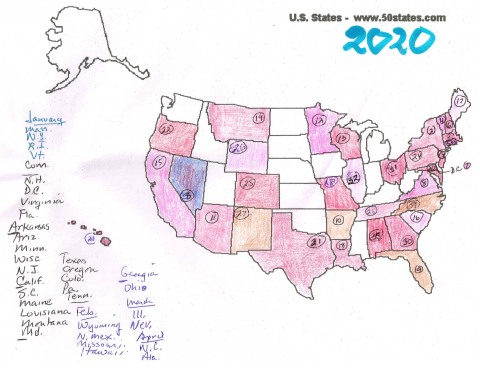
map of US with states colored in

I spotted Illinois in very early March and was looking forward to a good, solid March until COVID-19 and the stay-at-home orders skewered that expectation. I was on the road even less than usual, traffic was way down, and from the governor on down summer residents were being explicitly urged to stay home rather than risk overtaxing our limited-capacity hospital. Still, it was a bummer watching the month draw to a close with only one new sighting on the map . . .

Then yesterday, March 31, I was heading home from a round-the-island supply run, about to make the right turn from the Edgartown Road to Old County, when what should I spy heading in the opposite direction but Nevada.

I was thrilled. Not only does Illinois not have to stand alone, but it’s accompanied by one of the harder-to-get states. Nevada isn’t exactly rare, which is to say that I get it most years, but it’s not as common as Texas or California either.

Speaking of which, I’m wondering where North Carolina and Washington state are keeping themselves . . .

I’d be the last to claim that the license plate game has any redeeming social importance — as a long-ago Martha’s Vineyard Times colleague used to mutter whenever the subject came up, “Get a life!” — but thanks to COVID-19 I did use it as a source in several Facebook posts this past month. How? I’ll try to keep it short:

The year-round Vineyard has a complex, mostly under-examined love/hate relationship with “summer people,” a category that includes second-home owners, regular seasonal visitors, tourists, and pretty much everyone who swells the island’s population from less than 20,000 in the off-season to well over 100,000 in the height of summer. So when rising anxiety about COVID-19 was compounded by stories that summer people were fleeing here to their summer homes, some of the latent hostility spilled onto social media.

On Facebook hostility rarely stays latent for long, and misinformation spreads like, well, a highly contagious virus. (The figurative expression “going viral” didn’t come out of nowhere.) When the two interact, as they inevitably do, things can get ugly pretty fast. Sightings of New York license plates in supermarket parking lots were touted as proof that summer people were swarming to Martha’s Vineyard. The more polite comments on this focused on the hospital. The less polite charged that the incomers were importing COVID-19 to the island, which (presumably) could escape contagion completely if only those people would stay home.

It didn’t help that the first confirmed case of COVID-19 on the Vineyard was a guy from New York who came here to close on a house.

Anyway, I could go on, and probably will in another post, but here’s the license plate connection: I pointed out that I spotted license plates from 25 different states in January, that this was par for the course, and that plates from New York, New Jersey, and all New England states were plentiful all year round. Others backed me up on this, and we tried to inject as much reality-based info into the discussion as possible, noting especially that people come and go from the Vineyard every day all year round, to work, to shop, to visit friends and relatives, etc., etc. Most likely the #1 reason that no one early in the month had tested positive for COVID-19 was that here, just like everywhere else, testing was inadequate and often being limited to those showing symptoms.

I’m still not claiming “great sociopolitical import” (thank you, Janis!) for the license plate game or my inferences from my very non-scientific statistics, but if I got through to some people that not every vehicle on the island in the dead of winter is sporting Massachusetts plates, that’s something.

Posted in license plates, musing, public life | Tagged , , , , , | 1 Comment