This Blog’s for Norway

Living on Martha’s Vineyard makes me wonder if tourists ever see anything real, and if they do, do they recognize it? I also spend a fair amount of time seething about tourists and recent arrivals who write authoritatively about what they see, at best, only dimly.

Well, I’m about to write about what I think I saw on one of my very rare forays into tourism.

Last December I went to Oslo. The main purpose of my trip was to work intensively with the author and the translator of a book that I was going to be editing: the English-language edition of a book that was about to be published in Norwegian. I could pretend I wasn’t a tourist at all, but this would be crap. I’d known Lynn, the translator, for years online but we’d never met: she’s American-born, married to a Norwegian, with two teenaged kids. The deal was that I’d stay in a hotel for three days and we’d work our butts off, then I’d stay with Lynn’s family for three days, hang out, and do some sightseeing.

I could also pretend I wasn’t a tourist on the grounds that December is not peak tourist season in Norway: the temperatures are generally well below freezing, and the days are only six hours long. But if you live on Martha’s Vineyard, you know that off-season is the best time to visit, so I say it loud: Jeg var en turist.

I saw many wonders while I was in Oslo. Lynn helped me buy a bus pass and showed me how to use it. Pretty soon I was reading street signs and maps and getting on and off like I knew what I was doing.

On Saturday we went out to the Folkemuseum, where the wonders were too many to describe. Among them was the Julmarked (Christmas market), where I purchased a wondrous pair of slippers. Travvy still thinks they are the toy I meant to bring home for him, but he is wrong. (See right.)

After that we went to the Viking Ship Museum nearby. I got to walk alongside three craft that sailed Norwegian waters in the ninth century. Coming from New England, I tend to think history began around 1620 and that the centuries before that were mere prologue. I am wrong. These ships were awesome. So was the ninth-century bridle so well preserved that a twenty-first-century horse could wear it.
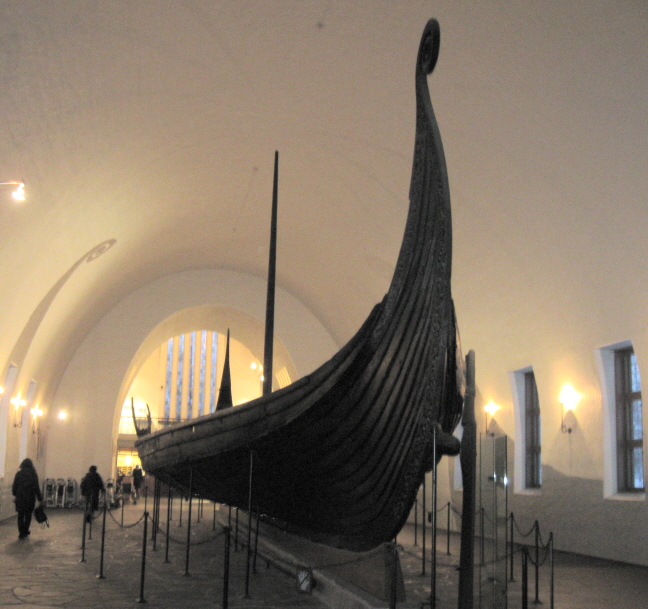
A Viking ship.
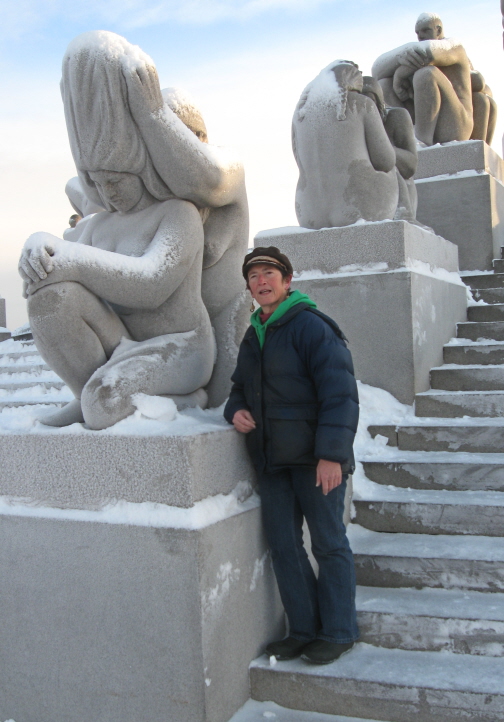
Susanna and stone friends.

The statues at Vigelund Park are a wonder. There are more than two hundred of them. Lynn took my picture next to one woman washing another’s hair. This is how you know that I am not making all of this up.

One marvelous evening I found myself at a professor’s supper table, swapping life stories and advice for dealing with mothers, lovers, and co-workers with several Norwegians, a Norwegian-American, an Afghani-Norwegian, and a Frenchwoman from Marseille.

The greatest wonder of all, though, I saw on my first full day in Norway. Lynn and I were walking along Henrik Ibsens gate past a big park, Slottsparken. I noticed the great stately structure up the hill in the middle of the park. The king’s palace, Lynn told me. I don’t have a photo of this wonder, because it’s hard to make a picture of something that isn’t there. What wasn’t there was a high metal fence, and uniformed guards with rifles and stern demeanors.

What I think I was seeing was a level of confidence and trust that in my country would be dismissed as gullibility. Maybe not on Martha’s Vineyard, though, where quite a few of us don’t know where to find the keys to our front doors but do know that the car keys are in the ignition. Gullibility, maybe, but with a touch of defiance: I do not choose to live behind fences and locked doors.

If you choose not to live behind fences and locked doors, you run the risk that terrible things may happen to you. What has happened in Oslo is beyond terrible, it’s heart-sickening. Could fences and locks have prevented this thing? I do not think so.

Hang in there, Norway. The whole world is watching, and the world needs your good sense, your vision, and your courage.
Posted in tourism | Tagged , , , | 2 Comments

Benefit

When times get rough, year-round Vineyarders usually come through for each other in a big way. It’s one of the things I love most about us, and the reason that despite all the place’s aggravations I’d think at least five times before I moved anywhere else.

Tonight I went to a benefit spaghetti dinner and silent auction to benefit Lisa Ben David Scannell, who fractured her pelvis in a bad horseback riding accident in early June. Many, many of us on Martha’s Vineyard are either self-employed, seasonally employed, or employed by very small companies, which is to say that even if we have adequate health insurance, we probably aren’t covered at all for lost work time. On any given weekend, all year round but especially in the off-season, there’s usually a benefit for someone who’s been injured or diagnosed with a serious illness, or for a family hit by a house fire or other misfortune.

Lisa Ben David Scannell

I came to know and admire Lisa during my decade of horse ownership. Lisa was also the much-admired mentor of the young woman who guided Allie and me through our first years together, so we’re in the same line of knowledge transmission — I’m sort of her grandkid, even though she’s quite a few years younger than I am. I’m largely out of the Vineyard horse world now, but when I heard about the benefit, of course I was going to go.

The benefit was held at the PA, the Portuguese-American Club, officially the Holy Ghost Association. When I got there, about a half hour after the event officially started, the large dirt parking lot was packed. The PA is a major nexus of island life: an active, down-to-earth social club (not “social network”) with more than 1,100 members and the host for so many parties and benefits that many non-members are regular visitors.

TA, hairdresser and horse buddy

Spaghetti with sauce and abundant meatballs was served in the low-ceilinged lower-level room, and if you still had room for dessert, the cake and cookie selection was formidable. Many ate at the rows of tables; others carried their plates up the main level, where the silent auction lined the walls and the PA’s cash bar served all comers of legal drinking age. Plenty of those in attendance were well below it — young enough, in some cases, to find toddling upright a challenge. The age range probably spanned at least eighty years, not atypical for a large island gathering. Having been out of the horse loop for over a year now, I had a good time catching up with people I hadn’t seen in at least that long, as well as those I see more often. One of the latter was TA,  a friend who’s got two miniature horses in her backyard and whose horsegirl daughter, an incoming high school senior, I’ve known since she was nine. Since TA is also my hairdresser, I was mightily relieved when she said my unruly curls were looking good and don’t bother to get them cut till September.

Inspecting the silent auction items

The auction offered an impressive array of items, some distinctively horsey but most of interest to anyone. Browsing, wondering how much money I had in my checkbook, I noted the connections between the donors and the island horse world. Cindy Bonnell, for instance, crafter of the exquisite lap quilt, is a horsewoman herself, as is her grown daughter. Ken Vincent donated a small painting — his wife is a horsewoman, and his sister-in-law’s a vet. The offerings included jewelry, all kinds of gift certificates, a wool vest from Allen Farm, and even two pygmy goats from Native Earth Teaching Farm, who went for $200 to someone who will take very good care of them. Bidding was brisk. I scored a freeform wampum pendant for a very reasonable price.

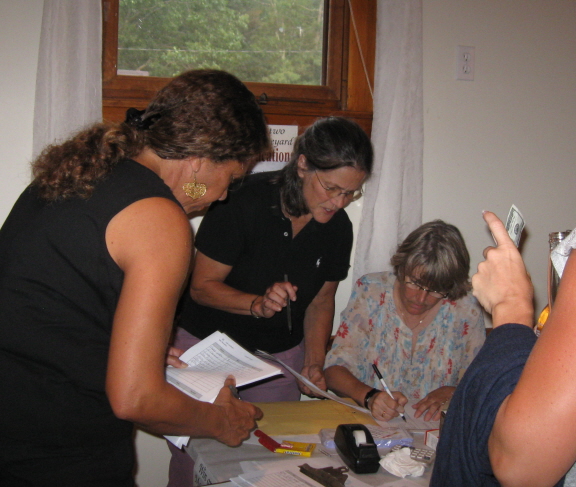
Keeping track of who owes what

Volunteers busily tallied up the auction results and accepted cash, checks, and credit cards. It looked as though enough was raised to enable Lisa to focus on her physical recovery without worrying (too much) about paying the bills. If you couldn’t be there, contributions are still welcome. Make checks payable to You’ve Got a Friend and send them to You’ve Got A Friend, Inc., benefit Lisa Scannell, P.O. Box 1317, West Tisbury, MA 02575.

Posted in Martha's Vineyard | Tagged , , , , | 9 Comments

Whose Arts & Ideas?

“First-Person Plural,” the preceding blog, lays the groundwork for this one. If you haven’t read it already, you might want to start there.

As soon as your eye slips down the screen (it has already, right?), it will become apparent that I have just discovered that my little photo program (Serif PhotoPlus SE) can do much more than crop, size, and retouch photos. I cannot draw a straight line on paper and I cannot draw a straight line on a computer screen, but boy, is this fun. 🙂

The first issue of Martha’s Vineyard Arts & Ideas is handsome indeed. The design is clean, the art and photo reproductions excellent. The creative collaboration between Rose Abrahamson and Cindy Kane is delightfully evoked in both images and words; Stephen DiRado’s photo portrait Mathilda is remarkable, and so is his description of how he made it; Tova Katzman’s photos add a dimension to Marnie Stanton’s story about water that could not be found in a newspaper.

So why did this magazine make me so angry that it’s taken me two weeks to calm down enough to write about it?

When I see “Martha’s Vineyard” in a name, I don’t immediately know which Martha’s Vineyard is meant, the year-round one or the summer one. Martha’s Vineyard Hospital, the Martha’s Vineyard Savings Bank, and Sail Martha’s Vineyard? Year-round, of course. The Martha’s Vineyard Institute, the Martha’s Vineyard Institute of Creative Writing, and the Martha’s Vineyard Book Festival? Those live on the summer island. When year-rounders are involved, it’s as support staff.

I so wanted Martha’s Vineyard Arts & Ideas to be a year-round thing. Where do year-rounders get to discuss, share, hone, and test our ideas about surviving and creating in this split-screen place? Other than our own kitchen tables, front porches, and Facebook, the options are few. Doesn’t look as though MVA&I will increase the number. The ideas to be found here are not the ones that puzzle and preoccupy me in my day-to-day life as an island creative working person.

Editor Patrick Phillips, according to an interview last month in Martha’s Vineyard Patch, has lived here less than six years. It shows. An editor more familiar with the island’s creative history might have fixed some of the gaps and confusions in his writers’ stories. Featherstone Center for the Arts did not spring out of nowhere: its collateral and spiritual ancestors included Meetinghouse, Wintertide Coffeehouse, the Art Workers’ Guild, and the Martha’s Vineyard School of Photography. One particularly muddled sentence suggests that Featherstone existed in 1978 and was founded by Virginia Besse: it didn’t, and Besse was one co-founder among several.

More significant is the complete omission of music. Of all the artistic/creative scenes on Martha’s Vineyard, music is arguably the most vital, diverse, year-round, and indigenous.

Ten — count ’em, ten — prose pages are devoted to reprints of work by Ward Just and Edward Hoagland. Another page goes to Fanny Howe, a poet who (last I looked) doesn’t live here. WTF? Way to kick Vineyard poets and writers in the face, people. Have you not been around long enough to realize just how much excellent writing is being done here, and by writers who don’t have the publisher connections of Just, Hoagland, and Howe?

Editor Phillips, he who has been here less than six years, uses the first-person plural with abandon. These are all from his introductory Editor’s Letter: our community, our connected imagination, our collective attention to a better future, our community conversation, we can all better imagine . . . At this point, Phillips adopts the royal we: our role as a publisher, our first editorial principle, we believe the role of the media, we will use . . .

Finally, in the last paragraph, we [sic] have two Is. The second precedes the word humbled: “I’m humbled . . .” The word humbling appears in the MVPatch interview mentioned above. Phillips doesn’t know what he doesn’t know, but he’s going to tell us all about it anyway? Humility is not the first word that comes to mind here.

Posted in Martha's Vineyard | Tagged , , , , , , , | 7 Comments

First-Person Plural

When I moved to Martha’s Vineyard in 1985, I’d been immersed for eight years in the feminist women-in-print movement and the local (mostly) lesbian women’s community. Before that I’d been a student activist and an organizer against the Vietnam War. If I’d learned anything in those tumultuous 16 years, it was that we is a shifty concept. When people say we or our or us, who do they mean exactly? Are they hiding I behind the illusion of great numbers? Are they overlooking significant differences in an attempt to suggest unanimity?

People in power love to talk about we as though it includes everyone. Often they assume it does include everyone: they don’t know any better because they don’t have to know any better. It took the civil rights movement to prove that the white we didn’t include black people, and the women’s liberation movement to prove that the male we didn’t include women. I’ve long been partial to the old joke about the Lone Ranger (white) and Tonto (his Indian sidekick) riding through a narrow canyon. Suddenly armed Indians appear high on the canyon walls to either side, dead ahead and not far behind. “Oh boy,” says the Lone Ranger. “Are we in trouble now.” To which Tonto says, “What you mean ‘we,’ white man?”

As a new arrival I figured out PDQ that Martha’s Vineyard was much more complicated than it looked from the outside. I wasn’t surprised: wasn’t this true of every other place I’d ever lived? The place was fascinating, often frustrating as hell, but never ever boring. I listened to my friends talk, I eavesdropped on strangers at the post office, I read the island’s two papers, the upstart new Martha’s Vineyard Times and the staid old Vineyard Gazette. I tried to explain Martha’s Vineyard to myself, but I was so newly and tentatively a part of the island’s we that I didn’ t try to explain it to the world.

Back then grand generalizations about Martha’s Vineyard were most commonly made by occasional visitors and summer people. When they made generalizations about the Vineyard they visited or the Vineyard where they had a summer house, I usually didn’t mind. What I did mind was their generalizations about the Vineyard where I lived. If they were going to make generalizations about that Vineyard, they’d better get it right — and they very rarely did. They could look right at something and not know what they were seeing.

The idea that summer Martha’s Vineyard and year-round Martha’s Vineyard are different places takes some getting used to. Take a deep breath, because I’m about to push the idea further: Summer Martha’s Vineyard and year-round Martha’s Vineyard are different the way that the worlds of men and women are different, or the worlds of white people and black people. What’s similar about these differences is that they all have to do with privilege. If you are privileged, there are plenty of things that you don’t have to see, and plenty of things that those with less power won’t tell you. Think what kids don’t tell grownups, or what employees don’t tell bosses.

Longtime Vineyarders tend to be somewhat circumspect about what we tell summer people and recent arrivals, even the ones we like. This creates a problem. Pretty soon the summer people and recent arrivals think that what they’re seeing is all there is to it. Because they’re well-educated, well-informed, and well-connected, they assume that they are right.

They’re missing something. Something big. To paraphrase Tonto: “What you mean ‘we,’ summer person?”

Posted in Martha's Vineyard | Tagged , , , , , , , | 7 Comments

My dinghy garden

I’ve got a couple of really bilious posts on deck, but I’ve just mixed up a sourdough sponge that will rise all night and be ready to knead in the morning, and tonight I’m going to write about my garden.

I am not a gardener. Rosamond, my paternal grandmother, was a spectacular gardener. My mother, Chiquita, was a pretty good gardener but according to her she didn’t have a green thumb so she wasn’t a gardener at all. I managed to avoid gardening even after I moved to Martha’s Vineyard, where everyone and her sister, brother, parents, cousins, and in-laws has a garden. It is actually easy to avoid something that all your friends are doing, especially if you are cussed enough to think you’re a nonconformist.

Last year, however, I had a garden of my own, my very first. My neighbor-landlady was no longer using the little dinghy garden behind my apartment; did I want to use it? First thought was that I didn’t know diddly about gardening and probably whatever I planted would die. Second thought was hmm, this could be fun. I’d just sold the horse I’d had for more than 10 years. Barn chores were no longer part of my daily routine. Gardening looked like a good excuse to get dirty. I planted cherry tomatoes, basil, parsley, and marigolds. I had way more cherry tomatoes than I could eat (big secret: I don’t especially like tomatoes), so I made myself popular with friends and neighbors by giving them away and bringing them to potlucks.

The dinghy on May 20

This year I’ve got cherry tomatoes and big ones, some bought as seedlings and others started from seed. I’ve got lots of basil (have already made pesto twice), Greek oregano, parsley, marigolds, and chives. Left is what my fledgling garden looked like in mid-May. Cute, isn’t it?

Flash forward a couple of months and it looks like this. This is after giving away 12 tomato seedlings that I didn’t have room for and ruthlessly (hah!) thinning a bunch before they got that far. The cherry tomatoes are starting to ripen. I’ve eaten 10 or so, sliced and sprinkled with fresh basil, Greek oregano, and/or chives. So far I haven’t been overwhelmed, but the number of well-set green tomatoes out there, large and small, is truly scary. I almost wish the slugs or the deer would claim a few. 

The dinghy on July 16

(Don’t you fucking dare!) Up on my deck I’ve got more basil, two more tomato plants, a pot of thriving chives, the morning glory my neighbor gave me, parsley seedlings I started toward the end of June, a planter of marigolds, and the osteospermum that my dog buddies gave me for my birthday.

Unless it rains hard (as it has a couple times in the last week), most days I water both early and late. I was underwatering at first — all-day sun dries out the soil in no time. When I started watering more, the basil plants and the chives in particular responded almost immediately.

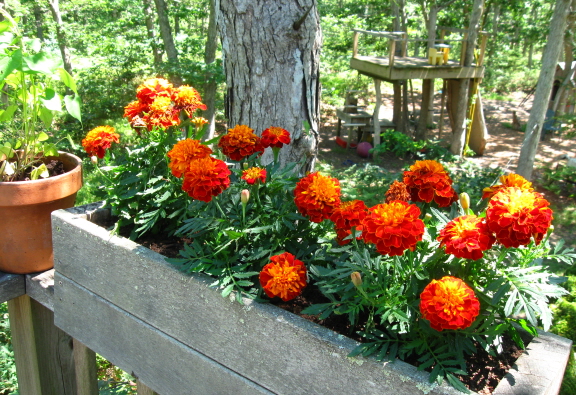
Marigolds on deck

So this is how my garden grows, despite my almost total lack of knowledge of how to garden: pretty well, thank you. If you need any tomatoes in the next few weeks, give a shout.

Posted in home | Tagged , , , , | 5 Comments

The Most Important Credential

In the late fall of 1976, I was driving west on the Boston Post Road (Route 20) toward my evening job as a proofreader in Sudbury. West of Wayland in those days, the Post Road was a sleepy two-lane road with fields and bogs and water on either side of it. Abruptly I was watching the asphalt through someone else’s eyes. Her name was Jamie Averill. She was driving, very reluctantly, to her younger sister’s wedding. She was wearing a long plaid skirt fastened with a kilt pin, and she was driving a VW bus; I was wearing jeans and driving my late grandmother’s Rambler sedan.

Jamie was the protagonist of a novel. I was supposed to write the novel?

The following spring, I moved back to D.C., got a job, immersed myself in the feminist women’s community, and came out. Life took a sharp turn for the better. I started writing a lot, mostly book reviews and occasional feature stories for the feminist and gay press. Writing, I realized, was my way of responding to the world around me and forging my connections with it. The long-haul isolation of writing a novel I was nowhere near ready for.

But Jamie did not go away. Through girlhood and into her teenage years, she had spent part of each summer on Martha’s Vineyard, at a small horse farm belonging to family friends. Around 1984 the farm owner called Jamie out of the blue and asked her to come manage the horse operation. Jamie said yes. I was outraged. If she could move to Martha’s Vineyard, why couldn’t I?

I moved the following summer. I did not have a job lined up; I had saved enough money to live on very frugally for about a year. I told people (and myself) that I was going to work on my novel. Aside: This is a horrible cliché. If you move to Martha’s Vineyard, do not tell anyone that you are coming to work on your novel or your screenplay. They will assume that you are a trustafarian with more money than motivation and that you intend to drink, drug, or meditate yourself into oblivion without your family looking over your shoulder.

What I wrote my first two years on Martha’s Vineyard was poetry. I was still writing essays, reviews, and other features for the feminist, lesbian, and gay press, but poems were my way of responding to the strange new world I was in. I wrote a sestina about carrying no keys because no doors were locked. One of my earliest MV publications was “Sonnets on a Planning Board Meeting,” published in the Vineyard Gazette in 1986.

Back then you only had to be here a year or two to understand that (1) you didn’t know diddly about Martha’s Vineyard, and (2) Martha’s Vineyard didn’t care what you thought anyway. I put the novel aside. Around 1987 I got drafted as a temp typesetter at the Martha’s Vineyard Times, which turned into a permanent part-time gig as proofreader and eventually the job of features editor. I wrote theater reviews, I wrote feature stories, I rewrote a few million press releases, and proofread (read: copyedited) just about everything that went into the paper. I listened. I listened a lot.

After a few years of this, I knew just how little I knew about Martha’s Vineyard, which is to say that I’d attained probably the most important credential a writer who wants to write about Martha’s Vineyard can have. In 1993 I wrote “Deer Out of Season.” Both I and the editor who bought it for a short-story collection thought there was a novel in there. We were right, but it took a while to get there: the novel was The Mud of the Place, which was more or less completed by 2003 but not published till 2008. The novel I was writing when I moved here still isn’t done. It probably never will be, but one of its main characters has barged into The Squatters’ Speakeasy. She’s creating quite a ruckus.


Posted in writing | Tagged , , , , , | 4 Comments

Here and Not-Here

The UPS Store, Vineyard Haven

My editor at the Women’s Review of Books needed the scan of an album cover to accompany my review of Alix Dobkin’s My Red Blood: A Memoir of Growing Up Communist, Coming onto the Greenwich Village Folk Scene, and Coming Out in the Feminist Movement (wonderful book, by the way; Alyson Books, 2009). My scanner couldn’t oblige, and calling around I couldn’t find anyone who could make a print-quality scan from a 12 1/2 by 12 1/2 inch original. UPS to the rescue. I sent the album cover — three of ’em, in fact — off yesterday afternoon.

No island is an island, and UPS, along with the other freight carriers, is part of the reason. The UPS Store arrived on Martha’s Vineyard in 2005; the big brown trucks were familiar sights on island roads for decades before that. By 2005 at least half my editing jobs were arriving electronically, but New York trade publishing was and still is very much wedded to paper. My trade clients overnight me the manuscripts, I edit them with red (occasionally green) pencils, and overnight them back by the appointed deadline.

Before the UPS Store, I drove to the Mailroom in Edgartown to return manuscripts to a publisher client that picked up the cost for FedEx. The rest of the time I used the U.S. Postal Service’s Express Mail. This made my clients nervous at first, but Express Mail was close to drop-dead reliable and they got used to it. Then a precious parcel arrived in New York several crucial hours past the guaranteed time, and in trying to ascertain what had gone wrong — and get a refund — I got into a phone squabble with a snippy USPS employee in Providence. I didn’t get my refund, but the UPS Store was in place by then so I haven’t used Express Mail for work again either.

Sidekick, illegally parked outside UPS Store

When my right retina detached in August 2004, I’d been off-island exactly once in the preceding two and a half years, and that was a day excursion by small plane to a horse event in New Hampshire. My friends were horrified. I was a little surprised myself. But I wasn’t exactly cut off from the outside world. I’d been online for ten years by then and in regular communication with writers and editors, horse and dog people, from literally all around the world. And for five years close to 100% of my livelihood had been coming from off-island, via the internet, UPS, FedEx, and the U.S. Postal Service. I was crossing Vineyard Sound several times in a single day, all the while my physical self remained at home.

I believe that being grounded in a place, rooted in a place, knowing a place, and — maybe most important — letting yourself be affected by a place are all incredibly important. I belong here more deeply and fully than I’ve ever belonged anywhere. But still I spend plenty of time on the virtual plane, involved in lives that are taking place in Ireland, Ontario, Indiana, Utah, Australia, and a few dozen other places. It’s a delicate balance I’m trying to maintain, here and not-here at the same time.

Posted in Uncategorized | Tagged , , , | 8 Comments

The Backside of the Knitting

Deep background: Long time ago, like when I hadn’t been around very long, I was astonished by what looked like the ineptness of most town governments. (We’ve got six towns on Martha’s Vineyard, plus the County of Dukes County — no kidding, that’s the official name — which includes mostly Martha’s Vineyard but also the Elizabeth Islands just across the water.) My first theory was that change had come too fast and the town governments, mostly run by “locals,” hadn’t caught up.

Wrong wrong wrong. Boy, was I wrong. Took quite a few years to even begin to get a handle on it.

Fast forward: WordPress software, without which this blog would not be happening the way it is, offers a draft feature. I can start a post, save it as a draft, and tweak it as necessary till it’s ready to “publish.” Cool.

Last Friday I started a post about the resignation of Michael Dutton as Oak Bluffs town administrator. I thought this resignation was overdue. Dutton had made several high-profile mistakes, some related to finances and procurement procedures. It was past time for him to get out. I wasn’t done, so I saved it as a draft.

I still haven’t finished that post. I started wading through all the he said/she said that follows in the wake of a resignation or other newsworthy event, and I mentally reviewed what I’d heard over the months from friends in town. Pretty soon I was tied up in knots. I could see this one’s point, but I was pretty sure that one had a grudge against this other one that probably colored his comments, and whenever an outspoken female gets trashed on Martha’s Vineyard you can absolutely assume that sexism is involved. I thought of how much entertainment Oak Bluffs town government has provided over the years (my town of West Tisbury is positively staid by comparison), and that maybe my impulse to write about the resignation was really about making more fun of the town. Oh yeah, and I’ve known various members of the Dutton family for years and I didn’t want to make any of them feel crappier than they probably do already.

I’m not going to finish that post. I’m offering this one instead. What looks like ineptness, unbearable procrastination, and even corruption in town government often has to do with the fact that when you’ve been around for a while, you have first- and secondhand knowledge of almost everything that happens, and all of it makes some kind of sense. This does not make you want to march into a meeting laying about you with a broadsword. You’d probably cut someone you like, or one of their kin.

So though we may be pointing fingers and baying for blood in private, in public we tend to be circumspect. When something really needs to be dealt with, we can put it off forever.

The ones who march in and start laying about with broadswords tend to be more recent arrivals. Ineptness and inefficiency bewilder and infuriate them. They’ll root it out PDQ! But they don’t see the relationships and histories that lie behind the public picture — what I like to call “the backside of the knitting.” Passive resistance may well greet their decisive action, but often it’ll have lasting consequences.

Systems in long-evolved equilibrium nearly always lose to incomers who have no stake in the equilibrium. Hence Native America lost to the Anglos and the Spanish, and hence Martha’s Vineyard continues to lose ground to well-heeled new arrivals with their minds bent on improvement.

Posted in Uncategorized | Tagged , , | 4 Comments

Thanks for the Fantasy

Dear B—,

Thanks so much for the invite to the two-day Rally-O trial in New Hampshire later this month. For sure I’d rather be there than here on Martha’s Vineyard at the height of tourist season, but I just can’t make it. Shelling out $90 for a round-trip ferry ticket is daunting, true, though my Inner Summer Person is sneering at me: “90 bucks? Get outta here. We pay $135 round-trip to get here from the mainland. You year-round people have it easy, and besides you live on Martha’s Vineyard. You should be grateful.

Yeah, right. I paid $4.259 a gallon for gas yesterday at Up-Island Automotive, best gas price on Martha’s Vineyard, and I can’t remember the last time I gassed up for less than $4/gallon on this side of the water. If I drove to New Hampshire, I could remind myself that somewhere in the wider world gas prices begin with a 3.

The real problem isn’t the cost of the ferry ticket. The real problem is that centrifugal force tethers your mind to the rock and your body forgets it can move: If you start swimming from Vineyard Haven harbor, you won’t have cleared the jetty 24 hours later. You’ve lost the Martha’s Vineyard where you live most of the year, and you’re not sure you’ll ever find it again.

Right now the summer is c-r-a-w-l-i-n-g by. We’re not halfway through July yet? It’s still more than a month till the fair? No, we aren’t, and yes, it is. Schoolkids love this, and I confess it has its attractions — three whole weeks till rent’s due! — but getting off-island for a couple of days makes the summer go faster. Why? Partly it’s the anticipation, partly it’s the being gone. Whyever it happens, I could use a little acceleration.

So I’m going to indulge myself in a little fantasy. Friday night the 22nd I’ll visualize myself packing trusty Malvina Forester, and Saturday morning I’ll rise at first light, load Travvy in the car, and head off for an early boat. 6 a.m. or 7? Whatever I can get. We’ll make our usual pit stop near the Falmouth Ice Arena, top off the tank for $3.60/gallon or whatever it is, then head off to New Hampshire. We’ll get home late Sunday night, and when I wake up Monday morning August will be just around the corner, the fair less than a month away.

Thanks again for the invite, B. I’m sorry we can’t make it, but you’ve just drawn September a little bit closer.

Hope to see you at the fall trials!

Susanna and Travvy


Posted in Uncategorized | Tagged , , , , , | Leave a comment

I, Trobairitz

The program cover

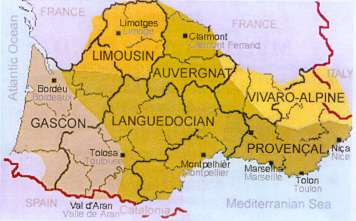
What’s a trobairitz? Why, a female troubadour! Troubadours and trobairitz were traveling musician-poets in twelfth- and thirteenth-century Occitania, in the south of what is now France (see map below). They sang, they wrote, they carried the news — and they pretty much invented romantic poetry of a distinctly sensual and erotic kind.

This afternoon the West Tisbury Library presented a reprise of last summer’s popular program, The World of Troubadours and Trobairitz: Poems, Songs, and Music. Most of the performers were returnees; all the material was new. A most welcome first-timer was Marisa Galvez, an assistant professor at Stanford University who specializes in the literature of the Middle Ages. She provided an introduction to the period and to the significance of the troubadours and trobairitz.

Occitania, land of the troubadours

There followed readings of poems — by me, among others — and musical interludes by Deborah Forest Hart on recorder and hammer dulcimer, Carol Loud on recorder, and Andy Weiner on hammer dulcimer.

The musicians

The pièce de resistance was a performance by Jessica Goodenough Heuser, a young soprano who specializes in early music and is, as she noted, a sort of trobairitz herself in that she travels to schools and other venues to sing her songs. She’s also the granddaughter of program producer Paul Levine, a retired Stanford professor who is currently working on a novel that draws on both the creative and the genetic legacy of the troubadours and trobairitz. The troubadours make fascinating reading. If you want to learn more, here’s a place to start: http://www.midi-france.info/1904_troubadours.htm. Continue reading

Posted in music | Tagged , | Leave a comment