Seasonal

Most of my time on Martha’s Vineyard I’ve lived in year-round neighborhoods. Mind you, with a couple of exceptions these wouldn’t be recognized as “neighborhoods” by most urban and suburban dwellers, not least because the dwellings are too far apart. What I mean is that we live in close enough proximity to recognize each other’s cars, kids, and pets. We know each other’s houses well enough to notice when something’s changed, and we know each other well enough to ask the occasional favor or borrow a couple of eggs.

“Year-round” means that you see the same people on the road summer and winter, spring and fall; nearly all the houses are occupied 12 months of the year. On our walks, Trav and I pass two that are seasonally occupied, but in both cases the owners make occasional short visits during the off-season and there are plenty of year-rounders in the vicinity to keep an eye out.
Nobody's home

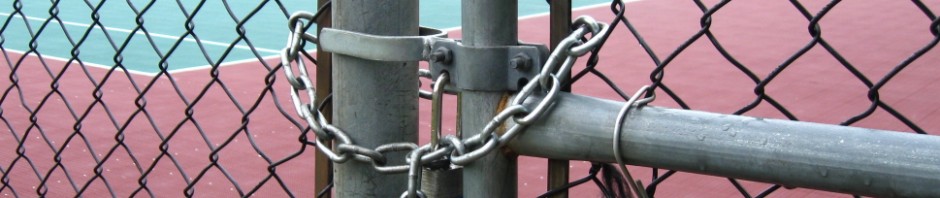
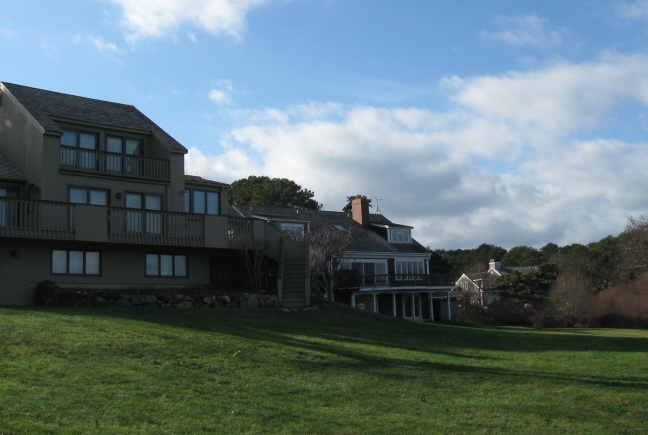
Recently circumstances took Trav and me to a subdivision where the opposite is true: almost none of the houses are occupied 12 months of the year. Only two of several dozen are occupied right now, in mid-December. It felt like walking around a small town all of whose inhabitants had vanished into another dimension, leaving only their houses and an infrequent car behind.
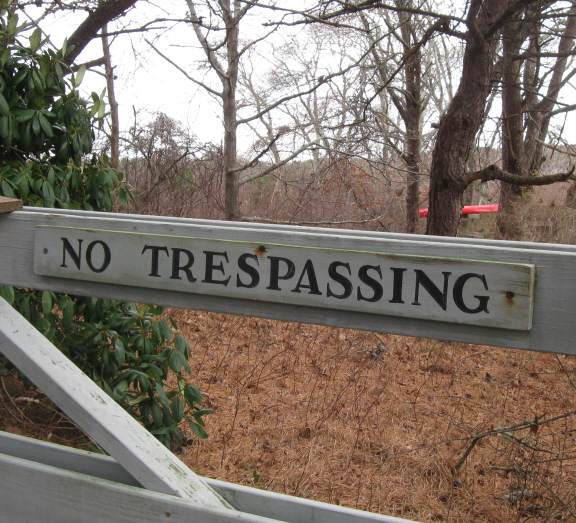
In my teenage and young adult years I spent plenty of time on Tisbury Great Pond. Virtually none of those houses — generally known as “camps” — were occupied in the winter, and for good reason: they weren’t insulated, and the only heat sources were sunlight and a fireplace. The houses in this subdivision are houses, real houses, with electricity, phone, cable, and all the appliances you’d expect in an affluent suburb. They’re big enough to comfortably house a family of six whose members can’t stand to be in each other’s presence.

In a neighborhood, neighbors keep an eye out for anything out of sync. An unfamiliar vehicle in someone’s driveway? A window open that shouldn’t be? Someone doesn’t leave at the usual time in the morning or come home at the expected hour at night? In this expansive neighborhood, there are no neighbors. Trav and I strolled at will across lawns and around houses. I peered through windows and looked under decks. I had a plausible reason for what I was doing, but no one asked me to explain myself.

In the absence of neighbors, security is provided electronically. Maybe Travvy and I now appear in the video annals of a local police department or security company. Maybe someone’s decided that no bona fide security threat would be casing the joint with an Alaskan malamute in tow.
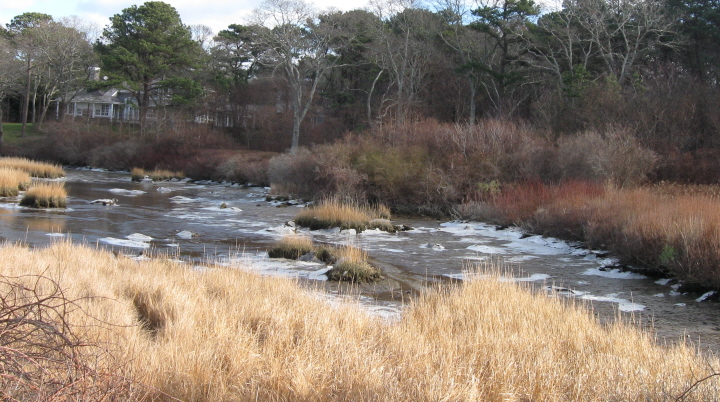
In my early years as a year-round Vineyard resident, I was amazed by the sight of snow on beaches. It had never occurred to me to wonder what the summer beaches I knew so well looked like when I wasn’t there. Winter after winter I’d go back to Lambert’s Cove Beach to marvel at the glittering patterns made by wave action under semi-frozen saltwater. The subdivision I visited features several ponds, and at least a dozen ducks weren’t heeding the “no swimming” signs. The temperature had dipped to the very low teens the night before, skimming some ponds with ice and framing the biggest one with frozen undulations. I’m here and you’re not, I thought.
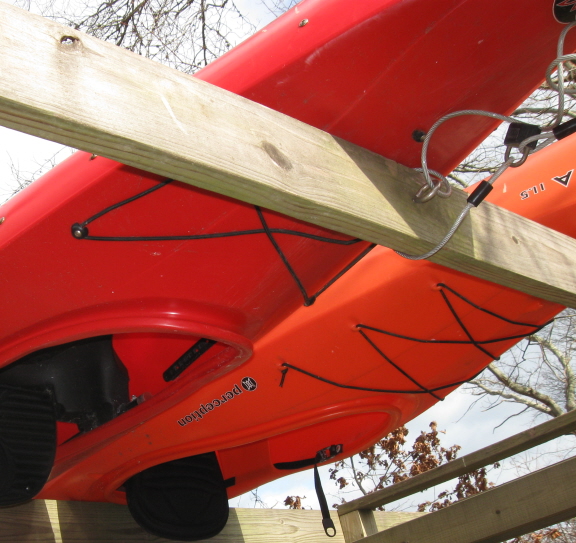
The kayaks in winter

In my prowling, I spotted precious few clues to the personalities of the absent people. The blocky houses are different from one another, but they look to have been made from the same kit. Many have first- or second-story decks accessed by sliding doors, ideal for summer entertaining, and sure enough, I saw several propane-powered grills either on the decks or stowed underneath. Quite a few of the seasonal householders do, it seems, like to take to the water. Sengekontacket Pond is close by and reachable by water by a shallow-draft craft. Kayaks fit the bill, and indeed I saw several, hibernating under decks or shrubbery or elevated on wooden storage frames. Winter colors are subtle. The kayaks glowed with the bright hues of a warmer season.

Water view, with no viewers

When I moved to Martha’s Vineyard in 1985, I knew exactly one year-round resident. Within two years the balance had shifted dramatically: I still knew all the summer visitors I had known when I was one among them, but now they were far outnumbered by the year-rounders. A gentle but strong current slowly pulled me away from most of them. They were only here between June and September, the months when I was working my butt off and living in a friend’s house till I could find my next winter rental. Wandering through this deserted subdivision, I guessed that most of the people who come every summer to live in these houses hang out with each other and go to each other’s parties. What year-rounders they know are probably tradesfolk, caretakers, and housecleaners, and they probably don’t know where or how those tradesfolk, caretakers, and housecleaners live. They don’t know that I was sauntering through their neighborhood, or why.
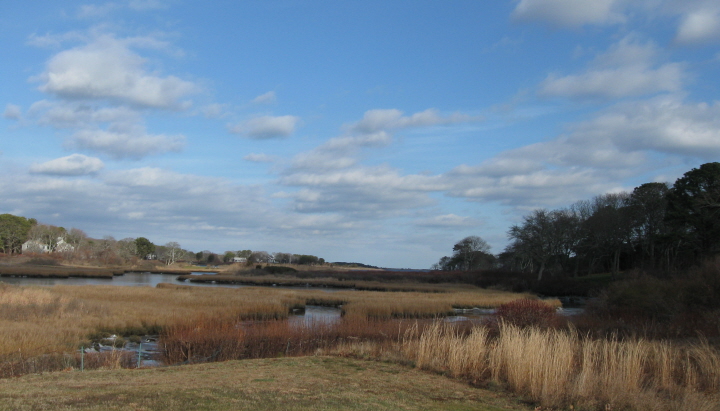
Looking toward Sengekontacket Pond. On the far side of that is Beach Road, and just beyond that is Nantucket Sound.

Posted in Martha's Vineyard, tourism | Tagged , , , , , | 7 Comments

Digital Dynamism

Talk about the “digital divide” has been de rigueur for years now. It’s generally taken to refer to the gap between those who have access to computers and the Internet and those who don’t, and/or to the quality and quantity of whatever access they’ve got. These are significant issues to be sure, but what intrigues me is how Internet access shapes one’s psychic map, and how my own map has evolved along with my relationship to the Internet.

Back in August I wrote about how we who live on Martha’s Vineyard don’t live on the same Martha’s Vineyard. Cyberspace is far shiftier than Martha’s Vineyard. And while people who’ve never laid eyes on Martha’s Vineyard can get some idea of what some of it looks like by looking at photographs, cyberspace is hard to imagine until you’ve been there.

I’ve had my own PC since 1985 and been online since 1994, when I signed up for GEnie so I could participate in its Science Fiction Roundtable (SFRT). My first view of cyberspace looked like old GEnie’s Aladdin interface, which was DOS-based: all lines, right angles, and words. The only graphics were those created with ASCII characters, like the simple long-stemmed rose that heralded the passing of any significant figure in the fantasy/science fiction world. I thought of the SFRT as a conglomeration of salons, some presided over by authors, others devoted to particular topics.

My virtual home

I’m not an early adopter of anything, and I’m especially slow to adopt anything that’s touted as the next wonder of the modern world. Since mid-2005 my website has been my home in cyberspace, a combination bulletin board and attic where I could both store stuff and let people know what I was up to. Beyond the standard contact form it wasn’t the least bit interactive. Surely that was enough? What did I need with Facebook?

Besides, I already spent plenty of time in front of a computer screen: I’m active on several e-lists, nearly all my communication with clients is via e-mail, I do work-related fact-checking online, I buy stuff online, and in recent years I’ve started doing most of my banking, bill paying, and ferry reservation making online. One thing I like about living on Martha’s Vineyard is that so much of it is face-to-face. I didn’t want to estrange myself further from the material world of dirt, dog fur, and flesh-and-blood people.

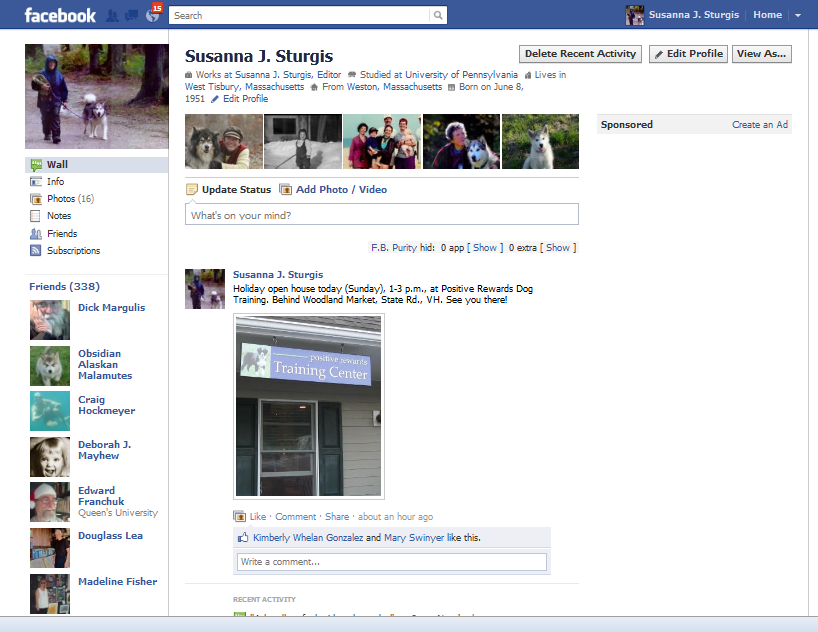
My FB profile, December 18, 2011

In a what-the-hell moment last January I finally got myself onto Facebook. It didn’t look like I expected it to look, which was something like my website. It took a couple of days to get the hang of it, but one big advantage of being a late arrival is that many of your friends have gotten there first and can show you the ropes.

Within a very few weeks Facebook — FB to its initiates — had surprised me several times and rearranged my understanding of cyberspace. My profile page, like my website, was fairly static, but my news feed was like a river, sparkling, eddying, flowing ever onward. Now that I’ve accumulated a few “friends” — 338 at last count — my news feed incorporates updates and photos from horse friends, dog friends, Martha’s Vineyard friends, editor and writer friends, and an assortment of feminist and progressive projects.

The juxtapositions can range from hilarious to thought-provoking. The horse and dog friends tend to be considerably more conservative than the writers and editors, so anti-Obama screeds roll by in the wake of links to articles excoriating one or more GOP presidential candidates. The Australians are sunbathing while the northern North Americans are decking ourselves out in down and longjohns. I know all these people! I marvel, grinning with delight.

Another surprise is that FB hasn’t estranged me from my real-time community; it’s immersed me in it differently and more deeply. I find out about and often attend events that I wouldn’t have found out about otherwise. People I’ve had a nodding acquaintance with for many years turn out to have facets I never noticed before; I meet people for the first time that I’ve already gotten to know on Facebook. Cyberspace and the material world flow in and out of each other. Nothing in my growing up prepared me for this, but still I manage to adapt without much difficulty to the additional dimension.

Blogsite

Facebook is like circulating through a party thronged with interesting people. The music is loud enough to hear clearly but not so loud that it drowns out conversation. You overhear an intriguing remark, drop in a response, then whirl on to the next cluster of people. The scene doesn’t lend itself to deep philosophical discussions or extended political debate, but you pick up plenty of thoughts worth following up on. The interaction that is Facebook prompted me to start the year-round Vineyarder’s blog that I’d been thinking about for a couple of years: From the Seasonally Occupied Territories launched in July and has become yet another virtual home or hangout.

Barely a week ago I acquired my very first hand-held digital device: a Nook Color. It’s an e-reader that can download books, access the web, play music, and show movies. No sooner had my little Nook brought e-books into my life than I started thinking of turning Mud of the Place into one.

Make it real . . .


Posted in Martha's Vineyard, musing, technology, writing | Tagged , | 3 Comments

Dogs I Have Known

Anda Divine

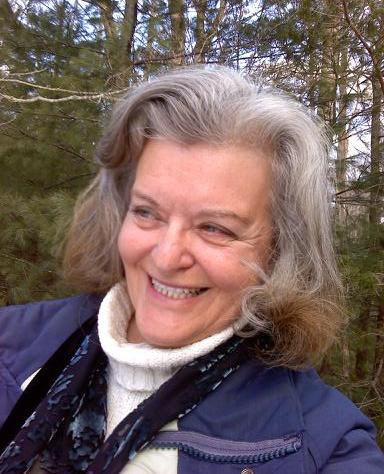
Here is From the Seasonally Occupied Territories’s first guest blog. It arrived as a comment but I think it’s too cool to get buried at the end of another post. No, it’s not about Martha’s Vineyard, but it’s about dogs and it’s written by a farmer — both good Vineyard topics, right? The author, Anda Divine, is a freelance book editor who also runs a small organic farm in the Blue Ridge Mountains in western Virginia.

A friend sent me this link to a photographer friend of hers, Mary Ludington, and I particularly loved the Dogs portfolio, which brought to mind the following snippets of dogs I have known.

Rhodesian Ridgeback: A long-ago friend of mine had a Rhodesian Ridgeback, whom I never met but who lived on a sheep farm in central Massachusetts. I always worried that this dog, whose ancestors were bred to hunt lions in Africa and thus had thin skin and virtually no coat, would suffer in the deep New England winters but apparently he thrived and even loved to romp naked in the snow.

French Bulldog: When my east-coast friend Susan lived in South Minneapolis, she and her partner had two male French Bulldogs — strictly indoor dogs who were the most most neurotic, oversexed animals I have ever met. They humped each other; they humped my leg; they humped a leg of the dining room table; they tried to hump the cat. Completely preposterous.

Golden Retriever: I gave my former partner a Golden Retriever puppy as a Christmas present in 1982. The puppy had a pale golden coat so we named him Sunny. Unfortunately, he bonded deeply with me instead of my former partner, which caused considerable friction in the household. Someone stole Sunny from our farm while I was at work. He is the only dog I have lost this way, and I was heartbroken.

Australian Shepherd: When my own sheep flock in Wisconsin reached the unmanageable size of 150 ewes and 225 lambs, I acquired a well-bred Aussie to work them with me. His name was Zack and he was terrific — smart, vigorous, no-nonsense. He, too, bonded deeply with me and actually came to despise my former partner, who, fortunately or unfortunately, wasn’t at the farm very often. When my former partner was at home, Zack took to crapping right under her home office desk, which caused even more friction in the household.

Border Collie: After Zack died, I needed another sheep dog, so a sheep farmer neighbor, Roger, gave me one of his, a black-and-white Border Collie named Lady. Well, sometimes there’s a reason why people give a seemingly generous gift. Lady was half-crazed with the sheep—she worked them much too hard and it was hard to call her off. Roger thought maybe I could reduce or eliminate this trait by retraining her but I could not. Lady went back to live with Roger and my sheep and I were restored to placidity.

Belgian Tervuren: It’s important that dogs live in environments suited to their temperaments, and also (usually) that they have a job to do. My Minneapolis friend Paula broke both of these rules when she acquired a beautiful male Tervuren some years ago. This is a working breed of dog, developed to herd cattle and sheep in northern Europe. They are high-energy, highly intelligent, and must have something to occupy their minds. Unfortunately, Paula lives in a second-floor apartment and she works full-time, so here this magnificent animal wound up indoors and bored up for hours on end. Not surprisingly, he started to misbehave and Paula became alarmed. I advised her to either commit to getting this dog involved in agility training and regular workouts and competitions (cattle and sheep being somewhat scarce within the Minneapolis city limits), or pass him on to a more appropriate owner. She did the latter and soon the dog was thriving on a cattle farm in Owatonna, Minnesota.

Afghan: I lived deep in the city of Seattle in 1972 but by early 1973 I had rented a small farm 40 miles to the east, near Issaquah in the foothills of the Cascade Mountains. One morning I awoke at dawn and saw, out my bedroom window, mist rising from the damp fields. It was so early that the birds weren’t even singing yet, so the silence was profound. Suddenly two adult Afghans, buff-colored with black muzzles and ear tips, plunged into view, romping and dog-playing and bounding in huge circles around each other in complete silence. Their long hair flowed and glistened in the backlit mist and their breath clouded around them, and their eyes gleamed and their teeth flashed and they leaped and swooped faster and faster in joy and then suddenly they whirled away. I thought it was a dream; I realized that I had stopped breathing.

Doberman Pinscher: Half a mile from my house here in the Blue Ridge Mountains lives a male Doberman named Princess. His owner is a beefy, unkempt guy named Gary who gave this dog the name Princess because he (the dog) has a ridiculous high, squeaky bark that I can hear at all times of the day and often well into the night. Princess, in spite of his name, often and loudly asserts his presence to all concerned: cardinals, chipmunks, wrens, and voles.

Goldie tricked out to go on a therapy visit. Her heart-shaped collar tag says "I am a Therapy Dog." Anda rescued Goldie, a yellow Lab/Beagle mix, from a no-kill shelter in Tennessee in 2005.

Brittany Spaniel: My neighbor Bill, another fairly hefty guy, recently acquired a lovely, fine-boned female Brittany named Bella. Bill is doing a good job of training her, so Bella usually stays in her own yard. But earlier this year when I had chickens and I allowed them to roam freely in my yard, the temptation proved to be too much for Bella and one afternoon she came charging into my yard while my dog Goldie was napping on the porch. The chickens scattered screeching into the trees, of course, and Goldie was so startled that she didn’t know what to chase first, Bella or chickens on the move. Bella had so much momentum going that she accidentally wound up inside the open chicken pen where there were no chickens, and she just stood there looking around until Goldie descended on her and they mixed it up a bit, and then Bella tucked tail and ran back home and has never come back since.

German Shepherd: For all of my life I have longed for a bona fide purebred dog, something that could actually be called something, like a Boxer or a Schnauzer or a Vizsla or a Cavalier King Charles Spaniel. But I’ve almost always had to make do with mutts — Nikki (Rat Terrier/?), Mandy (?/?), Bear (white Shepherd/?), beloved Rubin (Shepherd/Collie), Bruno (Shepherd/Doberman), Harriet (Shepherd/Boxer?), and Goldie (Yellow Lab/Beagle). Since “Shepherd” appeared frequently in these mixes, I once tried to acquire a top-of-the-line, CDX (Companion Dog Excellent)-caliber purebred German Shepherd from the best breeder I could find in the United States. That turned out to be the monks of New Skete, who since 1966 at their monastery in upstate New York have raised and trained unbelievably fine German Shepherds descended from the best sires imported from Germany. To be given the privilege of buying one of their puppies I would have to fill out a four-page application form and provide three character references, put down a deposit of $500 against the final price of about $1,500, and be willing to wait for a year to be granted a puppy. I would have to sign a contract avowing that I would take this puppy through professional obedience training and I would provide regular updates (text and photos) on the dog’s progress. Well, I became concerned that I would be intimidated by the provenance of said puppy and would lose sleep over whether I was a fit enough owner and that maybe said puppy, when he or she grew up, would wind up actually running the household, so I backed off. Sometimes I see a fine specimen of a German Shepherd in the city—always vigilant at its master’s side, always indifferent to urban temptations of squirrels and stray cats, always majestic—and I think I probably dodged a bullet.

Posted in dogs | Tagged | 1 Comment

Off-Island

When you live on an island, going off-island is a big deal. I live in West Tisbury. It’s about nine miles to Edgartown. It’s only seven miles to Woods Hole, but Woods Hole is much, much, much farther away than Edgartown. I can drive to Edgartown, complaining all the way about how far it is. To get to Woods Hole, I have to take a boat. Boats run on schedules. I am chronically late. Not very late, just a little bit late, but the SSA ferries wait for nobody. Deadlines are a big deal even if you’re not an editor.

Boats also cost money, especially if you want to drive: this time of year it costs me $59 to take Malvina Forester off and bring her home; in summer it costs $88. Even when gas costs well over $4 a gallon, it does not cost nearly that much to drive to Edgartown.

Because going off-island is such a big deal, we tend to exaggerate the differences between here and there. At least that’s one of the reasons. Sometimes we talk about off-islanders as if they’re a whole different species. This is peculiar because many of us were in the distant or not-too-distant past off-islanders, at which time we considered ourselves pretty ordinary. If you listen to us talk, you’d think that off-islanders were desperate people who wouldn’t give each other the time of day, never mind the shirt off their back.

Trav and his latest haul

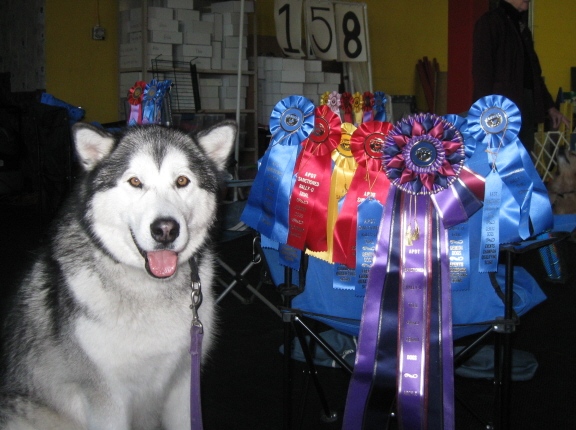
That’s the prologue. In case you hadn’t guessed, I went off-island this weekend. I went off-island to compete with Travvy in a Rally Obedience trial. If you’re reading this blog mainly because you want to see pictures of Travvy, here he is. Yes indeed, we had a good weekend.

My other objective was technological. When Amazon.com started promoting the Kindle Fire, I knew I wanted one. At least I wanted a tablet-like e-reader kind of thing. After doing a dizzying amount of research in a short period of time, I decided that I didn’t want a Kindle Fire at all. What I wanted was a Nook Color. I could have ordered one online, but one side-effect of living on this particular island is that I like to deal face-to-face whenever I can. Staples carries Nooks, there’s a Staples in Falmouth (of which Woods Hole is a part), so Committing Nook became an objective for this trip off-island. So what if Staples is not a mom-and-pop office supplies store. Real people work there, and I wanted to buy my Nook from a real person.

I went, I saw, I bought.

When I got to the Motel 6 in Leominster, I discovered that I’d left my credit card behind. Uh-oh. Being a frugal New England girl, I had enough money in my checking account to cover my motel bill with my debit card. Then I set out to locate my missing credit card. Uh-oh again. I couldn’t call Staples from my motel room because MCI no longer accepts credit cards, and third-party billing didn’t work because neither Travvy nor I was home to accept the charges. I set Hekate O’Dell up for Google’s phone service but it didn’t seem to work. For about the first time this year I wished I had a cell phone.

I left Travvy in his crate and walked over to the motel office. Could I maybe talk the desk clerk into letting me make a phone call? Aha! I didn’t have to talk anyone into anything: she immediately volunteered to make the call for me. She dialed, and handed me the receiver. I talked to someone at Staples. They said they’d call me back in five minutes. I gave them the motel’s phone and my room number, then I went back to my room. It might have been more than five minutes, but it was definitely less than ten before the phone rang. Staples had my credit card. Yes, I could pick it up on my way home. Sundays they were open till six.

So we had a very good weekend. Trialing with an Alaskan malamute is always an adventure. This judge, Sumac Grant-Johnson, likes to tell competitors that they can give her one of two things: a great performance, or great entertainment. When we showed under her before, Trav proved that it was possible to combine good performance with good entertainment. This time, Trav turned in seven solid performances in our eight runs. The eighth run was the entertainment: he made a beeline for the exercise that included food bowls, I made a beeline for him, and we aborted the run there.

In Rally, handlers are encouraged to talk to their dogs during a run; Trav sensibly figures that dogs can likewise talk to their handlers, and he does. Another competitor told me that she loved Susan Conant’s mysteries, which usually feature malamutes, but she’d never known exactly what “woo-woo-woooo” sounded like. Now she does. Thank you, Travvy.

We came home with a sheaf of new ribbons and our first Rally championship title. After dark on Sunday, we rolled into the parking lot outside the Falmouth Staples. I retrieved my credit card from friendly, courteous people. Having decided to splurge on some vodka and Kahlúa for these cold winter nights, I strolled up to Kappy’s discount liquor store. Two high school girls were selling raffle tickets to raise money for their spring trip to Washington. I bought a book, and got into a conversation with the father of one of the girls by saying that I used to live in D.C.

Then it was on to Woods Hole, filling the gas tank on the way. We missed the five o’clock, but my reservation was for 6:15. I had just enough time to buy and eat a turkey roll-up from Pie in the Sky, then the boat was loading.

Off-island really isn’t all that much different from Martha’s Vineyard, except the distances are longer and the gas costs a lot less.


Posted in dogs, Martha's Vineyard | Tagged , , , , , | 2 Comments

Monster Houses

Before I lapsed from monotheism, I was confirmed in the Episcopal Church. My parents said that if I completed confirmation class, I didn’t have to go to church anymore. (They didn’t put it quite that way, but close enough.) Some 47 years later, I still remember two things from confirmation class. One was that up to almost the last minute, horsegirl that I was, I thought it was conformation class.

The other is the definition of a sacrament. I can still rattle it off verbatim: “the outward and visible sign of an inward and spiritual grace.”

The concept drifted from its theological mooring and took deep root in my supposedly secular brain. To my mind, voting is a secular sacrament: the outward and visible sign of something less tangible — democracy or vox populi or whatever you want to call it. If the less tangible something isn’t there, the voting becomes an empty ritual. Elections alone, even “free” elections, do not a democracy make.

It just dawned on me that we have negative sacraments: outward and visible signs that something within is very screwed up. Take the trophy houses and mega-mansions of the very wealthy. We mutter about them at least as much as we mutter about mopeds, and unlike mopeds they don’t go away at the end of the summer.

Monster house on West Chop. Vineyard Gazette photo by Steve Turner.

Last Friday’s Vineyard Gazette (December 2) carried a story headlined “As MVC Considers Regulating Large Houses, Builders Cry Foul.” Last week the Martha’s Vineyard Commission’s land use planning committee met to consider making changes to the checklist it uses to decide whether or not a project is a DRI (development of regional impact). Yes indeed, this is the same MVC that managed for years to not-consider the proposed roundabout a DRI.

Arrayed on one side, according to the Gazette story, were island conservation groups, notably the Vineyard Conservation Society (VCS). On the other we had the architects of those huge houses. At one point a VCS representative called a mega-mansion designed by one of the architects present “a travesty.” That’s about as confrontational as politics on Martha’s Vineyard ever get.

Politics on Martha’s Vineyard also tend to get stuck on these negative sacraments, these symbols, these signs that something within is very screwed up. I posted this comment to the Gazette story:

Attempts to regulate the very rich are doomed to fail. In our economic system, money trumps everything, including ethics, the will of the people, and the “character of the island” (whatever that is), almost every time. But those who idealize and idolize Occupy Wall Street should take note: on Martha’s Vineyard and elsewhere many of the 99% make their livings serving the 1%. Those mega-mansions are disgusting, and the people who live in them will never, ever be Vineyarders, but how about the people who build them?

As a young antiwar activist, I learned that if, say, General Dynamics was the biggest employer in your town, your view of the defense budget and possibly the war currently in progress was likely to differ from that of someone whose income came from other sources or who had other options. Conservation groups are often, and with good reason, perceived as elitist because they don’t consider the implications of their positions for working people who are one, two, or three paychecks away from poverty.

For the most part, our material conditions shape our values. We hold the values we can afford to hold. People who have nothing to lose and people who can afford to lose a chunk of what they’ve got generally take more risks than people who are barely hanging on. Self-perception plays a role too, of course: some of us are farther from the brink than we think we are, and some of us are closer.

So I cheered when I read the comment of a fellow who, according to the Gazette story, “moved to the Island explicitly to build large houses.” This guy, Thomas Bena, said: “At every lunch break the guys and I sat around and said, ‘How the heck do you call this a home? It’s like a bus station in here and they’re only here for six weeks a year.’ For me, I had to stop being a carpenter. I didn’t feel good about it. I didn’t feel good about the work that I was doing every day.”

He sounds like a thoughtful man, and a brave one. The rules of our economic system give us no tools to deal with this, with the damage done to our psyches, our bodies, and our communities by so many of the jobs available to us. “You can always quit,” some would say, and in an ideal world we could. In this world of limited economic options and threadbare safety nets, we often can’t.

William Randolph Hearst’s mega-castle

These mega-mansions are a negative sacrament, true, a sign that our society is out of whack. Huge houses built to be empty nine or ten months of the year while so many live in cramped, deteriorating quarters — if they have housing at all? Individuals with enough money to call the economic and political shots for the rest of us, even though we never chose them to run our lives?

Well, yeah, but if I had to finger a single cause for the slow decline of Martha’s Vineyard over the decades, it wouldn’t be monster houses or the people who build them. I’d point instead to rising property values. Once land goes for a certain amount per acre, farming becomes economically foolish. Once land prices outpace what working people can afford, working people who need to make a living and don’t have land in the family leave. Those who stay are working so hard they have little time or energy to spare for the voluntary activities that keep community alive.

At the same time, those rising property values make it possible for property owners to take vacations, send kids to college, maybe even retire.

How tempting it is to blame it all on those monster houses.

Posted in Martha's Vineyard, musing | Tagged , , , , , , | 4 Comments

’Tis the Season (at Last! Maybe?)

Sure, the days were getting short and shorter and we’d had a couple of hard frosts and a few not-so-hard, but I couldn’t take approaching winter seriously as long as daytime temperatures were in the 60s (F) and people were running around in shorts and T-shirts. According to the calendar, December was getting closer, but I hadn’t done any of the things I usually do in early to mid November.

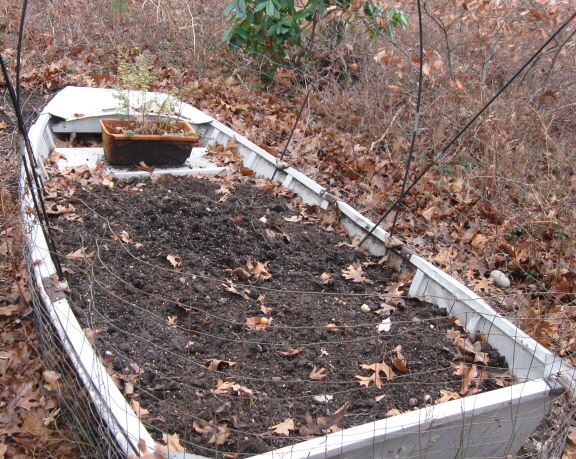
Nighty-night, dinghy garden

Contrary to James Taylor’s “Sweet Baby James,” the first of December wasn’t “covered with snow,” but the temp did take a dive from 60s to something close to seasonal. I snapped to it. First I pulled up the frost-blasted tomato and basil plants and put the garden to bed.

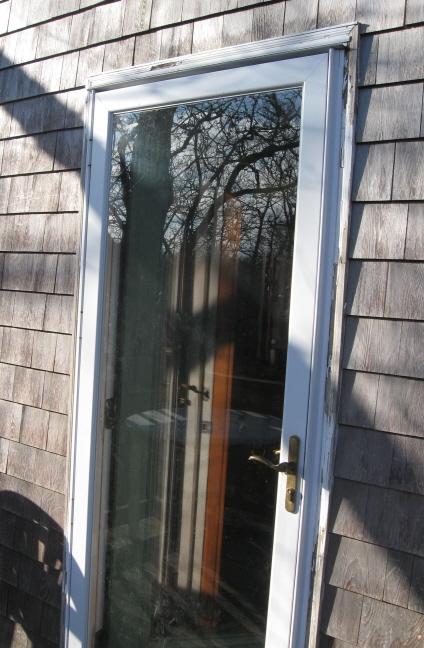
Blow, blow, thou winter wind: my storm door's up

How could I possibly remove the screen from the storm door when the main door was often open — and there were still a few hardy mosquitos and flies buzzing about?

When winter snapped, I finally got to it. The cold-weather insert is now in place.

My cold-weather companion — who for an Alaskan malamute seems to be an unusually indoor dog — is often on draft-dodger duty, sometimes inside the door and sometimes out-.

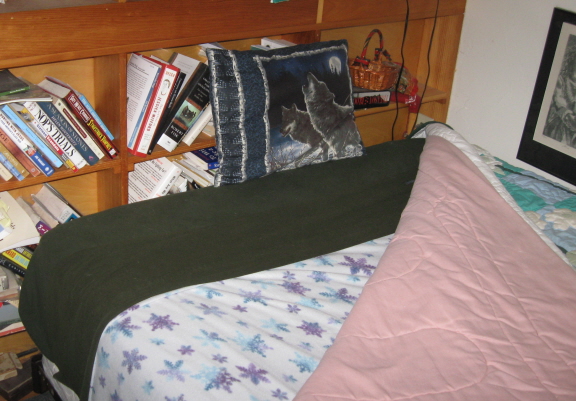
The last pre-winter prep was to put flannel sheets on my bed. I put this off partly because it was so warm and partly because I flip the mattress at the changing of the season, lightweight sheets to flannel and vice versa. The mattress is bulky, the space is tight, and I always manage to knock something over; hence I procrastinate. I had an additional incentive this year, though: the cool (OK, warm) fleece blanket I won in the Camp N Pack raffle in early October. Now my bed is ready for winter. Last night wasn’t even a one-dog night, but my one dog didn’t realize that. Between the flannel sheets, the fleece blanket, and Travvy, I might have been sleeping in the tropics.

On the first of December I also donned the first longjohns of the season. It’s a known fact that winter can be hastened and worsened by the premature wearing of longjohns, but once December 1 rolls around you don’t have to worry about that. Winter is on the way no matter what you put on in the morning.

Travvy draft-dodger

Posted in home | Tagged , , | 3 Comments

It Isn’t Nice

Last Friday’s Vineyard Gazette carried an op-ed about the roundabout by Dan Greenbaum, a retired transportation consultant who now lives in Chilmark. Mr. Greenbaum is a voting member of the Martha’s Vineyard Joint Transportation Committee, an advisory group that helped move the roundabout project forward. A letter he submitted to the Martha’s Vineyard Commission (MVC) before its September 1 public hearing was cited by more than one commissioner to support a pro-roundabout position.

So the first thing I noted about this op-ed was how lukewarm its support of the roundabout was. “Realistically,” wrote Mr. Greenbaum, “considering the advantages and disadvantages of the roundabout, it would not be the end of the world if it did not proceed at this time. Nor would it be the end of the world if it goes ahead.”

What moved Mr. Greenbaum to write his op-ed, it seems, was the controversy the roundabout proposal has stimulated, specifically its tone. Before I reached the end of the second paragraph, I’d encountered these phrases: “unwarranted accusations,” “so much negative energy,” and “extremely strong opinions and words.” The op-ed concluded with this plea: “And please, let’s avoid any more personal attacks.”

Of course I had to write a response. The writer gave no examples of what he considered “unwarranted accusations” or “personal attacks,” so I confined myself to explaining why, having followed the issue closely since it resurfaced last spring, I’m angry about what I’ve seen so far. I wanted to go further, but at 775 words my “letter” was already squarely in op-ed territory so I stopped there.

Malvina Reynolds, after whom my car is named

Recognize the source for “It Isn’t Nice,” the title of this blog post? Malvina Reynolds’s song was practically an anthem of the civil rights movement and its descendants. If you don’t know the song, or if you want to hear it again, as sung by Malvina (1900–1978), here it is.

It isn’t nice to block the doorway,
It isn’t nice to go to jail,
There are nicer ways to do it,
But the nice ways always fail.

When those in power can’t refute your arguments, or don’t want to be bothered, they love to call you rude or strident or not nice. Now I’m flashing back to the late Pat Parker’s classic “For the Straight Folks Who Don’t Mind Gays but Wish They Weren’t So Blatant.” The gist is that “we” are making “them” uncomfortable, so we’re the ones who should tone it down.

Dan Greenbaum didn’t give examples of the “unwarranted accusations” and “personal attacks” that he finds troubling, so I’m not sure what he’s talking about. In this very blog I’ve written some less than complimentary things about certain players in the drama, but they’re based on what I’ve observed firsthand and information I’ve gleaned from others. I’ve spent time blowing off steam in private with others who’ve attended the same meetings and are similarly exasperated. Better blow off steam in private than explode in public, say I.

True, less than temperate statements have been made by some posters to the Martha’s Vineyard Times website. Nothing nearly as vitriolic, however, as gets posted whenever the subject of Brazilian immigrants comes up. One commissioner did say that she found the online comments “intimidating.” As an example she cited one that said she was long-winded and never got to the point. I’m pretty sure that some people say the same thing about me. I might take issue with them, at least some of the time, but I don’t feel intimidated. If they threatened to slash my tires or kidnap my dog, then I’d feel intimidated. On the whole, I’ve found the online discussion pretty level-headed and informative.

Another commissioner, a veteran of island politics, pointed out that when you take a stand, you’re going to make some people angry. Implication: They might say nasty things about you. Still another commissioner said that he didn’t feel intimidated, even though he’s an anti-roundabout commissioner who was appointed by pro-roundabout selectmen. This is encouraging. Still, my hunch is that some of the commissioners are just a tad too isolated from divergent views, and unwilling to acknowledge that what they do in their meeting room has consequences beyond its walls.

If anything, island public opinion is too nice. We haven’t blocked any doorways or sat on any floors, never mind gone to jail. If we were really fired up, more than one commissioner would be either in the stocks or in the witness protection program. Maybe the commission’s discussions would be more incisive and lively. Who knows?

Now our new ways aren’t nice
When we deal with men of ice,
But if that is Freedom’s price,
We don’t mind.

Sing it, Malvina!

Posted in Martha's Vineyard, public life, writing | Tagged , , , , , , | 7 Comments

Artisans’ Fair

After several days of Black Friday gargantuan best-ever unbelievable don’t-lose-out bargain  e-mails, I vowed that on the day after Thanksgiving I was not going to patronize any establishment that used “Black Friday” in its PR. For a while there it looked as if this meant I would spend no money at all. This was no tragedy, since I have 95% determined that in the very near future I am going to commit Nook — whether Tablet or Color I haven’t decided, but either way that will take care of my disposable income for the next three months or so.

The Ag Hall in November

Presently it dawned on me that the Artisans’ Fair was up at the Ag Hall today and tomorrow. Neither the fair nor the artisans include Black Friday in their lexicon, and it was highly unlikely that anyone in attendance would pepper-spray her fellow shoppers in an attempt to get the best deal. As Reuters reported late this afternoon: “Up to 20 people were injured after a woman used pepper spray at a Walmart in Los Angeles to get an edge on her competitors. In a second incident, off-duty officers in North Carolina used pepper spray to subdue rowdy shoppers waiting for electronics.”

Jeri's glass

So after doing a decent amount of work and going for a bike ride with Travvy, I headed over to the Ag Hall. It was a little after three, late afternoon this time of year. The fair closed for the day at four, but there were still plenty of cars parked in more or less orderly rows in the field. What greeted me as soon as I passed through the door were the glowing colors of Jeri Dantzig’s glasswork. Nothing black about this Friday!

At least half the fun of the Artisans’ Fair is greeting friends and acquaintances among the artisans and the browsers. This I did. Tom Barrett was there, from whom I bought a most wonderful pair of brown sheepskin slippers at the Labor Day weekend fair. I told him how well-made the slippers were, and how comfortable and warm. Back in September Tom told me that he repaired damage done by dogs. I didn’t say that any damage done by Travvy would likely be irreparable. I was pleased to report that no dog damage had been done, though the brown sheepskin was now liberally garnished with malamute fur.

Photographer Lynn Christoffers, with Cynthia's cat, Daphne, looking over her shoulder

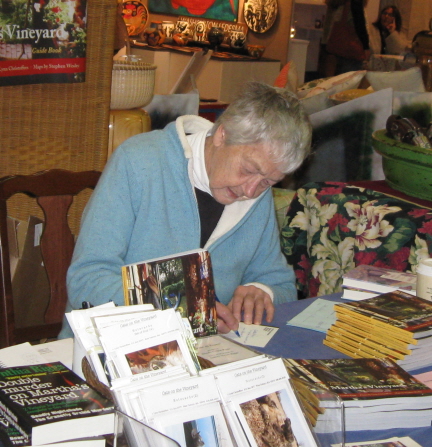
Cynthia Riggs and Lynn Christoffers were selling copies of Victoria Trumbull’s Martha’s Vineyard.  A bit of background: Cynthia is the author of a series of mysteries — 10 so far and she’s still going strong — set on Martha’s Vineyard and featuring Victoria Trumbull, a 92-year-old amateur sleuth based on Cynthia’s late mother, the remarkable Dionis Coffin Riggs.

Author Cynthia Riggs signs a book

This is a wonderfully idiosyncratic Vineyard guidebook that features snippets from the mysteries, excerpts from Dionis’s poems, and the marvelous images of Lynn Christoffers, one of the island’s greatly undersung photographers. Step Wesley drew the maps, and Janet Holladay came up with a design that combines these myriad parts into a cohesive whole. I copyedited the manuscript, but I hadn’t seen the final product. It’s beautiful. I bought two.

Washington Ledesma was there with his always colorful and intriguing ceramics. Knitwear and woodwork were well represented, as were painting and photography. I forced myself to walk past all the jewelry — I really want a pair of gold post earrings (I’ve got three unmatched ones whose mates have gone permanently missing), but that’s the kind of splurge that’s off-limits if I’m going to commit Nook. Ditto Betsy Edge’s Fleece Dreams booth: her velvety skirts and dresses make me forget how seldom I wear anything but jeans or shorts.

Linda Alley of New Lane Sundries

Edible artisanship is more likely found at the Farmers’ Market, which is now on its biweekly fall schedule, but Linda Alley was there with her New Lane Sundries. She had bowls set out so one could sample her jams, jellies, marmalades, and mustards. So what if yesterday I swore I’d never eat again? First I sampled, then I bought one jar of hot English mustard and another of ginger pear marmalade. I’ve got some excellent bread to spread them on.

Black Friday was never mentioned. No one was going ape for electronics because there were no electronics for sale. Shoppers and shopkeepers were all cordial to the max, and no police officers were in sight. Just another post-Thanksgiving Friday in West Tisbury . . .

Posted in Martha's Vineyard | Tagged , , , , | 2 Comments

99%

Success is easier to reckon for a Rally trial than for Occupy Wall Street.

A few weeks ago, en route to and from a Rally Obedience trial in Littleton, Mass., I listened to the CD version of Molly Ivins’s Who Let the Dogs In? I had 99% on the brain: Occupy Wall Street (OWS) has framed the current crisis as 99% of us against 1% of them — the richest, most powerful elite none of whose members we ever voted for and who still have such huge power over our global lives.

99% came up in two of Miz Molly’s pieces, one near the beginning of the book, one near the end. Her point in both cases was the same: that we in the United States have more control over our lives than 99% of the people who ever lived. I’m not about to do the math, but in essence she’s right. Some of us have more, much more, control over our lives than others, and some have very little control, but we collectively are less at the mercy of weather, disease, and capricious chieftains than 99% of the people who ever lived.

So why are so many people so enthralled with the notion that the mess we’re in is entirely the fault of the minuscule 1%? That’s a rhetorical question: I know the answer. Everyone’s the hero of their own story, right? White women tend to be more comfortable talking about sexism, of which we’re the victims, than about racism, in which we’re the oppressors. Men of color tend to be more comfortable talking about racism than sexism for the same reason. And so on.

Along these lines — OWS seems to have become a popular spectator sport for privileged liberals and progressives who are within a decade or two of my age (60, for y’all who’ve forgotten). What’s up with that? I’m seriously curious. When I was out in the streets as a young person, most of my parents’ generation was emphatically not on the sidelines cheering us on. We sang to them: “Your sons and your daughters are beyond your command / your old world is rapidly aging.” That was part of the point. Why are so many aging liberals and progressives rhapsodizing so uncritically about OWS?

One of the blinkers

I don’t know. I’m listening hard for clues. It reminds me a bit of the middle-aged former basketball star cheering his son (gender intentionally specified) on from the sidelines while his creaking knees preclude him from playing himself. Hmmm. Creaking knees may keep a guy off the basketball court, but they’re not much of a hindrance in political organizing. Martha’s Vineyard has seen a few OWS solidarity rallies in recent weeks. As far as I know, the focus has been on that bloody 1% again. A rally held at the blinker intersection was all about Wall Street. Was any reference made to the ongoing local struggle focused on that very location? Hmmm again.

Distant and monolithic is so much easier than close up and messy. The closer you look at the 99%, the messier we are. Working in small groups, living in a small town on a small island, I’m acutely aware of how diverse and contentious a hundred or a thousand people can be. We all turn out for the fireworks and the fair, but try to get us to agree on anything and you’ll start seeing fault lines based on sex, ethnicity, age, class, how long you’ve been here, what town you live in, and several other factors, not to mention sheer cussedness and grudges we’ve been carrying against someone who dissed us 10 years ago or maybe in second grade.

The 99% in other words is more cohesive in opposition than it would ever be if it had to construct something. So let’s everybody focus on the fat cats, OK?

OK, here’s a fat cat story set right here on Martha’s Vineyard. If you live here, you may remember it. On May 23, 2008, the Vineyard Gazette carried a story headlined “Sheriff’s Meadow Halts All Native Plant Removal on Foundation Property.” Seems the Sheriff’s Meadow Foundation (SMF — yeah, that SMF, the one that’s suing Ben Ramsey and Nisa Counter in land court over a small piece of Chilmark land) allowed a local landscape company to remove “large numbers of trees and other plants” from two of its preserves and sell them to one Dirk Ziff, to landscape his 30-acre estate near Lambert’s Cove. The Chilmark conservation agent was reported as saying: “For a couple of weeks they had trucks with trailers behind, running in and out. And they had a Bobcat loading the trucks very busily, pretty much all day for several days.”

In 2008, Forbes magazine ranked Mr. Ziff #97 among the 400 richest Americans. I believe that wins him a place in the elite 1%, no? Most people agreed that Mr. Ziff’s “deep pockets” contributed to the problem.

SMF acknowledged in the May 2008 story that Ziff had been a contributor to the organization. He and his wife are listed among current contributors in the $1,000-$2,499 category — mere pocket change for someone who’s net worth is estimated at around $4 billion. He’s also on the board of directors of the Martha’s Vineyard Museum.

So you could zero in on this Ziff fellow, who inherited his fortune as one of three sons of the late publishing magnate William Ziff Jr.; according to Forbes, his money is now “scattered across hedge funds, real estate, debt, equities, commodities.” Sure, his deep pockets have had a big effect.  But the 1% wield their power through the 99%. The guy didn’t drive the earth movers onto the conservation properties himself or dig up those trees. Presumably the Martha’s Vineyard Museum doesn’t condone such behavior; they’re just willing to overlook it as long as he helps sustain their organization, so he gets to sit on their board.

So are we of the vast, amorphous 99% willing to take a close look at how our lives, livelihoods, and communities are tangled up with the 1% up there on Mount Olympus? Or is that just too messy, too hard, too disturbing to the illusion that we of the 99% are all in this together?

Posted in musing, public life | Tagged , , , , | 6 Comments

Nonpartisan

I just signed up to contribute $25 a month to Elizabeth Warren’s campaign for the U.S. Senate from Massachusetts. I rarely contribute to election campaigns, never mind get physically involved in them. For probably a third of my adult life I haven’t been registered to vote. But I’ve rarely been uninvolved in politics. Politics is everywhere.

When I vote in state or national elections, it’s usually for the Democratic candidate. When I don’t, I’m either voting third party or abstaining. Since I live on a blue island in a blue state, it shouldn’t come as a big surprise that most people I know vote for the same candidates I do. When you consider what a diverse lot we are in terms of politics, values, and background, you have to wonder how much “I usually vote Democratic” says about a person.

Or, for that matter, “I usually vote Republican.” Most of us most of the time vote pretty much like most of the people around us vote.

Local elections are nonpartisan, which is to say that candidates don’t run as members of this, that, or the other party. At the state and federal level, you only see the players on TV or at formal occasions. Party affiliation becomes a shorthand to tell them apart. Before local elections, you see the candidates in the grocery store, at the movies, on the street, at social gatherings. They may be your friends, your neighbors, your relatives, or the friends, neighbors, and/or relatives of people you know pretty well. This complicates things in mostly good ways, like it’s hard to muster sustained loathing for someone you’re only two degrees of separation from.

In local elections, party affiliation is pretty much a non-issue.

The nonpartisan MVC

In all the Martha’s Vineyard Commission meetings I’ve been to in recent months, I didn’t once speculate about the party affiliation of the commissioners. I have, however, formed definite impressions of most of them, based on what they said and how they said it, what they didn’t say, and their apparent attitude toward the public, among other things. It wouldn’t surprise me in the least if virtually all of them, like me, vote Democratic most of the time. What does that tell me about them? Not nearly as much as what I observed firsthand.

So it makes me a little nervous contributing money to Elizabeth Warren’s campaign when all I know about her is what I read in the news media and watch on YouTube. I was all ready to sign on with John Edwards when he dropped out of the presidential race and then turned out to be a schmuck. We’ll see how it goes this time.

Posted in Martha's Vineyard, musing, public life | Tagged , , , | Leave a comment