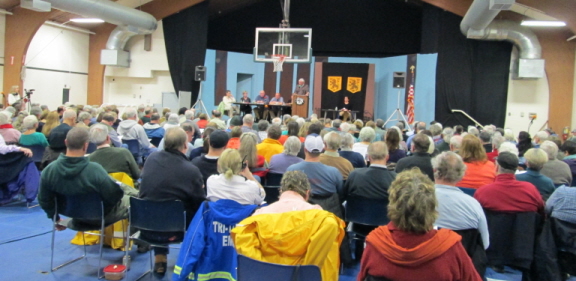
The townsfolk assembled in the West Tisbury School gym. Town officials sat onstage.
Neither dogs nor marijuana was on the warrant for West Tisbury’s annual town meeting last night, so most of the meeting was pretty dull. Most of the 42 articles passed either by unanimous voice vote or by a vocal majority so obvious that no hand count was necessary. We moved money around. We authorized the town’s contribution to constructing a new Little League field in Oak Bluffs, furthering an affordable-housing project in Tisbury, upgrading the electrical system of the county courthouse in Edgartown, and supporting Aquinnah’s efforts to acquire, restore, and relocate the Gay Head light, which is in danger of falling off a cliff.

The heading on two pages in the town report honoring residents who died in 2013. West Tisbury is sometimes called the Athens of Martha’s Vineyard. This may explain why we’re not so adept with Latin.
We took the penultimate step toward making the town treasurer an appointed rather than elected position, this with the hearty support of the town’s current (elected) treasurer. The idea is to open the field to qualified candidates who don’t live in town. The final step is approval in tomorrow’s town election.
Article 4, authorizing funds for a new police cruiser, was postponed indefinitely because the cruiser slated for retirement is still working fine and “you know how Skipper drives.” Skipper Manter is both a police officer and a selectman. Everybody laughed.
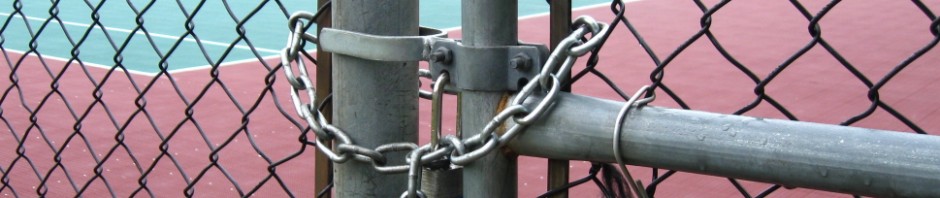
Article 21 wanted to see if the town would appropriate $75,000 to replace the fence around the town cemetery. One resident said that her forebears, who are buried in the cemetery, would not approve spending that much money to fix the fence. Another, an abutter, noted that cemetery visitors were sometimes accompanied by loose dogs; she wanted a sound fence between the dogs and her chickens. A third asked who the fence was trying to keep in. We laughed at that too. The voice vote was ambiguous, and for good reason: by hand count the vote was 108–102 in favor of the new fence.

Moderator Pat Gregory reads a warrant article.
Even the last three articles on the warrant, 41 through 43, passed handily, though they all dealt with rules and regulations and so were scarily long. Article 41, adding “General Requirements for All Solar Energy Systems” to the zoning bylaws, passed unanimously. Article 42, a string of amendments to the zoning bylaws, prompted some discussion but passed by a lopsided voice vote. “150 to 4,” ruled the moderator. Article 43, proposed by the board of health to regulate “the content and application of fertilizer for turf,” also passed unanimously.

Moderator Pat gives instructions to the volunteers who are about to count our raised hands.
As expected, the most contentious article on the warrant was #32. This asked the town to appropriate $30,000 “for design and permitting for dredging to preserve the Mill Pond,” with funding contingent upon the commitment of another $20,000 from private sources. Discussion took up the better part of an hour — the whole meeting was done in about three — and if it wasn’t quite as heated as recent years’ debates about marijuana dispensaries in town or dogs on Lambert’s Cove Beach, it came pretty close.
Why, you ask, did we wrangle so long over $30,000 when in the course of the evening we approved a town budget of close to $16 million? Is this yet another instance of the length of debate being inversely proportional to the importance of the issue? Yes, but it also illustrates William Blake’s line about seeing “the world in a grain of sand.” Big-picture politics can be downright baffling unless you pay close attention to how we act and interact at the most local level.

People on all sides of the issue were sporting the same button.
Consider: The Mill Pond is, as several speakers pointed out in various ways, the symbolic heart of the town. Virtually everyone in West Tisbury, and many people from other towns, passes it several times a week. We watch for the swans and the ducks, we note the changing of the seasons, we love to see kids standing with their fishing rods at the water’s edge. Everybody wants to save the Mill Pond.
Several speakers on both sides of the issue waxed rhapsodic and at some length about the beauty of the Mill Pond and its historic significance. In this case, however, the devil was definitely in the details — on which the rhapsodies were rather short. Everyone was on board with the rhapsodies. What we disagreed on was whether there was a problem and, if so, what should be done about it now.
After all, we’d already voted unanimously, and with minimal discussion, to add $15,000 to the $15,030 appropriated at last year’s ATM for a study of the Mill Brook watershed. The Mill Brook flows through the Mill Pond; hence an understanding of what’s going on in its watershed is helpful in figuring out what’s best for the pond. Quite a few townsfolk wondered why we should prepare for dredging before we knew whether dredging was necessary. Others were certain that without dredging the pond was in great danger.
At last one citizen noted that we were all looking at the same data but disagreeing on what they meant. This, he suggested, indicated that we weren’t ready to act yet.
And when the question was finally called, that is how we voted, but the vote was close: 119 to 110, announced the moderator, after the vote counters finished counting and reported their results.
Hard facts, multiple interpretations, appeals to history that didn’t have all that much to do with either the facts or the question of what to do about them, invocations of posterity that didn’t either, hints that if we didn’t act now bad things would surely come to pass, and general agreement that saving the Mill Pond was a good idea — it was all there. Substitute “the commonwealth,” “the United States,” or “the planet” for “the Mill Pond” and you’ll have a pretty good idea of what goes on in Boston, Washington, and the rest of the country.
The difference, maybe, is that we were all talking to each other as we filed out of the gym after the 2014 annual town meeting was adjourned, no matter how we voted.
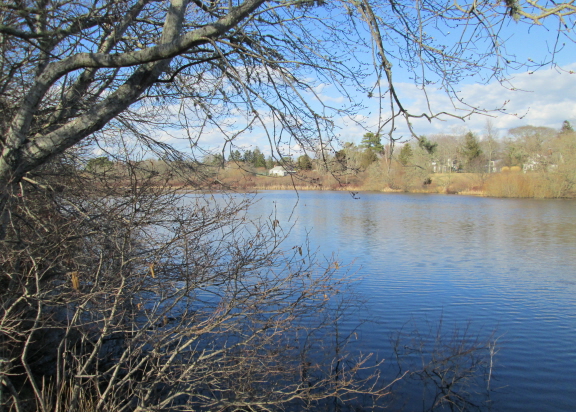
What all the fuss was about

Oh yeah, and these guys

These guys too
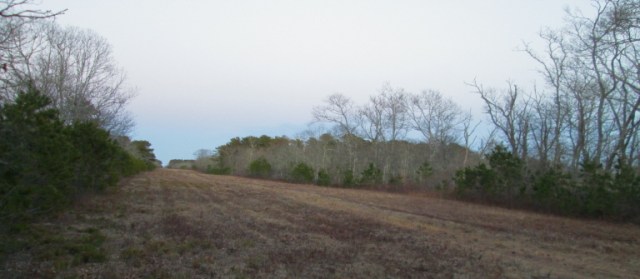
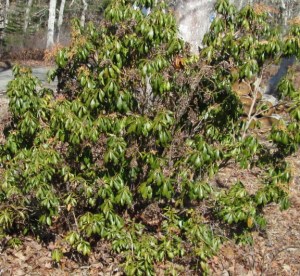 The last couple of days I’ve been looking for things I could see.
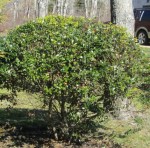 My neighborhood is short on floral color at the moment, so I trespassed into the yard of a summer resident, where something’s always flowering. No flowers yet, but I did find a jolly big shrub with what looked like new leaves on top.
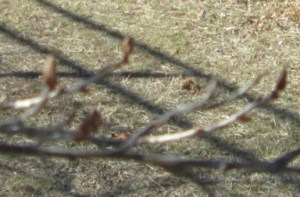 Buds really are appearing on twigs, but you have to look close to see them. I haven’t figured out how to do good close-ups with my new camera yet, so this will have to do.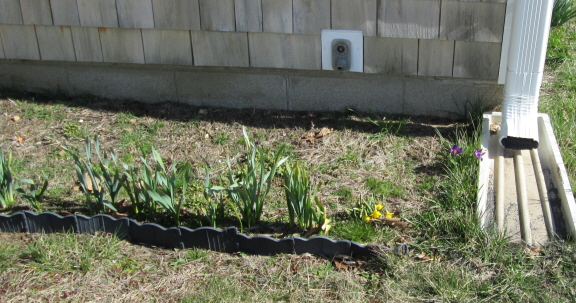
 Above me a plane drew an ephemeral path across the sky. It could see more than I could, and at the same time not as much.
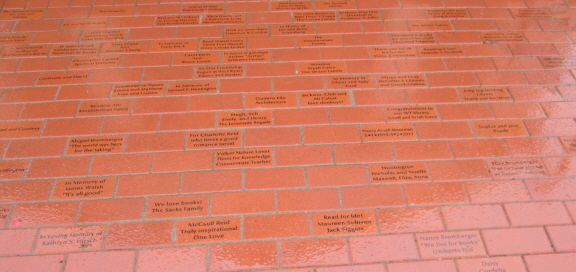
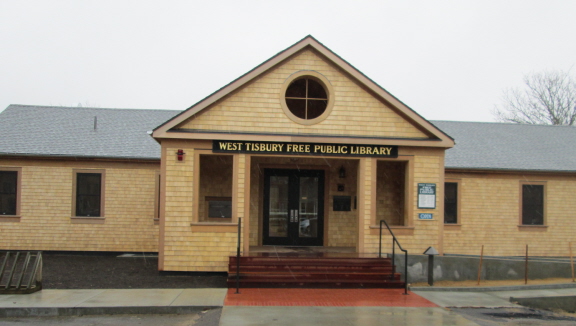 The walkway that bisects the parking lot and the area at the foot of the steps are studded with commemorative bricks. For a donation of $125 you could say whatever you wanted — within reason, of course — on a brick.
 Once through the front door I knew for absolute certain I wasn’t in Kansas anymore.
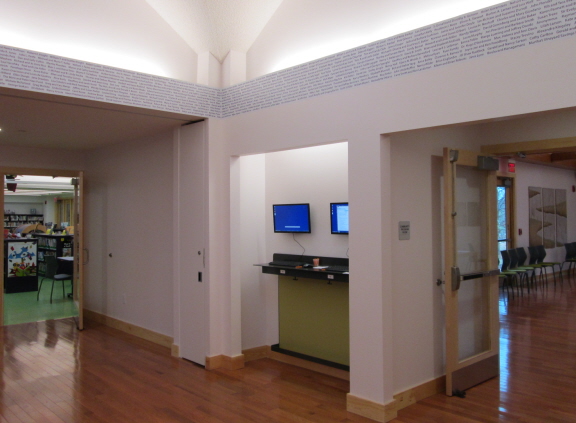 In the center is what I still sometimes call the card catalogue. From those terminals you can locate any book, DVD, journal, etc., etc., in the CLAMS (Cape Libraries Automated Materials Sharing) network, to which the West Tisbury library belongs. See those names up above? OK, it’s hard to tell that they’re names, a whole square of them. The names of contributors, year-round and seasonal residents, from West Tisbury and the other island towns. Instead of one megabucks donor’s name on the outside, we’ve got hundreds and hundreds of names on the wall and on the bricks.
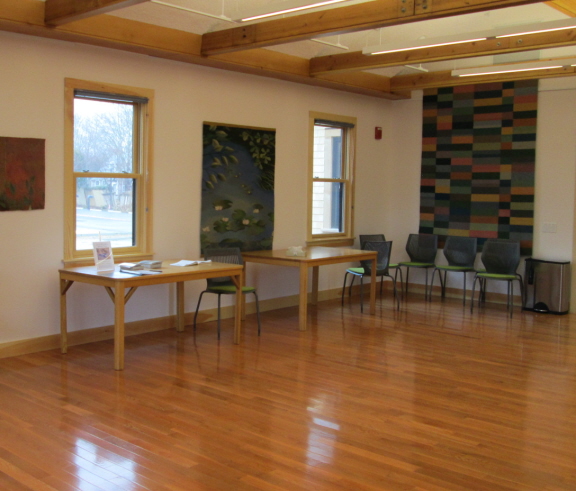 The new library has lots and lots of wall space to hang artwork on. Currently featured are the tapestries of West Tisbury artist Julia Mitchell. I doubt the chairs were chosen to coordinate with the tapestries, but it sure looks like it, doesn’t it?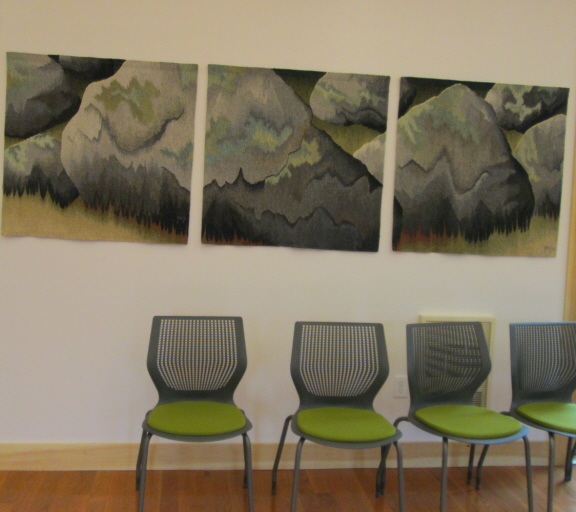


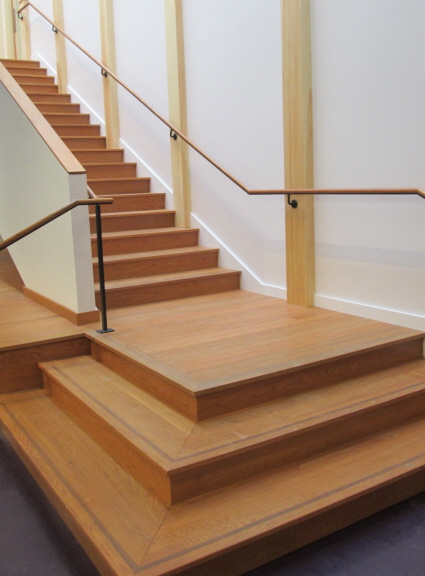
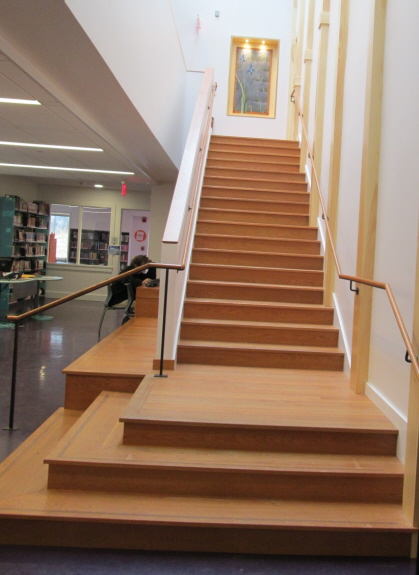 West Tisbury’s library has long been a bustling place — the heart of the community, some say, and with good reason. As plans for the renovation and expansion got under way, some townsfolk expressed apprehension that the small-town community feeling would get lost in the shuffle. I wondered too, but I also had fantasies of what could happen in the new program room that couldn’t have fit in the old library. Strolling around the new library, I glimpsed possibilities everywhere.








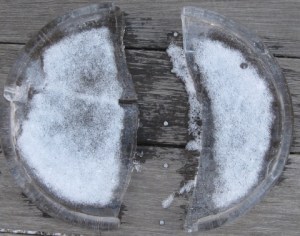
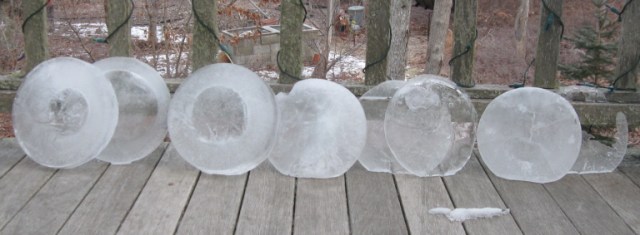
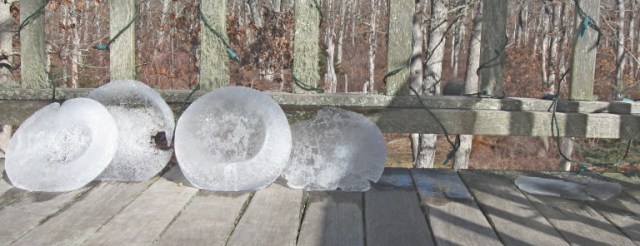




 From the Seasonally Occupied Territories . . .