I haven’t exactly been following the presidential primary campaign, but I’ve found it pretty hard to ignore, not least because I hang out on Facebook. My Facebook friends have interesting opinions and post links to interesting stuff.
Massachusetts allows “unenrolled” voters, those who claim no party affiliation, to take the primary ballot of either party. I don’t identify as a Democrat, but in the absence of a feminist party, I caucus with the Democrats and take the Democratic primary ballot.
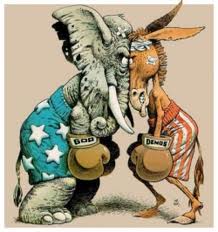 A February 22 Boston Globe editorial urged unenrolled voters to take the Republican ballot and vote for John Kasich. Why? The lead says it all: “Stopping Donald J. Trump is imperative — and not just for his fellow Republicans.” Some friends of mine are planning to do it.
Apocalyptic rhetoric is running wild this campaign, and running alongside it is the longing for a savior who can save us from the mess we’re in. I agree the country’s in a mess, but I’m skeptical about saviors and suspicious about apocalyptic thinking. I’m still planning to vote in the Democratic primary.
Bernie Sanders and Hillary Clinton are both credible candidates. Their positions aren’t that far apart, despite the rhetoric that suggests one is Gandalf, the other Sauron; compare either one to Kasich or Trump and you’ll see what I mean.
 What’s a Democratically inclined voter to do? Set up a balance and toss bits of information into one pan or the other, then vote for the candidate with the most pluses and the fewest minuses? That sounds rational enough, and I’m a pretty rational person, but it wasn’t working for me.
My Facebook friends and I don’t always agree on what’s a plus and what’s a minus, and when we do, we often weight them differently. We take in pretty much the same information but come to different conclusions. This may take us by surprise, but really it shouldn’t: none of us are purely rational calculating machines, and even if we were, we’d have a hard time assessing what either candidate might actually accomplish if elected.
So we bring our personal history to the exercise, along with, most likely, some emotional baggage that can weigh heavily in the balance but isn’t exactly rational.
For instance: In 2008 I never for one minute considered voting for Hillary Clinton. That’s how much I loathed Bill Clinton. My loathing went way beyond disagreement with what he’d done in office, and even beyond my disgust with his lack of self-control while in the public eye. I blamed Bill Clinton for pretty much everything bad that’s happened on Martha’s Vineyard since he came here on vacation in 1993. He brought with him what looked like the entire national press corps, and they proceeded to broadcast to the world their limited understanding of the place. Whereupon the affluenza (many of whom vote Democratic) descended, bid up the price of housing, and started rearranging the furniture, all the while gushing about how wonderful Martha’s Vineyard was.
See what I mean? Lately it’s dawned on me that I loathed Bill Clinton mainly because he was the first presidential candidate I voted for who actually got elected and I felt personally responsible for everything he screwed up, especially Martha’s Vineyard.
Barack Obama was the second presidential candidate I voted for who actually got elected. I’ve disagreed, often strenuously, with some things he’s done or not done, but I still admire the guy tremendously. My detachment is greater, my expectations more reasonable, and President Obama has never embarrassed me in public.
As a feminist, and a radical feminist at that, I don’t expect to support any candidate heart, mind, and soul. Feminism doesn’t fit easily on the left-right spectrum because feminism puts women in the foreground and the left-right spectrum developed with white men in that position; the rest of us have to keep insisting that our lives matter, otherwise we’ll be pushed off to the side until the white guys’ priorities are dealt with.
Nevertheless, I caucus with the Democrats because — well, because Republicans, that’s why. (The idea of casting a vote for Kasich, the guy who just defunded Planned Parenthood in Ohio, turns my stomach.)
In concert a few years ago, feminist singer-songwriter-activist Holly Near said she didn’t expect to find a perfect candidate so she voted for the one she thought she could struggle with. I like that. This means to me the candidate who listens and who seems to understand and take seriously the issues I think are most important.
Politics for me has never been primarily about electoral politics. Fresh out of high school in 1969, I started college in Washington, D.C., and almost immediately joined the movement against the Vietnam War. Through it I met many, many veterans of the civil rights movement, the Old Left, and the labor movement. I also came up against sexism, both at the university and in the antiwar movement, and discovered feminism. In the mid-1970s, after several years away, I returned to D.C., came out as a lesbian, and threw myself into feminist organizing.
In 1976 I did volunteer for the campaign to pass the Massachusetts Equal Rights Amendment (it won) and work for Fred Harris’s presidential campaign (it lost). In 2012, I tithed to Elizabeth Warren’s campaign for the U.S. Senate (she won) and even ran for local office myself (I lost). But my experience and my reading of history tell me that the most important and lasting changes are brought about by movements outside the electoral system. Electing people willing to listen to those movements is crucial, but without that outside pressure, officeholders are limited in what they can accomplish, not least because other movements are continually pushing and pulling them in other directions.
So I took an early interest in Bernie Sanders’s campaign, which aspires to be, and within the electoral system already is, an effective outside force. But electoral campaigns have a drawback: because all effort and energy is necessarily focused on electing the candidate or passing the referendum, they tend to crash when the election is over, even when the campaign is successful.
The labor movement, the civil rights movement, and the women’s movement all took a long-haul approach. Short bursts of energy won’t sustain a long haul. Long hauls require infrastructure to channel and sustain that energy, to keep long-timers motivated and draw in new-timers who aren’t burned out yet. Lacking infrastructure, Occupy Wall Street burned itself out pretty quickly; where it did develop some infrastructure, it lasted longer.
So we come around to something that weighs especially heavy in my balance: what it takes to accomplish even modest objectives when people of diverse backgrounds, interests, and priorities come together in an organization or a coalition. It’s fucking hard work. It takes sensitivity, perseverance, and the bedrock knowledge that you are not going to get everything you want. (Neither is anyone else.)
This is true in my town of fewer than 3,000 people. It will be true of the country if Citizens United is overturned tomorrow, if “dark money” drains out of politics and inequality of wealth and income returns to, say, what it was in the 1960s or ’70s.
The 1%/99% frame popularized by Occupy Wall Street did focus attention on economic issues, but these days it’s obscuring some people’s understanding of how politics works — and here again I’m not talking just, or even primarily, about electoral politics. In this framing, all too often banks, retail chains that pay crap wages, and “corporate greed” become the Great Satan.
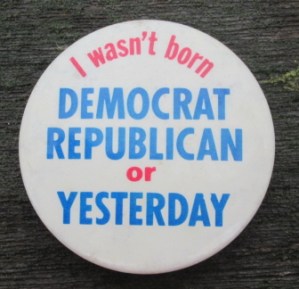 This view, like any framing that casts someone or something in the role of Great Satan, has at least three fatal flaws, which are not unrelated. One is that it lets the top 10 or 20 percent off the hook: we never have to look too hard at how we’ve helped perpetuate the established order, often because we were benefiting from it or it was leaving us alone. Two, anyone who appears to have associated with the 1% at any time becomes the Great Satan’s accomplice, toady, or dupe.
And finally, the Great Satan seems so omnipotent, especially to people who are too busy or too fastidious to get involved in “politics,” that clearly a savior is called for. When a prospect shows up, he gets cast in the role whether he wants it or not. Saviors are created in large part by our longing to believe. When elected to public office, they inevitably disappoint. This gives the all-or-nothing true believers an excuse to exit the field and return to their regularly scheduled programming.
If you’ve read this far, you’ve probably figured out who I’m planning to vote for in next Tuesday’s primary, and why: Hillary Clinton. I’m not looking for a savior. I’m looking for someone experienced in negotiating and coalition-building, who demonstrated a commitment to women before she started running for president. I like Sanders’s platform — who doesn’t? But without a clearer implementation plan, it’s all magical thinking — especially if his campaign doesn’t manage to continue past the election, which I doubt it will.







 Then I spotted the distinctive house marker (see photo at left) at the end of one neighbor’s driveway, so I knew where I was. After that it was slog slog slog along the path that winds behind the West Tisbury School. I hollered at whoever was blowing snow at another neighbor’s house, but the snow blower was too loud and nobody heard me.








 This turned out to be a brilliant move. There were days when I was so panicky, so sure that everything I’d done so far was crap, that I didn’t work up the nerve to open my Word file till ten minutes before midnight. And this was enough. Just opening the file and reading what I’d already written was enough to reassure me that this thing was good, this thing was worthwhile, I really needed to keep going till I finished this thing.


 From the Seasonally Occupied Territories . . .