Seen from a distance, Martha’s Vineyard looks bucolic, homogeneous, and maybe even a little boring. Up close it’s much more interesting. The best way to understand what the place is about, how it works and how it doesn’t, is to grab hold of a controversial event and tease out all the strands that make it up.
Lucky you and lucky me, we’ve got a doozy unfolding right this minute. The Martha’s Vineyard Film Festival (MVFF) last week made public its plan “to build a vibrant year-round gathering place for our community, a place where education, art, and inspiration intersect.” The idea, according to a story posted to the Vineyard Gazette website last Saturday, May 28, involves building “a 6,000-square-foot barn for film events, as well as plans to grow food on the property and sell it.”
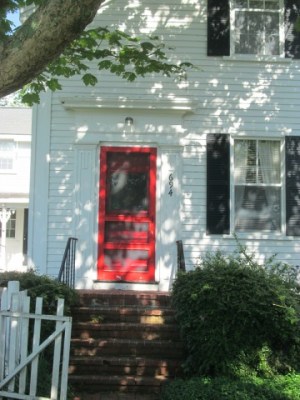
694 Old County Road, where MVFF plans to build its “arts center.” The house is bigger than it looks from this picture, and most of the arable 12.5 acres are out back.
The location chosen for this project is a 12.5-acre parcel in a quiet (one might even say “bucolic”) neighborhood near the heart of West Tisbury, a town that prides itself both on its rural character and its commitment to all things high-minded, like “education, art, and inspiration.”
MVFF offers programming year-round, but its flagship event is a summer film series that currently draws huge crowds to the Chilmark Community Center, creating major congestion and parking problems in the ordinarily bucolic heart of Chilmark, the town up the road that is even smaller and more rural than West Tisbury.
You begin to see the potential conflict, right? It gets better. Keep in mind that arts organizations generally aren’t rolling in money. Nevertheless, a closing date on the property, which has a price tag of $1.4 million, has already been set for June 22. Without doing any fundraising, MVFF managed to come up with a credible offer that was accepted by the sellers.
Without telling much of anybody, in fact, including the abutters to the proposed location. They did meet informally with the West Tisbury planning board at the end of March. The planning board suggested they come up with a more concrete plan. A project of this scale will require review and/or approval by several town boards and most likely the Martha’s Vineyard Commission (MVC) as well, the body that oversees developments of regional impact.
Nevertheless, MVFF is willing and able to commit to the purchase of a $1.4 million property for a project whose permitting process will be undoubtedly long, possibly expensive, and not necessarily successful.
Well, the compost started to hit the fan when news about MVFF’s recent letter to members was posted to the Islanders Talk group on Facebook, which I’ve often described as the island grapevine on steroids. With the Vineyard Gazette story, the fan started to spin faster and the compost kept coming.
The abutters were, not surprisingly, outraged by the size of the project, its implications for summer traffic, and especially the fact that they were not consulted in advance. Cries of “NIMBY” (Not In My Back Yard) were heard from further off, but they were relatively mild not least because so many of those dismayed by the proposal, abutters and otherwise, think well of MVFF and have attended its events.

The Mill Pond, April 2014
Around here NIMBY often comes cloaked in concern for the environment, and for sure environmental concerns were raised from the get-go: How would the septic system impact the beloved and ecologically fragile Mill Pond, which is not far away? Many a project gets nickel-and-dimed over possible threats to endangered flora and fauna and of course the Vineyard’s sole-source aquifer (where all our drinkable water comes from). Often it’s easier to shoot something down over environmental concerns than to actually grapple with the pros, cons, and implications of the project.
There’s also the agricultural angle. West Tisbury prides itself on its rural character, and it is absolutely true that farming does go on here and elsewhere on the island, but if one contemplates the price of land, the cost of living, and the challenges of farming, one can’t help wondering just how agricultural the place really is. Nevertheless, a significant portion of West Tisbury’s population likes to think that it lives in a rural, agriculture-friendly town. The extensive acreage behind the house is described as arable, and I’m told the area is zoned residential and agricultural. Hence MVFF’s plan “to grow food on the property and sell it” and perhaps lease out some of the land for agricultural use.
It’s emphatically not zoned commercial, which is to say that a movie theater — which is how quite a few people were thinking of the MVFF proposal — would not be permitted. Movie theaters belong down-island, said several, pointing out that there’s a ramshackle movie theater in Oak Bluffs just begging for restoration.
Ah, but MVFF’s chi-chi summer patrons, so it’s said, do not want to go to Oak Bluffs. As one commenter noted on the Gazette site, “it is unappealing to go down island and step over nip bottles and be inundated with roustabouts.” I suspect this was meant tongue-in-cheekily, but others didn’t take it so. What ensued was down-island bashing up-island and up-island bashing back. Some down-islanders were fairly salivating at the thought of bucolic West Tisbury turning into another Circuit Avenue. I must confess, I sort of was too.
Up-Island vs. Down-Island, West Tisbury vs. Oak Bluffs: This is a perennial undercurrent in island discourse. Sometimes it gushes into the open. Sometimes it’s good-natured, other times it’s not. It’s one of the ways we talk about, or don’t talk about, class on Martha’s Vineyard. But I digress.
MVFF is not presenting itself as a mere movie theater. It is presenting itself as a future “vibrant year-round gathering place for our community, a place where education, art, and inspiration intersect.” The zoning bylaws have a loophole for educational use, and MVFF was playing the education card.
This is where my interest was piqued. Why, I wondered, does MVFF need a home of its own? For 16 years it’s done quite nicely renting space in Chilmark. As I noted in a Facebook comment, “Physical plant can be a huge time and money sink, not to mention a distraction from the group’s main purpose.” I pointed out that the town already had a “vibrant year-round gathering place for our community, a place where education, art, and inspiration intersect”: the library.
Somewhat later I posted to the Gazette‘s website: “It should be obvious from the huge effort that went into the library expansion and renovation that West Tisbury does support the arts, education, and creativity in general. The library people did everything right: they solicited input from the community at every turn and kept the community informed. MVFF, for reasons known only to itself, has done none of that. The results are becoming more apparent every day.”
This bugged me. Could Thomas Bena, founder, board member, and executive director, really be unaware of the West Tisbury library, the libraries in the other towns, the Ag Hall, the Grange Hall, the Vineyard Playhouse, and especially Featherstone Center for the Arts in Oak Bluffs?
Then, thanks to the island grapevine, it all fell into place: How had MVFF come up with the money to sign a purchase & sale agreement on a $1.4 million property, without doing any public fundraising, pretty much without telling anybody? Why was it willing to close on the property before the permitting process even started? Why did Bena consider it unnecessary to consult with the abutters, the neighbors, or, apparently, other island arts organizations?
Money. Bena married into serious money. His mother-in-law, Cindy Doyle, is a trustee of the Tower Foundation, which has donated considerable sums to some large Vineyard nonprofits. Doyle’s father was Peter Tower, a successful broker who died in 2014. For a review of the family holdings, check out his obituary.
Community, or mutual interdependence, often thrives in spite of ourselves. We get along with people we disagree with or even find disagreeable because we need to. Once we have the resources to take care of ourselves, the incentive starts dropping. Community dwindles, even as its praises increase.
Income and wealth inequality aren’t problematic simply because Big Money does Bad Things. Big Money does Good Things too, lots of them. The problem is that Big Money gets to decide what it wants, and it doesn’t have to consult anyone else.
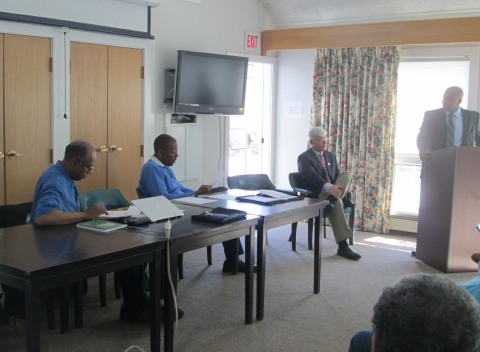
Unless, of course, “the people united” push back hard. Which seems to be happening in West Tisbury. The board of selectmen is meeting on the issue at 4:30. I’m going. Back later.















 Because the weather ebbs and flows no matter what the season, I keep a couple pairs of jeans in the drawers and a few turtlenecks hanging in the closet, just in case.



 Gathering reasonably reliable information about the presidential candidates is so challlenging that I sometimes think the phrase “informed voter” is an oxymoron. If the creature still exists, it should be put on the Endangered Species list before it’s too late and members interviewed for the secrets of their survival. The most conscientious among us do our best, but if we’ve got jobs, families, and/or other commitments, “our best” generally means taking a leap to one side or the other based on insufficient information.
 Shortly before the Massachusetts primary, I blogged “




 From the Seasonally Occupied Territories . . .