Henri, Meet Uncle Bob

As I write, we’re on the fringes of Tropical Storm Henri. The wind is blowing, there’s been some rain, but so far, so good. The electricity flickered a couple of times before 7 but I went ahead and made the quiche I’d been hankering for. It came out of the oven 15 minutes ago. I’m calling it quiche Henri.

Despite its advance billing, Henri has turned out to be less than a big deal for Martha’s Vineyard and environs, though of course the boats aren’t running and the last day of the Ag Fair was cancelled. It’s a bigger deal further west, like in Connecticut and New York.

Locally the advance billing has included frequent reminders of Hurricane Bob, which landed on these shores exactly 30 years ago, on August 19, 1991. I didn’t need the reminders. I, like just about everyone else who was here at the time, have plenty of stories to tell about Bob. My memories are so vivid I’m having a harder time reminding myself that three decades have passed since then.

Bob made a big impression.

I was Calendar & Community (i.e., features) editor at the Martha’s Vineyard Times, which was then still located in the old Spaghetti Pot building behind Woodland Market. (That building is no more. Gone forever is the orange carpeting that I’d swear was dyed with spaghetti sauce.) One of the many things Bob taught me was how the island’s electrical grid worked. The Times was on the same trunk line as the hospital, which is why our electricity was restored so fast.

Actually, it was jack-of-all-trades Times reporter Gerry Kelly who taught me that. He did the research and published it in the paper.

The Vineyard Gazette (which we habitually referred to as “an Edgartown weekly,” while they called us “the other paper”) was not so lucky. August 19, 1991, was a Monday. In those days the Gazette published on Tuesday as well as Friday — and the Gazette, unlike the Times, was printed in-house, on its own presses. Which required electricity. Google (which definitely wasn’t around at the time) just jogged my memory: that week the Gazette came out on Wednesday. The lead paragraph of the lead story is worth quoting:

The earliest hurricane in New England history roared up the East Coast Mon­day, plowing across Martha’s Vineyard with harbors full and seasonal popula­tion at its peak. Hurricane Bob lashed the Island with winds officially clocked at 98 miles per hour and reported in places as high as 110.

The story was accompanied by grim photos of smashed boats in Edgartown and Vineyard Haven harbors.

At the time I was living up-island on State Road, where it’s West Tisbury on one side and Chilmark on the other. We didn’t get power back for almost 10 days, so having access to running water and refrigeration at the Times office was a blessing. I washed my hair in the office sink at least once. Staffers brought the spoilables from our inoperative refrigerators in to share, and we feasted for a couple of days. Then as now the Times came out on Thursday, so Monday was our “on your mark,” Tuesday was “get set,” and Wednesday was “GO!” So feasting on Tuesday and Wednesday was a big plus.

We had electricity at the newspaper, but most of the island didn’t. Since most people’s answering machines weren’t working, it finally dawned on me just how indispensable they were. The 1991 Ag Fair had just ended: it was only three days at that point, and since the “new” Ag Hall hadn’t been built, it was still at the Grange. Several of us were on what was usually a routine assignment: rounding up results and collecting anecdotes about the fair. Being unable to leave a message when someone wasn’t home was a time-consuming PITA. Anecdotes don’t vary all that much from one year to the next, but we couldn’t exactly recycle the previous year’s without getting caught out by half the island.

I have this vague recollection of trying to verify a report that some couple had gotten married on the Ferris wheel. Whether it turned out to be true or not I don’t remember — and if it was, it might have been at some other fair.

Bob transformed the landscape as well as doing serious damage in the harbors. Brandy Brow is a hillock where State Road in West Tisbury intersects the Edgartown Road. If West Tisbury center had a gateway, Brandy Brow was it. I passed it on my way home almost every day: it was so densely wooded that you barely saw the land itself. After Bob passed through, that was almost all you saw. At least three-quarters of the trees were gone.

After Bob, walking the King’s Highway, an ancient way in Chilmark, required plenty of scrambling over fallen trees. For horses or mountain bikes — forget it. The state forest was decimated, or so it seemed. (Keep in mind that “decimated” doesn’t mean “leveled”; as the word itself suggests, it means to take one-tenth of the whole. It wasn’t literally that bad, but the damage was major, and it was many years before it was cleaned up.)

Several big trees blocked the dirt road I was living on, but here I lucked out: a nurse at Martha’s Vineyard Hospital lived on this little network of roads, so volunteer EMTs, firefighters, et al. showed up with chainsaws to clear the way so she could get to work. Everyone in the neighborhood benefited.

Tesah Toyota, 1988–2003

The West Tisbury fire station on the Edgartown Road left its outside hose open so those of us without running water could refill our buckets. I did this quite a few times. It helped that at the time I was driving a pickup, the late Tesah Toyota, so I didn’t have to worry about water sloshing in the cargo bay.

Bob was a windy storm (understatement of the century), but it wasn’t a wet one. As a result the summer and fall of 1991 were very strange. November arrived almost overnight, turning the salt-scorched oak and maple leaves prematurely brown. But lilacs and other spring blossoms arrived in September — it became clear to those who hadn’t already figured it out that nature doesn’t pay all that much attention to the calendar.

And then there were the bees. Bees were everywhere, taking advantage of fallen trees and spring-in-fall blooming. One morning, at the outdoor patio at the Patisserie on Main Street, Vineyard Haven (long gone, fondly remembered), I admired the homemade bee-catchers (one-liter soda bottles cut in two, baited with something sweet, and hung from the ceiling) designed to distract the bees from my breakfast.

Also omnipresent was the sound of chainsaws. They could be hard to tell from mopeds. Was that a moped coming up Main Street, or was it a chainsaw?

Hurricane Bob also prompted me to look for a year-round rental. For several years I’d had a place to go in the summer while I had winter rentals the rest of the year. My summer housemate, whom I’d known for years, was a kitchen slob. I’m not exactly a fastidious housekeeper, but if I slice a tomato and use half of it in a salad, I don’t leave the other half on the counter. Imagine, if you will, 9 or 10 days of this in August heat without running water or refrigeration.

Fortunately reasonably affordable year-round rentals weren’t all that hard to find in the early 1990s, and I found a good one: I actually lived year-round in the same place for almost 10 years. And that alone should remind me how long ago this was, in case I forget.

Posted in home, Martha's Vineyard, outdoors, work | Tagged , , , , , , , , | 5 Comments

Tam Gets Bit by a Fence

The late Rhodry and Travvy both spent time around horse barns so they learned about electric fences early on. Rhodry in particular didn’t even trust rope lying on the ground: if he couldn’t detour around it, he’d clear it by at least two feet.

When the barn where I worked at the time was being re-roofed and we had to do some squeezing between gates and construction equipment, I managed to come in simultaneous contact with a live wire, a metal ladder, and a puddle. Don’t try this at home.

Tam Lin, however, is not a barn dog. He doesn’t run around loose either, but I still wanted him to get the basics about electric fences. The obvious place was the outer perimeter of the pastures at Misty Meadows horse farm, which we walk along several mornings a week. The fence comprises three bands of electrified tape, with the lowest a few inches above the ground, the highest at my chest level, and the middle about the height of a big dog’s nose. At one corner there’s an “electric fence” warning.

Trouble is, not once in the last almost two years has the electricity been on. I regularly run my finger along it: nothing. Tam brushes against it when sniffing the grass: nothing.

A few days ago another opportunity presented itself. Sheep, goats, and cattle have at various times been brought in to graze in the meadow adjacent to the horse farm. Electrified mobile fencing keeps the livestock in and curious dogs out. Last week three cows and seven calves showed up. (I’m curious about this. Cows occasionally have twins and, rarely, triplets, but single births are by far the most common. Did these three cows produce all seven calves?) The cattle were mostly snoozing, Tam was curious but not over-excited, so we walked along the outside of the fence.

Before long Tam yelped. Mission accomplished. He doesn’t seem to have been traumatized by the encounter. Since then he’s been fine walking past the fence; he just doesn’t get too close.

The cows and calves are still there. This morning one of the calves was outside the fence, so when I got home I called the farmer to report. No, I did not have my phone with me. 😉 Here are some cow pictures.

Posted in dogs, outdoors | Tagged , , , , , | Leave a comment

Evening Walk

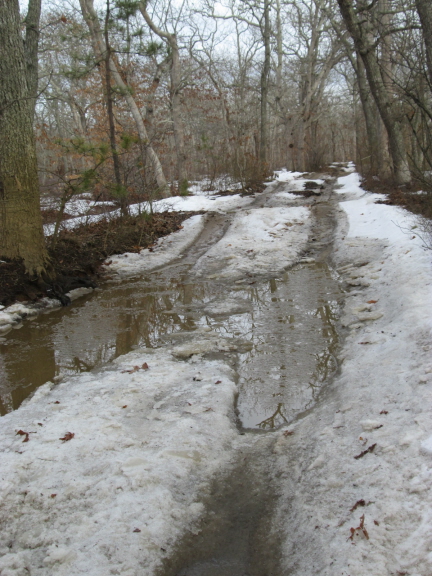
I’ve got loads of photos of the Dr. Fisher Road in all seasons, in some of which it looks like a canal, but this is what it looks like this morning.

So Tuesday night Tam Lin and I are approaching the worst stretch of the Dr. Fisher Road. It’s not quite pitch-dark but close.

Up ahead are red brake lights. They aren’t moving. This is unusual.

When we come up next to the brake lights, I see that they belong to a West Tisbury police cruiser with no one in it. This is even more unusual.

Then I glimpse through the trees the front end of a white box truck, maybe a 12-footer. I begin to get the picture.

At the back end of the truck, through the gloom I recognize my buddy from the diversity task force, Officer Brad. I hail him through the thin line of scrubby trees — Tam and I are on the path close to and parallel with the so-called road — and ask if someone was navigating by GPS.

Affirmative. They’re waiting for the tow truck. Brad admires Tam, who of course has to go say hi. I say I hope the tow truck shows up soon, Brad does too, and Tam and I hang a left on Pine Hill and head for home.


I posted the above on Facebook. Among the commenters were a couple of FB friends who are real-time neighbors too. We brainstormed some appropriate signs to warn unwary motorists before they get stuck:

  • “I’d turn back if I were you”
  • “Abandon shocks, all ye who enter here”
  • “GPS is junk here”
  • “WARNING: GPS doesn’t know a road from a path through the woods”

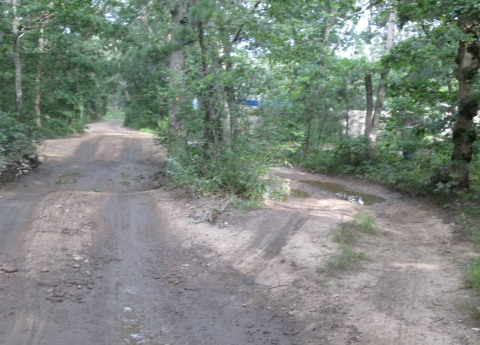
I have photos of this particular stretch of the Dr. Fisher Road in all seasons. Here are a few.

Snow, ice, and mud are such a lovely combination, March 2015
After a nor’easter, March 2018
Drivers keep trying to create detours, which are soon as bad as the road itself (August 2021) . . .
. . . and local residents keep trying to prevent them (August 2021).
Posted in home, outdoors | Tagged , , , , , , | 1 Comment

July License Plate Report

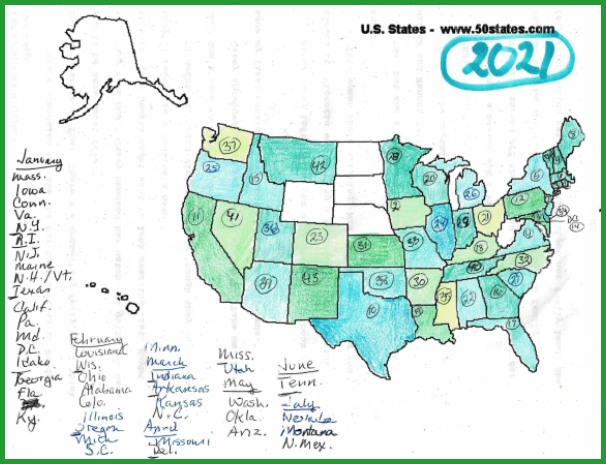
Three western states showed up in July — a pretty good catch. New Mexico got in just under the wire: I spotted it at up-island Cronig’s yesterday. Earlier in the month, Nevada was just leaving downtown Vineyard Haven as I was driving in, and Montana was at the Merchants Mart next to the Black Dog Café. The Montana plate was one I’d never seen before, plain blue on white, but I’ve since learned that Montana has as many as 400 different plates so I guess I shouldn’t be surprised.

There’s generally very little action in the last five months of the year, but I’m not giving up.

Posted in license plates | Tagged | Leave a comment

I’m Not Jogging

I hate jogging. Don’t even talk about running.

I do love to walk. I walk a lot. I walk about four miles on an average day. (Read on and you’ll learn how I know this.)

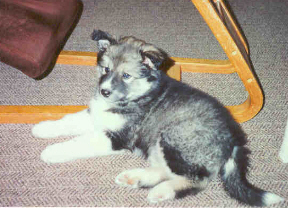
Puppy Rhodry soon after he moved in with me, at about six weeks

Some people walk because they have a dog. Me, many years ago I got my first dog, the late great Rhodry Malamutt (1994–2008), because I liked to walk. Friends who worked conventional hours would ask me to take their dog with them when I went for a walk. Walks occasionally turned into overnights (“Hey, could you possibly look after . . . ?”), and eventually I realized that I was responsible enough to have a dog of my own. Rhodry, by the way, was the younger full sibling of two of my foster dogs.

So last fall a bunch of us activist Vineyard women took part in a Run/Walk for RBG challenge. (RBG, need I say, is Ruth Bader Ginsburg, who had died a few months before and been replaced on the Supreme Court by — don’t get me started.) The idea was to run or walk 87 miles, 87 being RBG’s age when she died. You didn’t have to do it all at once: you could do it in increments. The organizers’ website provided a handy way to keep track of your miles.

Me and my RBG swag, January 19, 2021 (the day before President Biden was inaugurated, btw)

This was a benefit for several worthy women’s organizations, and it came with some fun swag, like an RBG T-shirt and a medallion that says WE DISSENT on the ribbon.

It also meant that I had to log my miles, which meant taking my phone with me when I went for a walk. Danger danger danger . . .

For many years I was a cell-phone resister. Since I work from home, have a working landline, and spend at least half my day on my laptop, I didn’t need one. I’m also not, and never have been, a phone person. My medium (big surprise) is the written word. Email suits me just fine.

Also I was afraid a phone would take over my life. I would become one of those people who can’t shop for groceries without talking on the phone.

In January 2019, however, I got my first cell phone. A Samsung Galaxy J7, in case you’re wondering. It still works fine.

By the fall of 2020 I was pretty sure I’d be OK. If I was going to turn into a phone junkie, it would have happened by now, right? It had come in handy several times, like in May 2019, when I used GPS to successfully navigate my way through Boston for my 50th high school reunion. (It was less helpful on my way home from picking up puppy Tam Lin in Canandaigua, N.Y. If I hadn’t jettisoned GPS and started following the signs to I-95, I probably would have missed the last boat home.)

I did take to texting, and when I was editing on paper I used my phone for dictionary look-up and consulting the Chicago Manual of Style. (When I’m editing on screen, I invariably have Chicago and two or three dictionaries open in Firefox.)

Nevertheless, to take my phone when I went out walking meant venturing across another line. The signs didn’t say KEEP OUT but they did urge CAUTION.

A longer (almost 3 miles) version of our morning walk. The squiggles in the middle are on a school field. We stopped to play on the tennis court (with the mile counter paused) and when we detoured so Tam could jump the bench that’s always out there.

I got the Map My Walk app, which did indeed map my route(s) and tell me how far I’d walked and how long it had taken me. It also gave me my average pace and my fastest pace. (I refused to let it tell me how many calories I had consumed. Enough is enough.) I learned that the shortest version of my usual morning walk was closer to 2 miles than the 3+ I’d been guesstimating. I learned that my fastest pace was about 4 miles an hour, which I expected from previous informal attempts to time myself, but my average pace when walking with Tam was less than 3 1/2. The discrepancy wasn’t hard to figure out: walking with a dog involves plenty of pauses to sniff or pee.

What prompted me to try jogging? (Keep in mind that I don’t jog and actively dislike jogging.) Those statistics, plus curiosity! Would jogging a few steps change my fastest pace?

It would, and it did: it raised my fastest pace to 5 mph. At first glance this doesn’t seem like much, but hey, it’s a 25% increase. Walking without Tam I could cover a mile in 15 minutes. If I jogged a mile, I could do it in 12.

No way could I jog a whole mile. This is what intrigued me: with good shoes I can walk for miles and miles, but jogging for a mere fraction of a mile was out of the question. Jogging was work. My legs, knees, feet, and lungs made that quite clear. What’s the difference?

A friend who both walks and runs thought it was the increased speed. When jogging I noticed that at one point in each stride both feet seemed to be off the ground, something that doesn’t seem to happen when walking. Could that be requiring more effort? It definitely added to the concussion of foot on ground, even when the ground was mostly dirt. This is one reason I don’t jog (much): when walking, I work out snags in whatever I’m writing or editing, or just mull things over. Jogging pushes all thoughts out of my head.

Aside: I just Googled “why is jogging different from walking” and OMG what a rabbit hole I almost fell down! This article is actually quite useful.

The short version is that from time to time when Tam and I are out walking, I jog a little bit, just for the hell of it. I count to 10 when I’m doing it, over and over again. Mostly I don’t pay attention to distance, but a few days ago on the bike path I wondered if I could jog from Neptune to Uranus. (See photo below if you’re wondering about this.)

Well, yes, I could, and I’ve done it several times since. I feel moderately accomplished about this. I’ve even wondered if I can make it as far as Saturn. But don’t worry: I’m not jogging.

Uranus is actually in the other direction, but WTH. After the old planets were paved over in the resurfacing of the bike path, they were painted again — but the project stopped in June 2019. All the planets are there, but Neptune is the only one with a name. I keep hoping teacher and schoolkids will come back and finish it. The teacher who masterminded the original project has retired, then Covid-19 intervened, but maybe . . . ?
Posted in dogs, home, outdoors, technology | Tagged , , , , , , , | Leave a comment

Privacy? Muwahahaha . . .

The other day I came across a clever aphorism so of course I did it up pretty and posted it on my Facebook timeline as “Quote of the Day:

“Dance like nobody’s watching. Email like it may one day be read aloud in a deposition.”

To me this is common sense, cleverly put and topical too, given the number of emails, text messages, and photos that are winding up in courts and congressional hearings these days. But one FB friend thought it was “sad,” and another regretted that “privacy was a thing of the past.”

This prompted my (loaded) question: “What is this privacy of which you speak?” Which I of course then answered, more or less as follows:

I, like most of us, started off as a kid. Most kids have zero privacy. What privacy they have is at the discretion of adults.

As an antiwar activist (and undergrad at Georgetown University, which at the time was big into in loco parentis, especially for women), I learned to assume that anything I did, wrote, or said on the phone might be seen or overheard by someone who did not wish me well.

As a feminist, ditto, plus as a lesbian I was careful about what I wrote in a postcard or on the outside of an envelope.

Since 1985 I’ve lived on Martha’s Vineyard, an island of small towns. Long before social media, we had the grapevine. Before long I knew — or at least had heard — plenty of stuff about people I didn’t know, and (as an out lesbian who’d come from “away”) I was pretty sure that many people had me pegged without the benefit of firsthand information.

At the same time the grapevine helped me find “my people”, mainly through theater and music (surprise surprise — in every time and place “misfits” tend to congregate in these areas).

So I’m curious. Are some people not aware of this, or are they just leading such unexceptional lives that they don’t realize they’re being noticed, such solitary lives that they aren’t being noticed, or such privileged lives that they don’t have to worry?


I could have gone on. Working at D.C.’s feminist bookstore was a bit like living in a fishbowl, but I never had to worry about losing my job because of what someone overheard me say or because they noticed I was reading, say, Lesbian Fiction or, heaven forbid, Lesbian Sex. People in other places or with other jobs had to be continually vigilant, even, in some cases, at home.

Such vigilance isn’t unique to lesbians and gay men either. Not by a long shot. The phrase “in the closet” didn’t take long to move from lesbian and gay subcultures into the straight world because so many of us have things about ourselves that we have to keep quiet about for fear of repercussions from the outside world.

So back to the original aphorism, and why I don’t find it sad at all. The idea is to dance like nobody’s watching even when someone is watching, and to be able to stand by the words and images you send out into the world, whether by email or social media or blog post. For most of us, it’s highly unlikely they’ll end up in a deposition, or going viral on Twitter, but what if they did? Could you stand by them, or would you say “Oops” and start back-pedaling?

Posted in Martha's Vineyard, musing, public life, writing | Tagged , , , , , , , , , | 3 Comments

Laundry Musings

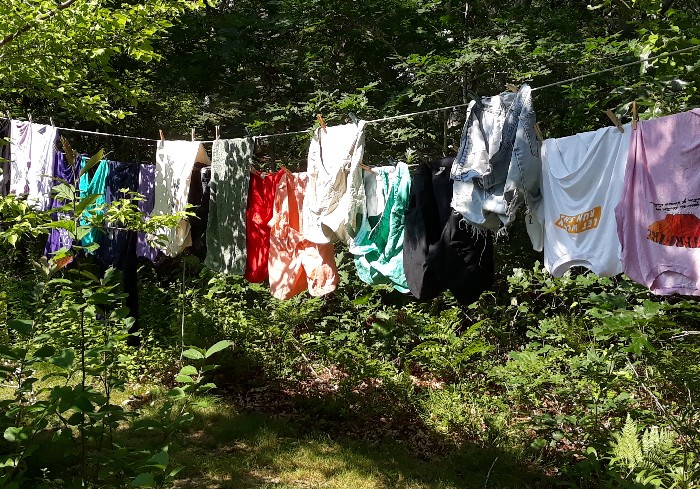
I don’t need a calendar to tell me what season it is. My laundry line makes it clear. Guess what? It’s summer!

Saturday’s laundry line included lots of T-shirts and no long pants. What prompted this particular laundry day wasn’t the usual, that I was out of clean underwear; the impending dearth was of shorts. Even though I bought two new pair last month. (Both “dry on the fly” shorts from Duluth Trading, in case you’re wondering. Took a chance on the first and liked it so much that I immediately ordered a second.)

Several of the Ts had long sleeves, reflecting some cool, April-like weather we had in late June and early July. Then it rained a lot. The rain left but humidity didn’t. We’ve been living in Sauna City for quite a few days now. Tam hates it, but manages to take good care of himself. I’m tempted to change T-shirts three times a day (which still doesn’t excuse the size of my T-shirt collection). Mushrooms are blooming all over the place.

T-shirts and shorts, shorts and T-shirts

In a possibly hopeless attempt to justify my T-shirt collection — it’s not a collection, it’s my wardrobe — earlier this year I started a blog devoted to them: The T-Shirt Chronicles. A week ago I blogged about Lammas Bookstore in D.C., where I was the book buyer from 1981 to 1985. I’m wearing the 10th anniversary shirt, from 1983, right now, by the way.

This reminded me of a story the owner-manager, Mary Farmer, told about doing her laundry in the neighborhood laundromat. An occasional customer came up to her and said she was surprised to see Mary doing her own laundry.

This story has stuck with me for almost 40 years now. It surfaces whenever someone writes or says something that suggests s/he doesn’t have a clue about the challenges of running a small business, especially a bookstore, which operates under constraints that may not be unique but certainly aren’t typical of retail.

There’s a Q&A I learned in horses that applies pretty well to bookselling and other business enterprises: Q: “How do you make a small fortune in horses?” A: “Start with a large one.”

Especially on Martha’s Vineyard. Some people are sure they’re being gouged by island businesses. They may complain bitterly that this or that retailer isn’t open year-round, and while we at it, Main Street doesn’t look the way it used to; now it’s all boutiques and T-shirt shops.

Well, yeah. If you factor in the cost of land, and the insane rents often charged for commercial retail space — how much merchandise at what markup do you have to turn over just to pay the rent, not to mention the staff? — and the short peak selling season, and while we’re at it competition from online behemoths who can get you anything you want faster! cheaper! than even driving into town . . .

It’s not all that hard to understand. But plenty of people just don’t want to think about it.

Short version: I do my own laundry. I rarely use a dryer. I can afford to wait for a good drying day, and I like hanging the wash out. I would, however, almost certainly feel differently about hanging things out if I were in charge of laundry for four, or six, or ten.

And do check out The T-Shirt Chronicles if you haven’t yet. I’m mostly hanging out in the early 1980s at the moment, when I was living in D.C., but the Vineyard has come up a few times already.

Same line from the other end
Posted in home, musing | Tagged , , , , , , , | Leave a comment

Bread Baking in Summer

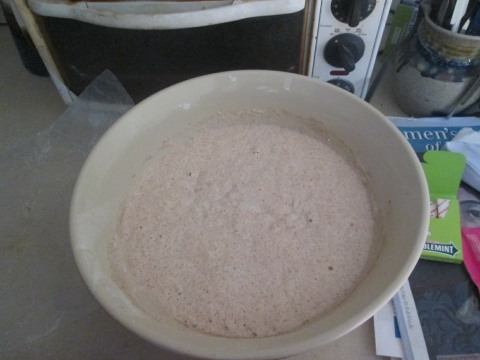
Hot, humid weather — which is to say “summer” — can be challenging for a bread baker. This bread baker uses sourdough almost exclusively. Most of the year, my loaves rise in a leisurely fashion. In winter they rise so leisurely that if I got started late in the day they may not go into the oven till two in the morning.

Batter rising in big bowl

In summer, however, my starter acts like it’s on steroids. A couple of times I’ve thought I had time to run a couple of errands or go for a walk with Tam before the rising loaves are ready to go into the oven, only to come home to dough overflowing the loaf pans. Whereupon I throw the dough back in my big bowl, punch it down, knead it a little, and loaf it again.

Even when I catch it in time, dough that’s risen too fast bakes into bread with a coarse, uneven crumb. It tastes fine but looks ugly. I live in an un-air-conditioned studio apartment, and if there’s a way to slow the rising down, I haven’t figured it out yet. Any ideas? (I’ve tried setting the loaf pans in shallow baking sheets filled with cold water, which I replenish regularly, but this doesn’t seem to make a difference.)

This afternoon, instead of loafing the dough immediately after kneading it, I let it rise in the bowl. It doubled in barely an hour. I punched it down and let it rise again three times, hoping it would wear itself out, and you know what? It didn’t slow down, but I think it helped. My loaves rose briskly, but I kept an eye out and got them into the oven at just the right time. The texture is a lot better than that of my last couple of bakings.

In fact, I’m quite pleased with these loaves. They’ve got chopped walnuts and dried cranberries in them — I’m congenitally incapable of baking bread without putting stuff in it — and because I didn’t skimp on the cranberries, there’s a pleasant tartness in each bite.

The other challenge of hot, humid weather is mold. Ordinarily I finish off a two-pound loaf of bread in a week or 10 days. Three seasons of the year the bread will keep that long. Toward the end of its lifespan, it’s not exactly as chewy and wonderful as it was in the first few days, but it makes perfectly good toast or French toast. In summer, however, bread starts developing blue-green splotches after four or five days. In summer I also don’t eat as much bread.

But I wasn’t about to give up baking just because of summer. Kneading is good therapy, among other things, and a good time to catch up on podcasts (I can’t listen to spoken-word anything when I’m working). Instead, I cut the liquid (in this case orange juice and a little applesauce, which I count as liquid because it’s squishy) from two cups to one and a half, which means the dough will absorb less flour (about two and a half cups each of whole wheat and white and a scant cup of rye that I wanted to use up) and turn into less bread.

Then, instead of cutting the dough lump in two, I cut it in three: two one-pounders and one one-and-a-half. When they cool, one will stay out for eating, and the other two will go into the freezer.

I’m pretty sure I can finish off one of these smaller loaves before the blue-green splotches start taking over. And the other two are waiting for me in the freezer, where mold can’t get to them.

Note that the middle one has an overhang like a toadstool. That loaf pan is the same size as the one at the far right, but it had more dough in it.
Posted in home | Tagged , , , | Leave a comment

Happy Fifth of July

In 1852, Frederick Douglass declined to address a Fourth of July celebration. On July 5th he explained why, in one of the greatest speeches of all time: “What to the Slave Is Your Fourth of July?”

That speech sparked a change in my relationship to the Fourth of July. Coming of political age during the Vietnam War, I did not love “America.” I saw little to celebrate on the Fourth besides hypocrisy. Then, in 2014, I was invited to participate in an annual group reading of Douglass’s speech, a tradition that already went back at least a decade. In preparation I read the speech all the way through for almost certainly the first time in my life.

As I wrote in this blog at the time: “So this year, after decades of not flying, saluting, or pledging allegiance to the flag; of sticking flag stamps on my envelopes upside down; of trying to live with, understand, and shape my undeniable Americanness, I finally got seduced into celebrating the 4th of July.”

My first “Speech on the Beach,” 2014. Producer Abby McGrath is at the mic. I’m just to the right of the mic, studying my script.

I’ve participated every year since, except for the one year it didn’t happen, in what is fondly known as “the Speech on the Beach” because it usually happens at the Inkwell beach in Oak Bluffs. Last year, thanks to Covid-19, it was virtual: each reader taped his or her own segment and they were stitched painstakingly into a whole. It was a little ragged, but it worked. The power of the words came through.

This year it was again virtual, but with a couple of big differences. Most of the video was handled by a pro, Michelle Vivian-Jemison, and so was the editing. This version is shorter then in previous years — it runs about 25 minutes — but it captures much of the original’s power. (Nevertheless, please read or reread, listen or relisten to, the whole thing at your earliest possible convenience.) The cast was larger than in previous years, but once again producers Abby McGrath and Makani Themba pulled it off: Out of Many, One.

What started with participating in the reading of Douglass’s “What to the Slave Is Your Fourth of July?” has continued in the years since November 2016. The Fourth of July has come to mean more than a celebration of off-the-rack patriotism. The vision of the founders was limited by the world they were grounded in, but at the same time that vision was expansive and expandable. What it’s taken me a few decades to get is that it’s up to us in every generation to do the expanding.

Douglass himself got it. After staring slavery in the face for an hour — for his whole life — he says this:

Allow me to say, in conclusion, notwithstanding the dark picture I have this day presented of the state of the nation, I do not despair of this country. There are forces in operation, which must inevitably work the downfall of slavery. “The arm of the Lord is not shortened,” and the doom of slavery is certain. I, therefore, leave off where I began, with hope. While drawing encouragement from the Declaration of Independence, the great principles it contains, and the genius of American Institutions, my spirit is also cheered by the obvious tendencies of the age. Nations do not now stand in the same relation to each other that they did ages ago. No nation can now shut itself up from the surrounding world, and trot round in the same old path of its fathers without interference.

“Nations do not now stand in the same relation to each other as they did ages ago” — and neither do individuals. I too am “cheered by the obvious tendencies of the age,” some of them, even while I’m infuriated and disheartened by others. And I too manage most of the time to draw “encouragement from the Declaration of Independence, the great principles it contains, and the genius of American Institutions.” Seeing them under attack by forces that Douglass would surely recognize has made me — almost — patriotic.

Here’s the 2021 Vineyard rendition of Douglass’s speech (abridged):

Posted in public life | Tagged , , , , | 2 Comments

Flunking Inspection

Malvina Forester. She’s a 2008, I’ve had her since 2010, and this photo is from before the 2020 election because she’s since added a Biden/Harris and an Ed Markey to the sticker collection.

In Massachusetts, non-commercial motor vehicles get inspected once a year. When I learned to drive, in the mid/late 1960s, it was twice, spring and fall. Now it’s once, and the year is, sensibly enough, broken into months; probably some effort is made to divide all registered vehicles into 12 semi-equal parts.

Since you have a whole month to get inspected, theoretically this avoids long lines at inspection stations that don’t require appointments. In practice — well, you know what happens: procrastinators all crowd in during the month’s last few days.

This would include me. Getting inspected provokes some anxiety, mostly about the possibility of doing something stupid like not noticing that one brake light is burned out, so I invariably put it off. These days Malvina Forester gets inspected in May. Around mid-month I realized that the hand brake wasn’t holding as well as it should, so I scheduled a visit to my mechanic for the Monday of the last full week in May. That would give me plenty of time to get inspected before the end of the month — which was actually the end of that week, because the last three days of the month were Memorial Day weekend.

Hand brake fixed, oil changed, everything in good working order, that Wednesday afternoon I headed off to my regular inspection station, Mid-Island Repair in beautiful downtown West Tisbury, better known as Kenny Belain’s. To my astonishment Malvina flunked the emissions test. WTF?

When you flunk the emissions test, you get a four-color brochure from the commonwealth about what this means and your Vehicle Inspection Report includes a list of “local registered emissions repair shops.” “Local” notwithstanding, only two of the 10 were on the Vineyard and Courtesy Motors, which has taken great care of my vehicles as long as I’ve been on the Vineyard, was not one of them.

So at the next opportunity I headed up there to consult with Larry, who now runs the shop with his son Jesse, who might not have been born when I made my first visit and if he was he would have been very young. Courtesy Motors is very well named: Larry is a soft-spoken, unfailingly polite guy who has never treated me like a car-clueless female even though on some occasions I have been known to act like one. He called my attention to the small print on page 2 of the inspection report: “Your vehicle’s On-Board Diagnostic (OBD) system is not ready to be tested. As a result, your vehicle cannot receive a complete emissions test at this time. This is often caused by a disconnected battery or recent repair work.”

Aha. Larry explained that mechanics may disconnect and reconnect the battery in the course of doing repairs, that this causes the car’s on-board computer to reset, and that the car has to be driven a while before it’s functioning normally again. I hadn’t driven much between between the repair work on Monday and inspection on Wednesday. This had to be it — I hoped. At least the specter of major repairs in my future receded somewhat. Larry said if I wanted to bring the car by before I took it to be re-inspected, they’d test the emissions to make sure I’d pass on the second try. The flunk report said that “if your vehicle does not pass a re-test within 60 days of its initial inspection, RMV [Registry of Motor Vehicles] may suspend your registration,” so this was reassuring.

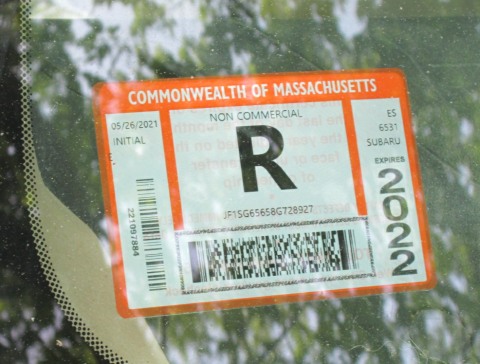
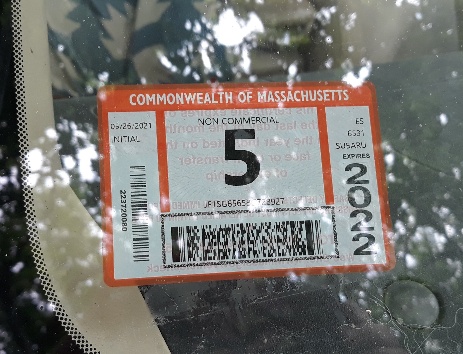
In Massachusetts at least, all inspection flunks are not created equal. If you flunk any of the safety tests, you have only 7 days to fix them and get re-inspected. If you flunk the emissions test, you have 60 days. Clearly an emissions flunk is a higher class of flunk, and the two have different color Rs on the sticker so vigilant police officers can tell them apart.

The 60-day deadline gave me more time to procrastinate and worry from time to time about what-ifs. So at the tail end of June I finally got myself back to Kenny Belain’s. There were 9 or 10 cars in line: clearly I’m not the only one who leaves inspection to the last minute. July was coming right up, like on Thursday, so I turned around and went home.

When I returned, on Thursday, July 1, there was no line at all. Malvina passed her emissions test, we’re legal again, and I know better than to go for inspection soon after having repair work done. My inspection month is still May. Fine with me, because there are a lot more cars on the island in July.

Maybe next time I’ll know better than to leave it all to the end of the month?

Posted in technology | Tagged , , , , | 3 Comments