Winter Concert

sing sign 2Last night I sang in the annual Winter Concert. As usual, the Hebrew Center was packed, admission was free, we got the audience singing, and (as far as I could tell) everyone went home happy.

What’s not to like about this concert? We sing songs no one is sick of because most people in the audience have never heard them before. The songs come from all over the world. Nearly all relate to winter, the dark time of year, or the harvest season that precedes it. This year several of the songs came from Africa, East, West, and South. Another was in Hebrew. At least one came from the gospel tradition. Some were traditional, others composed. Some are rounds, others are in three- or four-part harmony. What a wonder the human voice is, especially when it blends with other human voices.

The singers are a varied, multi-generational lot, though the women and girls far outnumber the men. (In my years of singing in the chorus I don’t believe I’ve ever seen a boy, i.e., a male person too young to have children, in our ranks.) Not to worry: women like me who usually sing alto get to explore the lower end of our ranges. Everyone wants to sing alto because in these arrangements the altos usually get the melody. This year I sang tenor. I can’t harmonize for shit but I love to try, in the privacy of car or home or the anonymity of a large group of people. Slowly but surely I’m getting better at it.

Dress rehearsal at the M.V. Hebrew Center. Director Roberta Kirn is at right.

Dress rehearsal at the M.V. Hebrew Center. Director Roberta Kirn is at right.

Anyone can sing. Every year director Roberta Kirn sends out the call, and we convene for our first rehearsal in early November. You don’t have to read music. Roberta prepares a CD with all the songs on it, with the various parts broken out to make them easier to learn. I learn the songs driving around the island. Others learn them while walking or cooking or sitting at the computer. We have six weekly rehearsals and a dress rehearsal the day before the concert. For years we’ve rehearsed at the M.V. Public Charter School, where Roberta used to be the music teacher; officially we’re the Charter School Community Chorus, but mostly we’re a pickup group that re-forms every year, albeit with a solid core of returnees who know the drill and at least some of the songs. This year we rehearsed at the Unitarian Universalist Society chapel in Vineyard Haven.

Roberta is a woman with a vision. In her vision music is part of our daily lives, not just because we’re listening to it but because we’re making it, singing, drumming, and dancing it. For years she’s been a protegée of Ysaye Maria Barnwell, longtime member of Sweet Honey in the Rock and the originator and leader of Building a Vocal Community: Singing in the African American Tradition workshops. In last night’s concert, we sang “Breaths,” a setting by Ysaye Barnwell of a poem by the Senegalese poet Birago Diop. I was in the audience when Sweet Honey recorded it for their live album Good News: 1980, All Souls Unitarian Church, 16th Street, N.W. It’s not often that my Vineyard life connects so viscerally with my D.C. days, and wouldn’t you know it would be through music?

I’m not a musician, but I can’t live without music. I’ve got music playing almost all the time, in the car, in my apartment — not, however, when I’m out walking. When I’m out walking, I might be humming or singing or listening to the words and images streaming through my head or just paying attention to the sounds around me.

Something I’ve loved about Martha’s Vineyard ever since I got here is that it’s possible to take part in all sorts of things even if you aren’t, and don’t aspire to be, an expert. Theater, politics, music. DEMOCRACY IS NOT A SPECTATOR SPORT, says the old League of Women Voters bumper sticker. Damn straight. Neither is music. Walt Whitman heard America singing. Mostly I hear America squabbling. Maybe we all need to sing louder.
 

Posted in Martha's Vineyard, music, public life | Tagged , , , , , , | 1 Comment

Moon Walking

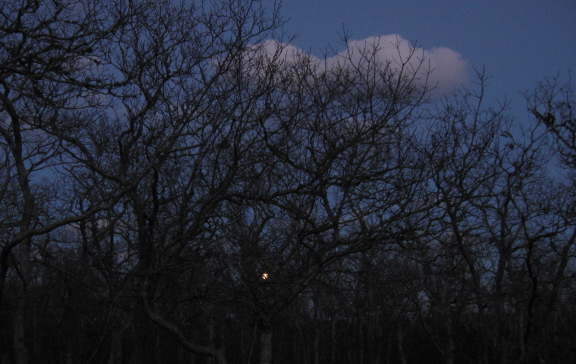
20131216 full moon rise

After several days of overcast and rain, the sky cleared as the moon was nearing full. It’s stayed clear as the moon wanes. Most nights Trav and I have gone out moon walking. I carry a little flashlight in my pocket, but the moon is bright enough to light my way and show our shadows.

Tonight the waning moon was hiding. Finally I spied it, glowing through a long thin gap in the clouds above the West Tisbury School. When we got home, Trav slurped water while Ms. Moon reappeared among the trees, a little later and a little smaller than in the photo above.

Winter arrived officially at 12:11 this afternoon, but it’s been in the 50s (F) all day. It’s 53 now. No need for a hat: a warm wind tangled my hair as I walked. My fleece vest hung open over my sweatshirt. I would have left it on its hook if it didn’t have dog biscuits in one pocket and string cheese in the other.

Not for the first time, I thought how fortunate I am to be able to go walking at night down dark lonely paths and dirt roads, with no fear for my safety. Freedom from fear is an ongoing revelation. Freedom from fear is even a little scary.

I had a breakthrough with Squatters’ Speakeasy this past week. I’d been afraid it was going nowhere, afraid it was crap, afraid I wouldn’t be able to figure out what it needed. I didn’t want to keep walking. What was the point if I wasn’t going anywhere?

Then there it was, the connection I needed. Now I’m walking through the dark. The wind is blowing. A nearly full moon is rising.

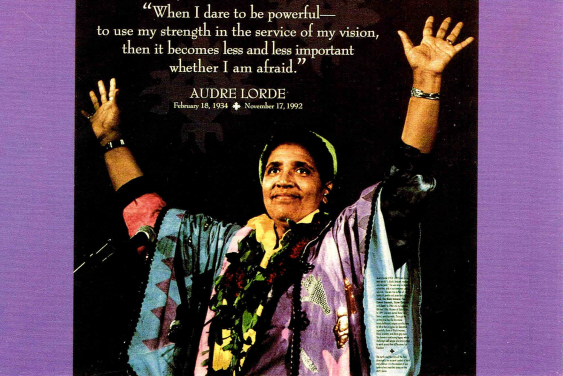
audre postcard

Posted in Martha's Vineyard, outdoors, writing | Tagged , , , | 2 Comments

Quintet Fail

Yesterday
all my ice disks seemed here to stay

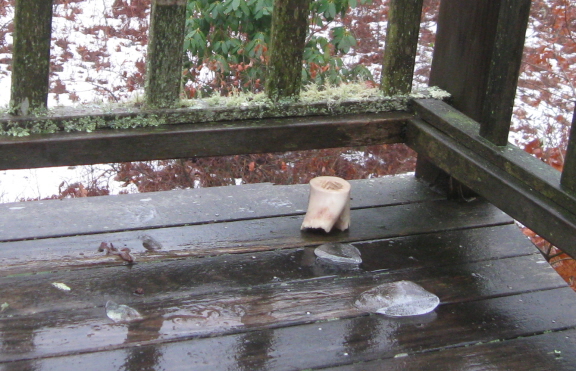
20131214 bone quartet

Now the weather’s made them go away

20131215 fail

Sniff

Posted in Martha's Vineyard, outdoors | Tagged , | 1 Comment

Ice Diskology

The season that’s currently occupying Martha’s Vineyard is winter, so From the Seasonally Occupied Territories is going to blog about that. With pictures.

Raw material

Raw material

Last winter I had an epiphany. No, it was not news to me that water freezes when the temperature goes below freezing (32 F, 0 C). Nor was it news that the water in Travvy’s outside water dish froze. Hadn’t I broken the ice often enough, with fist or foot, or dropped the dish from shoulder height to smash the ice? (Once upon a time I did this to an outside water dish forgetting that it was pottery, not plastic or stainless steel. The ice smashed but so did the dish.)

Thick and thin

Thick and thin

The epiphany was that ice removed from the dish could stand up on its own. Depending on the temperature and how long the water had been quietly freezing, some ice disks were thicker than others. Depending on the sun’s angle, or whether the sun was out at all, the disks might glow with light or look cold and forbidding.

Disk with corona

Disk with corona

Actually the biggest epiphany of all was that when I posted photos of “dog dish ice art” on Facebook, my friends liked them. As with dogs, so with humans: behavior that’s reinforced tends to continue. You can blame my friends — or yourself if you are one of them — for everything that comes next.

Disk overboard

Disk overboard

One day without thinking I flung a disk off the deck. It was a cold morning with rising temps predicted; I knew it wouldn’t last. It didn’t fly like a Frisbee, but it didn’t break either. Of course I had to go get my camera.

The hole near the top was made by Travvy’s nose.

When cold snaps continue, the ice disks multiply. To light and thickness the variable of position is introduced. This is when things start to get fun.

20131212 two w leaf

The leaf was floating in the water. I didn’t put it there, but it did give me ideas. Read on.

20131213 trio & kongTrav’s Kong Wobbler spends most of its time on the deck. It wanted to be in the picture. I’m not one to turn down a little red.

20131213 trio distance

There’s a story here but I’m not sure what it is. Is the disk in the front coming or going? Did Kong suggest that it wasn’t just a third wheel and it should really come back and hang out?

No idea.

Creative wisdom advises that one work with the materials available. What I’ll never run short of is marrow bones that Travvy has chewed clean. At any given time, there are between six and eight of them in the freezer slathered on the inside with peanut butter. That still leaves another six or eight on the apartment floor waiting to be stepped on with bare feet.

When I go out, I leave Travvy on the deck (inside if the weather is foul) with a peanut butter bone and the Kong Wobbler with treats in it. When he rolls Kong around, the treats come out the keyhole-sized opening in its side.

So yesterday afternoon — brainstorm. My attempts at mixing media were twice thwarted by Travvy, who plucked the bone out of the water, but the ice got thicker and I put the inside water dish outside so he’d have something else to drink out of. Voilà!

20131214 solo bone 2Here’s the ice disk quartet.

20131214 bone quartet

Is there a quintet in our future? Likely so. After that who knows. Temps tomorrow are supposed to get into the high 40s. The high 40s are not kind to ice disks, though the thicker ones hang on longer than one might expect.

But it’s only mid-December. The winter solstice is still a week away. Dog dish ice art season has barely begun.

Posted in dogs, outdoors | Tagged , , | 2 Comments

Live and Learn

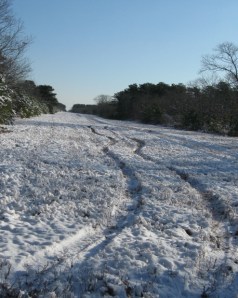
What Travvy and I saw as we set out on our walk this morning

What Travvy and I saw as we set out on our walk this morning

Yesterday it snowed. Yesterday was a gray day. The snow was wet and there wasn’t much of it.

20131211 fire laneThis morning it sparkled. The snow was both pristine and easy to walk in. What’s not to like?

Snow reveals the passage of birds and small animals that ordinarily go undetected by my untutored eye. It took no tutoring at all to spot the motor vehicle tracks in a place where motor vehicles are not welcome: the bike path.

At the edge of the fire lane, the vehicle stopped, backed up, and headed down the fire lane. My untutored eye could figure out this much but not what kind of vehicle it was or what it was doing there. Shotgun deer season is still on. It could have been hunters, but this would be unusual: hunters usually park by the side of the road or in a handy trailhead then walk into the woods. Emergency vehicle? Law enforcement? Inquiring minds want to know, sorta, but not enough to follow the tracks.

My buddy and I turned right and followed the edge of the field toward Old County Road. Up ahead a black Lab wearing a blaze orange vest approached. Some distance behind him walked a man. The dog was not on a leash. That struck me as a little odd: deck your dog out in orange for shotgun season but let him run off-leash a literal stone’s throw from the state forest?

Travvy on the alert

Travvy on the alert

Trav’s generally friendly but he’s also reactive and 80 pounds of bouncing malamute is a handful even with no snow on the ground. I know the drill: call him to heel — he was on his Flexi — and bite off a big chunk of string cheese from the tube in my pocket and put it in my mouth. String cheese makes me more interesting to Trav than almost anything else in the world, and it’s easier to dole string cheese out of my mouth than out of my pocket.

The Lab was now lying sphinx-style, showing no signs of aggression. His owner had almost caught up. “He’s friendly,” the guy called.

I’ve heard this so often that my groan was strictly internal.

At that point the Lab could contain himself no longer. He broke his stay and rushed up to and past us. Whereupon Trav could barely contain himself and tried to follow. A couple of words and a piece of string cheese got his attention back.

“He’s friendly,” the man repeated.

I’d already figured that out. The man seemed friendly too, which is why I was still smiling when I glanced down at Trav and said, “He’s reactive, and I’ve got a sort of gimpy knee.” I don’t generally cop to this, but it’s been true since my encounter with Lyme disease last summer. I did not want to be broadsided either by Trav or by an exuberant Lab of similar size.

20131211 fuzzy butt

Same fuzzy butt, different trail

“Oh, OK,” said the man, and got his dog by the collar. They went on their way. Trav and I went on ours.

We’ve had dozens of encounters like this. Maybe hundreds. “He’s friendly,” says the other dog owner, as if his or her dog were the only variable in the situation. I used to say, “Mine’s not,” but then I stopped. One, it wasn’t true, and two, putting the word out that your large, wolfish-looking dog isn’t friendly might lead to trouble down the road. What to say instead? Often I say “My guy’s reactive,” as I did this morning, but people who understand what “reactive” means generally have some dog-training experience, in which case they’re not letting their dog rush up to mine in the first place.

The gimpy-knee gambit, which I’d never used before, might have possibilities. True, I look too sturdy to be knocked to the ground by anything smaller than a charging Newfoundland, but the possibility of bodily injury — and consequent lawsuits? — might stick in people’s minds when they encounter someone smaller or more fragile-looking.

This was a good-sized branch when Travvy first invited me to play tug with it. Several tug games later, it's well on it's way to becoming a stick.

This was a good-sized branch when Travvy first invited me to play tug with it. Several tug games later, it’s well on it’s way to becoming a stick.

People with some dog-training experience, especially those who have experience with reactive dogs, bemoan the cluelessness of dog owners who let their dogs run loose in public places. “She’ll come when I call,” these owners will say as you approach, then in about 95 percent of all instances they’ll proceed to demonstrate that this is not true. Whereupon they add, perhaps a little sheepishly, “She’s friendly.”

I’ve been among the bemoaners and almost surely will be again. But I have to admit that before Travvy I was just as clueless. It took firsthand experience to give me a clue.

Ain’t that the way with just about everything? I thought as I walked down the field and into the woods. Trav sniffed happily at tufts of grass, peed on promising tree trunks, and pounced on voles — real or imaginary I don’t know, because they all got away. Possibilities remain remote and maybe even unimaginable till they happen up close and personal.

Lately I’ve been thinking this about health insurance. If you’ve done time in the ranks of the uninsured or underinsured, if you’ve stayed in a job you loathed for fear of losing your insurance, if you’ve ever been denied access to needed treatment, you probably get why the Affordable Care Act is a step in the right direction, even if you aren’t happy with all the specifics.

People who are dead-set against the very idea of it? On one hand, I don’t understand them. OK, so they’ve been lucky: they’re covered, they’ve always been covered, they’ve never feared losing their coverage. Don’t they know anyone who hasn’t been so lucky? Can’t they imagine . . . ?

I can imagine not knowing where my next meal is coming from, even though I’ve never been that broke.

But I couldn’t imagine what canine reactivity looked like until I found myself living with a reactive dog.

20131213 panorama 2


Posted in dogs, Martha's Vineyard, outdoors | Tagged , , , , , | 6 Comments

Deer Season

Deer season began this past Monday. We used to call it “deer week,” but now it runs two weeks, no hunting on Sunday.

Deer season actually began on October 21 and continues through the last day of the year. Archers can hunt deer from October 21 through November 30; December 16 through 31 is for hunters with black-powder rifles. When people around here say “deer season,” they usually mean “shotgun deer season.” That’s when we non-hunters stay out of the woods.

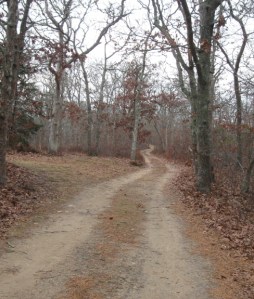
Pine Hill Road

Pine Hill, the better traveled part

Monday morning Trav and I saw three hunters on Pine Hill. All were wearing blaze orange vests and caps. Blaze orange doesn’t occur naturally in the woods. (Bittersweet berries come close, but they’re small). One hunter stood at the side of the road. Even the two back in the woods were easy to spot.

Pine Hill is a barely traveled, mostly dirt road that’s frequently on our morning walk route. The stretch of it between Porter’s house and the Boucks’ is only passable by walkers, bikers, and horseback riders (and cross-country skiers in season). On one side it’s bordered by woods that back up to a huge open pasture that no livestock currently graze in. Hunters aren’t supposed to shoot within 500 feet of an inhabited dwelling, and on this stretch of Pine Hill it’s easy to keep your distance.

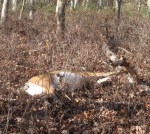
Dead deer in the woods

Dead deer in the woods

Deer are always bounding though the woods around here. On November 9 we found a dead deer about 25 feet off the road. Well, OK, Trav found it: deer are well camouflaged in the autumn woods, so I might not have spotted it if Trav hadn’t suddenly started pulling in that direction. Did it die of natural causes, or was it maybe hit by a car? It could have been wounded by an arrow and escaped the archer. Trav was on his Flexi, so I couldn’t get close enough to tell how it might have died — not without risking a pitched battle to get
Trav away from the carcass.

My father taught me to shoot with his .22. He nailed a tin can lid to a board: that was my target. Eventually I managed to hit the lid, but I never hit the nail in the middle. At summer camp I earned a bunch of National Rifle Association (NRA) badges, but not nearly as many as my brother. I haven’t shot a gun since I was about 14.

In 1969 I became a city girl. I learned to be wary, very wary, of guns. Cops carried them. I was a marshal (as peacekeepers were called in those days) at many demonstrations. One of the marshals’ jobs was to keep the fringier elements on our own side from antagonizing the cops. These fringier elements, virtually all of whom — like the cops — were men, thought that getting your head cracked by a cop radicalized people. I don’t think they really believed this. I think they just liked to make things go boom. I saw cops go overboard with billy clubs and tear gas but never with guns. After the shootings at Kent State and Jackson State in May 1970, however, we knew anything was possible.

Guns were used for breaking the law as well as enforcing it. Guns were used for holdups and break-ins and settling disputes. People were wounded, people were killed, and over the years I knew quite a few women who were raped or robbed at gunpoint. Guns inspired fear, guns caused harm. This wasn’t hard to understand.

After I moved to Martha’s Vineyard in 1985, my view of guns started to evolve — “expand” may be the better word. I was meeting lifelong hunters and people who had hunters in the family. (Yes, some women hunt, but the overwhelming majority of the hunters I’ve met socially or seen in the woods are men.) They dressed and eventually ate what they shot. During my horsegirl years (1999–2010) I’d ride pretty much anywhere during archery and black-powder seasons. Archers and antique rifle enthusiasts tend to be acutely aware of their surroundings. They have to be if they want to hit anything. By sound and sight they can tell a horse from a deer.

No way would I venture into the woods, especially the state forest, during shotgun season. I heard enough stories, I saw enough empty beer cans in the woods when it was over. But the hunters I saw last Monday morning didn’t worry me. I didn’t recognize them, but they looked familiar. I’m pretty sure they were local.

In the almost three years I’ve been on Facebook, gun control has come up several times, most spectacularly after the school shootings at Newtown, Connecticut, almost a year ago. My Facebook friends are a fairly diverse lot, and what I’ve noticed is that their opinions about guns and gun control diverge most clearly not along liberal vs. conservative lines, or blue vs. red state lines, but along urban vs. rural and small-town lines. Rural and small-town people, I suspect, are much more likely to either use or have friends and kinfolk who use guns to put food in the freezer. For city people, people with guns, whether cops or criminals, are far more likely to be hostile. Different. Not like them.

There’s more to it, of course. The NRA, which seems to represent the interests of firearms manufacturers at least as much as it represents those of hunters, recreational shooters, and amateur enthusiasts, is pumping millions of dollars into misinforming and scaring people. It’s not hard to scare the white guys who are already convinced that “government” and/or people of color are going to hunt them down if they don’t have guns at hand.

Gun control advocates often don’t know what laws and regulations are already on the books. They don’t distinguish between shotguns and assault rifles. Some of them seem to think that anyone who owns any gun for any reason is an irresponsible jackass.

Their opponents meanwhile are insisting that “guns don’t kill people; people kill people.” But guns kill people in ways that other potentially lethal weapons don’t. It’s much easier to kill someone with a gun than with a knife or a garrote. It’s easier to kill from a distance. It’s easier to kill on impulse. It’s easier to kill by accident. People who attempt suicide with a gun succeed more often than those who use pills or a knife.

WCTUAside: Based on no evidence beyond reading and thinking and listening to women talk, I have this hunch that for some women gun control is a way of controlling the excesses of male behavior. Like the crusade against booze in the late 19th and early 20th centuries. The big problem wasn’t alcohol, it was what men did under the influence of it. Prohibition didn’t improve male behavior — quite the contrary. Will stricter controls on guns do the trick? I’ve got my doubts.

What’s the solution? As usual, I don’t have one. Just keep in mind, when talking about guns and gun control, that in our various mind’s eyes the people carrying the guns aren’t the same. For some it’s the National Guard at Kent State. For some it’s criminals invading their home or their neighborhood. For some it’s the hunters along Pine Hill — who also, like as not, might be volunteer firefighters or EMTs.

And for some, of course, it’s “all of the above,” plus the child who gets hold of an unsecured pistol and kills someone else, or himself. That complicates things greatly — but it also makes possible the kind of discussion that searches for solutions instead of drawing lines in the sand.

Trav is real. The deer isn't.

Trav is real. The deer isn’t.

Posted in Martha's Vineyard, outdoors | Tagged , , , | 4 Comments

Maple Red

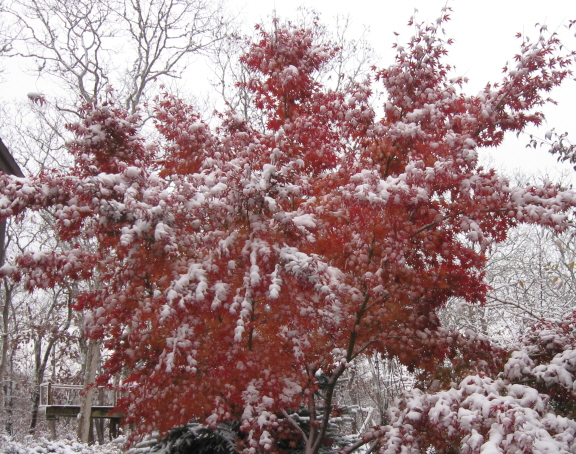
When February 2014 comes — or, possibly, given February weather, skids — to a close, Travvy will be six years old and I will have lived in this apartment for seven. Outside my west-facing windows all that time have been a Japanese maple and its firry buddy. The fir is tall, elegant, and shapely. Some winters it’s dressed in tiny lights. Whatever the season, it draws my eye when I walk, bike, or drive in the driveway.

Six autumns came and went with me barely noticing the maple. This November that changed. This November I fell in love with a tree.

This is what I saw whenever I came home.

maple eclipsed

How could I not have noticed?

When I opened the shade and pulled the curtains in the morning, Maple Red greeted me.

maple & sill

My maternal grandmother loved salted peanuts, the number 7 (she was the seventh of nine children and called her memoir Seven Homes Had I), and the color red. I’ve always been a little ambivalent about red. It’s loud, it’s overpowering, it calls attention to itself.

In November it’s all of the above and more. Maple Red upstaged everything else in the landscape and she didn’t care. I saw her in the dark when the curtains were closed. I saw her in my sleep.

mapleIn mid-November it snowed.

The snow melted. The landscape kept fading, but not Maple Red.

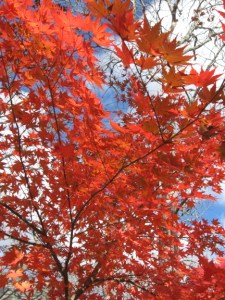
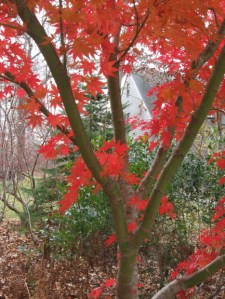
maple leaves 220131117 maple branchesHer every leaf was perfect. They caught the light in so many ways.

Maple leaves forever.

20131123 almost leaflessWell, not quite forever. Slowly, perceptibly, the red faded. Late November winds took their toll.
She’ll be back in the spring. Green, not red. Red comes later.

I’ll be waiting.

maple leaves

Posted in Martha's Vineyard, outdoors | Tagged , | 5 Comments

Belonging

This started off to be a follow-up to “On (the?) Island,” but it didn’t go where I thought it was going. Surprise, surprise, surprise. I seem to be on a “what am I doing and where do I belong?” kick. So what else is new?

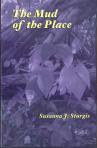
With some trepidation I asked mystery writer Cynthia Riggs to blurb The Mud of the Place. Trepidation because I had only a nodding acquaintance with Cynthia at the time and because blurbing a novel means — for the conscientious among us — reading it first What if she didn’t like Mud? (Now that I’ve been in her Sunday night writers’ group for several years, I know how accessible she is, and how supportive of other writers.)

mud cover2She wrote: “A sensitive, witty, and tightly plotted novel of life on Martha’s Vineyard that only a true Islander could have written. Nice going, Susanna!”
I cried when I read it. It still makes me a little weepy. Not just for the praise but for “that only a true Islander could have written.” If a person from away becomes an islander when an islander calls her one, I’d already qualified — but this was in writing and Cynthia’s island bona fides are unimpeachable: among many other things, her house on the Edgartown–West Tisbury Road has been in her family since around 1750.

My second thought was that only a true islander could have written it, but a true islander wouldn’t have written it. Not just because Mud‘s two main characters are a gay man and a lesbian, but because a true islander would have no need to write it. To write about a place, you have to stand at least a little ways outside it. That’s where you find both the words and the time.

Which pretty much sums me up: I wanna belong but I don’t wanna, and any category that tries to include me I’ll try to redefine so it doesn’t.

When I was features editor at the Martha’s Vineyard Times, the people who came in to pitch stories about themselves were almost invariably from somewhere else, and not long ago either. Longtimers would say things like “You really should do a story about [native islander X] — but she probably won’t want to be interviewed.”

I was told by more than one person that islanders were only supposed to get their names in the paper three times in their lives: when they were born, when they married, and when they died. By that standard I was a lost cause: not only was my byline in the newspaper nearly every week, I put considerable effort into getting it into publications elsewhere.

Islanders were supposed to be circumspect. They weren’t supposed to toot their own horns. This isn’t just a Vineyard thing: it’s a New England thing, and I’m New England born and bred. (We’ll ignore for the moment the fact that on my mother’s side I’m more than half southern.) Indeed, I’ve heard that “three times” dictum quoted about other places. But in my newspaper days the loudest horn-tooters were invariably from away, and the louder the tooting, the less time they’d been here.

At some point I looked around the Martha’s Vineyard Times newsroom and realized that no one on the editorial side was a native islander. Native islanders might write town news columns and occasional feature stories, or work in production, or sell ads, but they weren’t reporters or editors. The same seemed to be true at the rival Vineyard Gazette.

This wasn’t, I surmised, because of the “three times” rule, or because islanders were being discriminated against. It was mostly because both newpapers paid peanuts and the only way you could afford to work there was if you had another source of income — family money or a high-earning spouse — or if you were willing to live on a shoestring. Most working islanders didn’t and weren’t.

Nearly all of the people telling the Vineyard’s stories, in other words, were from somewhere else. This is still true. Mystery writer Cynthia Riggs and the eminent storyteller Susan Klein are among the very few exceptions.

So when Cynthia said that The Mud of the Place was something “only a true Islander could have written,” I took it to heart, even as I didn’t quite believe it.

This portrait of Fred hangs in the Ag Hall. Painting by C. Kenney, photo by Randol Rynd.

This portrait of Fred hangs in the Ag Hall. Painting by C. Kenney, photo by Randol Rynd.

On the subject of who was an islander, the late Fred Fisher Jr., dairyman, used to say, “If a cat crawls in the oven and has kittens, that doesn’t make ’em biscuits.” This wasn’t original with Fred. I’ve heard it said of Vermont and other places. But you get the idea. Fred not only looked like a quintessential islander, he acted like one: farmer, selectman, mainstay of the M.V. Agricultural Society, organizer of the draft horse pull and show at the Ag Fair . . .

Fred, however, wasn’t born here. He was from (if I remember correctly) Hingham. Hingham is on Boston’s South Shore. This isn’t, and wasn’t when Fred was born, one of the commonwealth’s more rural places. Think about it too long and this islander thing gets complicated real fast.

Whether you consider me an islander or not doesn’t matter so much, though I’m honored if you do. What matters more is that you acknowledge that I’ve been here a while and that I’ve been paying attention all that time.

Many years ago, a quote by the late Stan Hart caught my eye, on a Peter Simon calendar of all things. I’ve long since forgotten the exact words, but it went something like this: “I realized I’d married the Vineyard, and any changes to be made would have to come from me.”

You know I’m not the marrying kind, and not likely to become so even now that same-sex marriage is legal in Massachusetts. My longest “romantic” (you could call it that) relationship lasted about three years; my relationships with Rhodry (dog), Allie (horse), and now Travvy (dog) lasted a lot longer. So when I look back at my years on Martha’s Vineyard — 28 so far; add 20 if you want for the very extended courtship that began when I first set a very reluctant foot here in 1965 — I have to admit that this may not be a marriage, but it’s a very long-term relationship.

A contentious one to be sure, but still — a commitment.

Posted in Martha's Vineyard, musing, writing | Tagged , , , , | 9 Comments

November License Plate Report

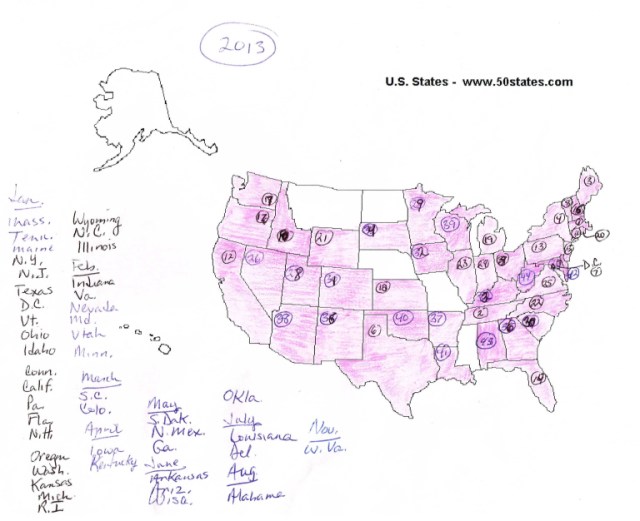
So I thought November’s big news was going to be spotting British Columbia at up-island Cronig’s in the middle of the month. Officially I’m only tracking U.S. states, but Canada’s western provinces are rare, rare, rare on Martha’s Vineyard, and I don’t recall ever seeing a BC here.

Then, pulling out of the Our Market parking lot a few days ago, what should I spot in my side-view mirror but West Virginia, on a Range Rover I’d never seen before. I backed up and looked out the window to be sure. Huzzah! Usually my West Virginia belongs to a summer visitor I know who’s only here in the late spring. I missed her this year and thought West Virginia was going to remain a blank spot on the map. Guess not.

So the 2013 tally stands at 44. Missing are Mississippi, Missouri, Nebraska, North Dakota, Montana, Alaska, and Hawaii. Prognosis isn’t good for any of them. Missouri is the most likely but I’ve been saying that for months.

2013 nov license plate

Posted in license plates, Uncategorized | Tagged | Leave a comment

On (the?) Island

A Facebook conversation the other day zeroed in on the phrase “on-island.” Are those who use it — as opposed to, say, “here” or “on the island” — giving themselves away as recent arrivals? Are they perhaps a little insecure about whether they belong or not?

“Who cares?” someone asked. Good question — but the conversation got me thinking, not for the first time, about the words we Vineyard people use to describe our relationship(s) with Martha’s Vineyard — and the importance we attach to them. Many of us do care, whether we admit it or not.

Not long after I started working for the Martha’s Vineyard Times, around 1988, the Times launched a new magazine. The magazine was called On Island. Naturally it inspired plenty of grumbling. (The omnipresent background noise on MV isn’t distant thunder, it’s grumbling.) Some people didn’t like the magazine, some people didn’t like the very idea of a magazine, some people didn’t like the name. “On island,” so the reasoning went, is an off-island term. No islander would use it. Ergo the magazine lacked credibility. Ergo it didn’t belong.

On Island published only one issue, so the grumblers turned to other subjects. The grumbling made an impression on me, though. At that point I’d been a year-round resident for a scant three years. That’s not nearly long enough to know where the bodies are buried and the mines are laid. After three years you’re just becoming aware that the bodies and mines are out there. If “on island” was going to make people write me off as a clueless newbie, I’d stick with “on the island.”

Spend some time listening to Vineyard people talk. (That includes you if you live or spend time here.) The typical Vineyard conversation isn’t linear. It goes off on tangents, takes detours, and sometimes loses sight of the main road entirely. This is because whenever a new name is mentioned, we have to establish how we’re connected to that person, and how that person is connected to people we know. We want to know where people fit in the social fabric. In part, this is so we can avoid tripping over dead bodies and triggering mines.

In the process we generally manage to convey how long we’ve been here and how well assimilated we are (if we came from somewhere else). We have words for the various degrees of belonging — native, islander, Vineyarder, year-rounder, summer person, wash-ashore, etc., etc. — but usually we locate ourselves in the social fabric by telling stories. Stories are more interesting than labels, for one thing. For another, the labels are, as the academics say, contested. We don’t all agree on what they mean.

Applying the wrong word to yourself or someone else can get people grumbling, just like “on island.” We probably won’t grumble to your face, by the way. We’ll grumble to someone else. The grumbling might get back to you second- or third-hand, and it probably won’t have anyone’s name attached when it does.

As I headed into my first winter on Martha’s Vineyard, I was told that you couldn’t call yourself an islander till you’d made it through three winters. I don’t recall who told me this, but I suspect they hadn’t been here much longer than I had. Yes, three winters was a noteworthy milestone, at least at the time: plenty of year-round wannabes didn’t make it that long. No, it didn’t make you an “islander,” and if you didn’t grow up here, you better think twice about calling yourself one.

Some believe you aren’t an islander unless you were born here. Most who so believe fit the bill. I’ve heard a handful contend that even if you’ve got several generations of islanders on both sides of your pedigree, if you were born somewhere else you don’t qualify. Still others say that you can become an islander when a bona fide islander acknowledges you as one.

So is it all about lineage or do other things matter?

If this sounds vaguely familiar, it should, because it’s not unrelated to the question that perplexed early Calvinists: They agreed that some human beings were among God’s Elect and many human beings weren’t, but is salvation predestined — determined by an inscrutable God — or can it be earned? And can believers tell which among them are among the Elect and which are not?

If God is truly inscrutable and beyond human understanding, the only answer is that it’s all in God’s hands and no one knows what God is up to: either you’re saved or you’re not, and neither you nor anyone else knows for sure. This view, however, started losing ground almost as soon as it was formulated. Why? Because it gives religious authorities no leverage over their flocks’ behavior. If you’re saved or damned no matter what you do, why should you behave yourself? Pretty soon the religious authorities were second-guessing God and telling people (1) what they had to do to be saved, and (2) how they could tell if their neighbors were saved.

If membership in the Elect — that is to say, the ranks of those entitled to call themselves “islander” — is limited to those born to it, why should the rest of us behave? Which is to say — why should we at least attempt to take our cues from the place and the people who got here before us, as opposed to, say, turning the Vineyard into a generic suburb that happens to be surrounded by water?

If “islander” is a closed category, its significance is limited. Either you are or you aren’t. Both newspapers use “islander,” “Vineyarder,” and “year-round resident” pretty much interchangeably these days. So do many year-round residents. But category “islander” isn’t entirely, or even primarily, about where you born and where you grew up. It’s about who knows best what the island is about, who belongs here, and who has the credentials to speak on its behalf.

Who cares, or even notices, whether you say “on island” or “on the island”? I don’t think it’s all that big a deal. But listen to us talk and you’ll realize before long that belonging is a very big deal. We have myriad ways of conveying how long we’ve been here and how well we belong. More about that later.

Posted in Martha's Vineyard, musing | Tagged , , , | 5 Comments