Monday was sunny but cool enough that I kept the front door closed. Clearly it was time to swap the screen insert for its sturdier cold-weather alternative. This I did.
Just in time: Monday night’s temperatures produced the first ice disk of the season, which is to say the water in Tam’s outside water dish froze solid enough to be unmolded and stand up on its own.
This particular ice disk was neither the earliest nor the latest in my personal record, which goes back to January 2012 but got seriously under way in the winter of 2012–13. Last year’s first disk showed up on Nov. 6, my earliest yet, and the latest was around Nov. 22, so this one is about average.
(Note: If you search this website for “ice disk” you’ll learn more about ice disks than anyone needs to know, but here’s a brief explanation of how my cold-weather hobby got started, along with some photos.)
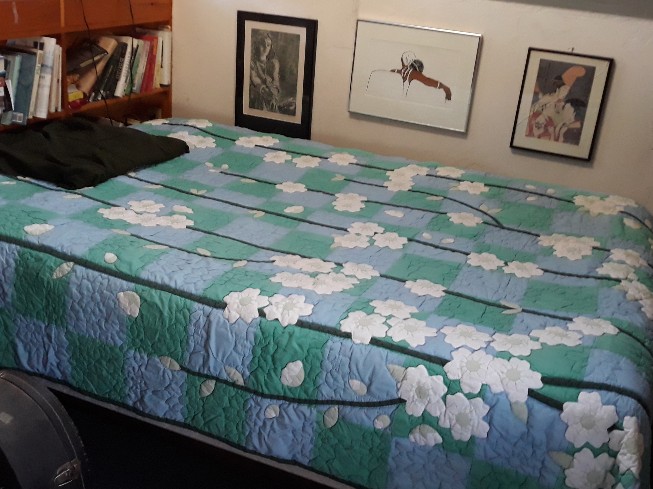
Yesterday I got serious about approaching winter. First step was to put flannel sheets on my bed, along with the quilt that’s too warm from April to November and so spends the summer on a barely reachable top shelf.
The quilt is beautiful but it spends most of its time incognito because Tam, like Travvy before him. likes to sleep on my bed, and though Tam, like Travvy and most malamutes, is a self-cleaning dog, the fur and dirt he leaves behind accumulates and looks dingy. The quilt has to be laundered at the laundromat, and frequent washing will almost certainly decrease its longevity.
Here’s what it looks like at its most pristine.
At that point I was on a roll. Last week I really was wearing shorts and a T-shirt, but long pants and long sleeves have been steadily taking over the laundry line, so it seemed a good time to do the Great Seasonal Clothing Switch.
This requires using the bed as a staging area.
Here you see why the beautiful quilt spends much of its time obscured by a 30-year-old comforter that is showing its age but still does the job. Those are warm-weather clothes at the back, the hangers they hung on in the middle, and, in the front, a glimpse of the flannels and other cold-weather shirts that are about to take their place in the closet. Tam’s cold-weather clothing is entirely home-grown.
The short stack of T-shirts is there because they fell off their pile in the closet. For many years my ridiculously large T-shirt collection has been stored in two less-than-sturdy cardboard storage boxes that are deteriorating from age and the number of T-shirts stuffed into them. The one on the bottom is, understandably, deteriorating faster from the weight of the box on top of it. One of today’s projects — it’s now Wednesday — is to hit the thrift shop in Vineyard Haven in search of shelves or something similar that will fit in this tight space and make it easier to keep track of my T-shirts. (For those following The T-Shirt Chronicles, progress has been long delayed for reasons that have nothing to do with deteriorating storage boxes, but restoring order in the closet is a step toward getting that blog going again.)
I finished the day by making black bean soup, which is one of my cool-weather staples.
The days are short and getting shorter, but I’m feeling more energized than I have in months. The midterm election results definitely helped. I’m making some other changes too: I’m not running for re-election as secretary of the Martha’s Vineyard Democrats (six years is enough), but I am joining the executive committee of the Vineyard branch of the NAACP.
I’ve also been doing the Great Courses introductory Spanish course, which I like a lot. I’m not a total beginner, having studied Spanish in high school and also having a mother and grandmother who spoke Spanish to each other when they didn’t want the kids to understand them. (I have never entirely forgiven either one of them for keeping it to themselves.) I’m also doing Allen Wyatt’s online course in Word macros, even though I have little need for macros in my editing; stretching my mind is good, and maybe it’ll turn out to be useful.
I’ve got some things to say about the election, but I’ll save that for another time. An amazing number of people have told me how useful my election recommendations were, both before the primary and before the general election. Some of these people I didn’t know at all: they were forwarded my email and blog link by a mutual friend. So I think I’ll be doing that in the future. Nothing like positive feedback to keep me going!
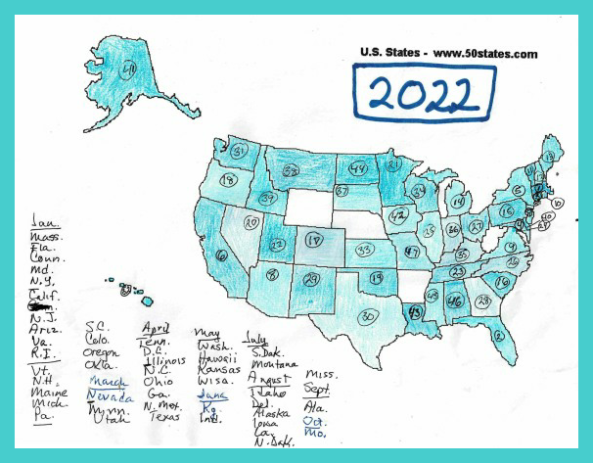
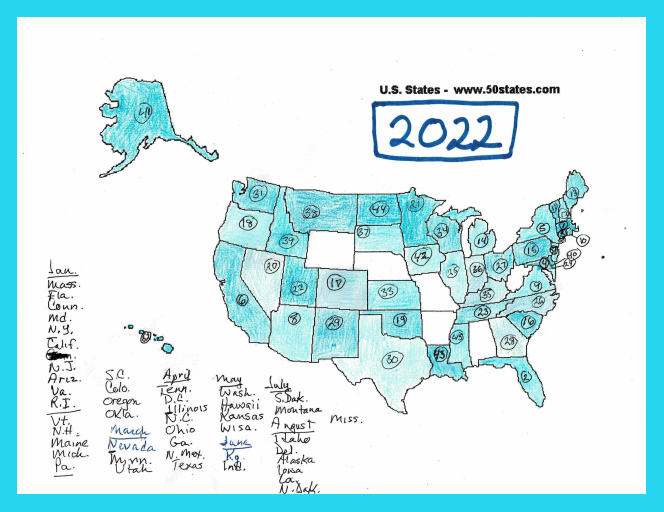
Sorry to be so late with this one: state names have been swirling through my head, but they weren’t on license plates, and I don’t remember ever obsessing so much about Arizona, Nevada, and Georgia in particular. All three of them, you’ll notice, are on the map and have been for some time: Arizona since January, Nevada since March, and Georgia since April.
The last three months of the year are often a wasteland in the license plate game, or close to it, so I was very happy to spot Missouri in October. I was thrilled to see one of the missing four today as I was driving home from getting my second COVID booster at the M.V. Hospital drive-through tent, but I’m not going to say which one it was till next month.
OK, that’s mean. If you’re on Facebook, you’ll find it there. 😉
Tam came with me to get my shot. He got two biscuits out of it and much admiration so he’s probably wondering when we can go the hospital again.
or know someone who hasn’t and maybe could use a little nudge, or more information, or a ride to the polls —
I posted my “Pre-Election Prep Talk” a couple of weeks ago. If you read it, you will recognize the dog in the photos below. (His name is Tam Lin, and he’s a popcorn junkie.) The short version: Please vote Democratic from the top of the ballot to the bottom, and that includes the six candidates on the ballot for Dukes County Commission. I’ll recap my statewide and regional picks below.
This is primarily to let you know about three write-in candidates. You may know about them already, because several people (including me) have been emailing every Vineyarder in our address book about them, but there’s been almost nothing about them in the papers, so here goes. When you write a candidate’s name in, it’s best to include their street address, but definitely include their town.
Julianne Vanderhoop, 682 State Rd., Aquinnah, is running as a write-in for Dukes County Commission. There are six candidates on the ballot and seven seats open. This means that Juli, who’s currently a member of the Aquinnah selectboard and also a Wampanoag tribal member, has an excellent chance of being elected. Please vote for all six on the ballot, then write in Julianne Vanderhoop, 682 State Rd., Aquinnah, and vote for her too.
The Martha’s Vineyard Commission (MVC) is a little more complicated. There are eight candidates on the ballot and nine seats open, but the MVC rules require that there be at least one elected member from each island town and no more than two. If you read the fine print under the names on the ballot, you’ll notice that none of them is from Aquinnah. This means that write-in Carole Vandal, 6 Waduchuemesmayak, Aquinnah, has an excellent chance of getting in. (She’s a biologist, climate activist, and member of the Wampanoag tribe, among other things.)
If you’re voting for all eight candidates on the ballot, you only get one write-in, but I’m not so I’m also writing in Jennifer Smith Turner, Oak Bluffs (sorry, I don’t have her street address). She’s a novelist (Child Bride, 2020) who has held several executive positions in various companies, including as interim president/CEO of the Newman’s Own Foundation. Unfortunately, the odds are against her because there’s already a candidate from Oak Bluffs on the ballot and for Smith Turner to get a second OB slot she’d have to get more votes than at least one of the candidates on the ballot. I’m voting for her anyway.
Here are the statewide and regional candidates to vote for:
Governor & Lieutenant Governor: Maura Healey & Kim Driscoll
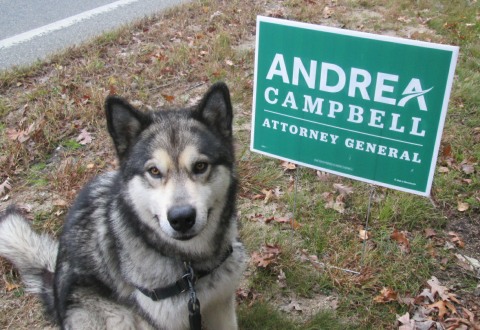
Attorney General: Andrea Campbell
Secretary of State: William Galvin (incumbent)
Auditor: Diana DiZoglio
Treasurer: Deborah Goldberg (incumbent)
Member in Congress: Bill Keating
Cape & Islands DA: Robert Galibois
State senator: Julian Cyr
State representative: Dylan Fernandes
Dukes County sheriff: Robert Ogden
I’ve bolded Rob Galibois for DA and Julian Cyr for re-election as state senator because they’re both running in the Cape & Islands region, they both have Republican opponents, and the Cape, especially the Mid-Cape, is rather purple. A strong Democratic turnout from the Vineyard will help put both over the top. Rob in particular is a first-time candidate running for an office that has been held by Republicans since it was created around 1970. He’s a great guy, and (unlike the outgoing DA) he’s already made strong connections on the Vineyard among law-enforcement and social services people, and others.
The Martha’s Vineyard Times, which rarely endorses candidates, strongly endorsed Rob Galibois for DA in an October 26 editorial. I couldn’t have said it better myself. 😉
Light candles, pray, cross your fingers, and do whatever else you can do to ensure a pro-democracy outcome on Tuesday!!
Like the stillness in the wind before the hurricane begins . . .
Dylan’s “When the Ship Comes In” has been one of my most favorite songs since my college antiwar activist days. I still know all the words, but my mind is playing that line over and over again. I don’t add — I try not to even think — the next line:
The hour that the ship comes in
In the song the ship’s arrival is all about change for the better, a world “where the sun will respect every face on the deck” and “Goliath will be conquered.” The song is a celebration of hope for the future.
I’m afraid that the ship coming in, the one that arrives on election day, is bringing bad news. I’m doing my best to take Dan Pfeiffer’s advice to “get off the Pollercoaster”:
Two weeks until the election, the “Pollercoaster” is in full effect. Every day brings a barrage of new polls and a fresh wave of terror about the outcome of the election. The polls are tightening in races that seem in hand, and they are widening in longer-shot races in which we thought we had a chance. Even the polls with positive news for Democrats are dismissed out of legitimate fears that they are biased against Dems. Political reporters are relishing the opportunity to make Democrats suffer. . . .
Thing is, I’m not obsessed with polls. My fears have more to do with a long string of missed opportunities and a house whose entire structure has gone rotten from lack of attention and endless procrastination.
“The Boy Who Cried Wolf” is in there too. Apocalyptic rhetoric is epidemic during campaign season. I was only 13 when the presidential election pitted LBJ against Barry Goldwater, but I still remember the slogan —
Goldwater in ’64 Cold water in ’65 Bread & water in ’66 No water in ’67
Every time an election rolls around, we hear so many dire predictions of what’s going to happen if our opponent wins that we screen them out. When dire things do happen after our opponent wins, but not to us, we screen that out too. Not until 2016 did many of us start seeing, really seeing, the fissures in the house we were living in. (Anyone else remembering Edgar Allan Poe’s “Fall of the House of Usher”?)
So now, with many wide-awake and intelligent people warning that “our democracy is at stake,” I have zero trouble imagining plenty of voters thinking “Oh yeah, here we go again” or “So what?” Inflation has a more tangible effect on them than an abstraction called “democracy,” and they know so little about what causes inflation that they think voting for Republicans is their best hope of fixing it, even though the Democrats didn’t cause it and the Republicans have no economic plans worth discussing. Maybe these voters have been so swayed by the continual drumbeat of “election fraud” that they think that the electoral process is corrupt, just like Congress. (They may actually have a point about Congress.) If they do vote and their (Republican) candidates don’t win, the election must have been stolen.
Come to think of it, whenever I hear myself going on about the importance of democracy and how this election probably is the most important one of my lifetime, a little voice in my mind is sneering “Sucker!”
What it comes down to is that I don’t have much faith in my fellow Americans, especially my fellow white Americans, to realize what the stakes are and vote accordingly. Some of them may indeed realize what the stakes are and have decided that if democracy is multicultural, multiracial, and not 100% Christian, they want no part of it.
Yes, there are reasons for hope. The overwhelming Kansas vote in support of abortion right is one of them, and boy, am I clinging to it. Tens of thousands, maybe hundreds of thousands, maybe even millions, of my fellow Americans are canvassing, talking to friends and neighbors, contributing to campaigns, signing up to be poll workers or to help people cast their ballots easily and safely, and so on. The forces arrayed against us are vast, but hey — David and Goliath, remember?
Zoom sing with Susan Robbins, August 2020. Susan is in the upper-left corner and I’m on her right. I’ve blacked out everyone else’s name.
I’m also hoping that the cosmos is on our side. Since the pandemic started, I’ve been participating most Wednesdays in Susan Robbins’s Zoom sings for women. Group singing on Zoom may seem strange because we can’t hear each other, but it’s been pretty wonderful. Susan teaches each song line by line and then we sing it. Some of the songs are from Libana’s repertoire (Susan is the founder/leader of Libana, whose roots go back to 1979 and whose music comes from all over the world), some have identifiable composers, some are “traditional,” which is to say we don’t know who wrote them.
This past Wednesday we sang, not for the first time, “Dark of the Moon,” a three-part round by Karen Beth. It’s all about how the dark of the moon is a time for new beginnings, planting seeds and helping them grow. This is the third part:
Dark of the moon What we envision will come to be by the full moonlight
We were singing, Susan said, in the dark of the moon — and the moon will be full again on the morning of election day, at 6:02 a.m. eastern time. So I’m holding on to that: that all the work, all the envisioning, we’ve been doing during the dark of the Trump years and its aftermath will bear fruit on election day and that what we’ll see is not the death of democracy but a renaissance and recommitment to making democracy work for all of us.
There’s also a total lunar eclipse that night, by the way, which should be complete just before the moon’s peak fullness. Then the moon starts coming out of the earth’s shadow. Since, as Marge Piercy wrote, “the moon is always female,” I take that as a good sign too.
People say this all the time. I do too. It’s metonymy: it’s less about your literal eyes and more about your perception, non-visual as well as visual. But my eyes have been crappy since I was in elementary school, and since for the last four decades and then some, I’ve made most of my living in the print trades, it’s also very much about my literal eyes.
About two months ago I noticed that the vision in my left eye was getting blurry, so blurry that eventually it couldn’t distinguish printed words even when I had my reading glasses on. This was serious. My left eye has made my living for me since my right eye had two retina detach-and-reattachments in 2004 followed by cataract surgery in 2008. Since then right eye has been OK for distance but, thanks to what the ophthalmologist called a “perforation” in the reattached retina, imprecise for close-up work, of which as an editor and proofreader I do a lot.
By early September the blurriness was serious enough that I saw my optometrist. To my great relief the problem was common and the fix relatively simple: the lens inserted in my left eye when I had cataract surgery in 2018 was clouding over, but it could be remedied with a quick laser procedure at the Cape Cod Eye Surgery & Laser Center in Sandwich. Having been to this place many times, both on my own behalf and when driving a friend to her regular appointments for macular degeneration, I could find my way there in my sleep. (I started to type “with my eyes closed,” but thought better of it.)
The good news was that I could drive myself home afterward. This was not true of cataract surgery or retina reattachment surgery. The bad news was that my appointment was six weeks down the road: October 24.
My body as a whole has given me remarkably little grief (so far) in my 71 (so far) years. I’ve never broken a bone, despite a few accidents that could have had serious consequences. In my born-again horsegirl days — basically my fifties — I had a horse flip over on me and use my right thigh as a launching pad. The bruise was dramatically huge, but it eventually went away and all I have to show for it now is a hoof-shaped imprint in the flesh of my right thigh. On a horse-sitting job once, a ladder slipped out from under me when I was climbing up to the client’s hayloft. I fell 10+ feet with no ill effects beyond a sore bum.
My eyes and my teeth have required more attention. I seem to have lost the genetic lottery in those departments, having inherited my mother’s myopia and my father’s lousy teeth. In recent decades I’ve taken better care of the latter, which may explain why I’ve still got all of my originals, apart from the molar that broke and had to be replaced by an implant.
The eyes, on the other hand — well, sometimes I do wonder why I adopted a trade like editing that depends on having reliable eyesight along with a brain that does a great job processing detail. Possibly it was fate’s way of teaching me “Don’t panic! Things will work out.” Which indeed they have, even this time. My right eye, for all its imprecision, turned out to be a pretty good pinch-hitter, even though one of my jobs right now is on un-enlargeable paper and the font sizes used range from about 6 point (very small) to 12 (pretty normal). Thanks to a magnifying glass I could clarify whether, for instance, there were two ts or one and whether there was an r tucked in there between the a and the t.
Driving also presented additional challenges. In its clouded-over state, at night my left eye saw half a dozen headlights approaching when in reality there were only two. Right eye was fine for driving, but left eye, being the more dominant of the two, kept trying to horn in, so I’d sometimes see two sets of yellow lines down the middle of the road. (I should add here that my two eyes have never worked together well, but my brain has compensated for the lack of coordination.) This was easily remedied by closing left eye when the duplication got distracting.
I’ve lived on the Vineyard year-round for 37 years and counting, so though I couldn’t literally find my way around with my eyes closed, I do know the roads pretty well (apart from dirt roads in Chilmark. When it comes to dirt roads in Chilmark, all bets are off, and sometimes GPS is unavailable). Not to mention — after Labor Day, and definitely after Columbus Day, the traffic is less, and less crazy, than it is in the summer.
I did worry a little about driving to Sandwich, regardless of how many times I’d been there. After all, I hadn’t driven off-island since 2019 — or been off-island, period, since very early in 2020, just before COVID-19 shut everything down. I worried a little about my one-eyed depth perception driving onto the boat. Once I’d managed that, on the 8:15 yesterday morning, I stopped worrying.
All went well. The Cape Cod Eye Surgery & Laser Center in Sandwich has to be one of the best organized operations around. I’d filled out the required forms online the day before. I got called for my various pre-procedure tests only a couple of minutes after my report time of 11 a.m. The procedure itself took less than five minutes: from my perspective it was all about holding still (easy, given the apparatus you stick your face into) and staring at the red/white light coming at my left eye.
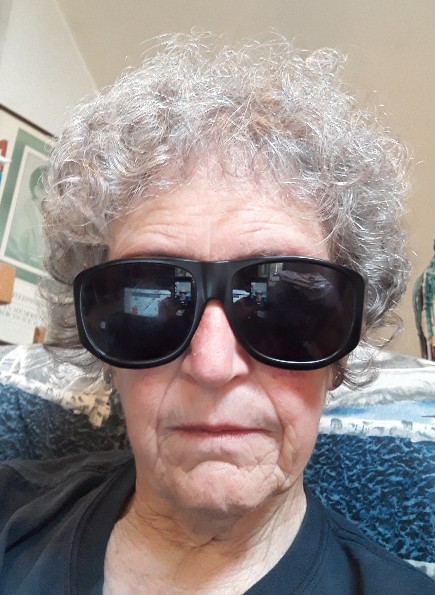
After lunch at the nearby “family restaurant,” I did indeed drive myself home. Having once attempted to drive with my eyes dilated, I knew better to try it again — the glare is terrible — so I wore the extremely unfashionable sunglasses I had in the car, probably from an earlier eye adventure. With them on, there was no glare; the tradeoff was that the speedometer was too dark to read. I took my cues from the other cars on the road and none of us got busted for speeding.
The 3:45 boat got me into Vineyard Haven at 4:30, and I arrived at Animal Health Care in time to pick Tam up; he’d spent the night at the kennel. He tried to convince me that he hadn’t had supper, though the kennel attendant assured me he had. I bought him off with the popcorn I’d brought home from writers’ group on Sunday, because he wasn’t there to enjoy it on site.
Tam seems to have forgiven me, and I’ve got two working eyes again. Life is good.
Me and my dark glasses. Foster Grants they aren’t.
I thought of titling this “The Perfect Is the Enemy of the Good,” but (1) it’s too long, (2) it’s a cliché, and (3) I don’t always agree with it. However, when it comes to electoral politics, it’s a good axiom to keep in mind, not least because if “perfect” exists anywhere, it’s not in electoral politics. You’ll see why I considered that title in what follows.
Mail-in voting is already under way in Massachusetts. Early voting started today, Oct. 22. If you’re on the Vineyard, you can find early voting hours for all six towns and other essential info in this Martha’s Vineyard Times story. Registration deadline is this coming Saturday, Oct. 29, and the story includes a link to do that online. If you’re anywhere else in the commonwealth, contact your local election official. You can find almost everything else you need to know about the election on the secretary of state’s website. If you’re not in Massachusetts, Google!
This post is divided into statewide races, regional/local races, and ballot questions. The short version for all races is VOTE DEMOCRATIC, goddammit. This is true for virtually all races in mostly blue and even purple states. Plenty of people like to say “I vote for the person, not the party,” maybe because they think this makes them look thoughtful and independent. Once upon a time this might have been true, especially in states like Massachusetts and Maryland where competent, non-Trump Republicans could still get elected.
Democratic-leaning voters in deep red states, however, face a dilemma. Very likely the candidate with an R after their name is a Trumpish election denier who might also be batshit crazy. The candidate with a D after their name — if there is one — (1) might be the best person for the job, and (2) doesn’t have a snowball’s chance in hell of winning. I hear reports that in states like Montana and Utah, Democratic-leaning voters are campaigning and voting for Never-Trump Republicans running as independents. If you’re interested in salvaging and even growing our democracy, this is good strategy.
In Utah, this means supporting Evan Mullin, who is running as an independent against U.S. Senator Mike Lee (R), who supported the insurrection and is generally disgusting. Some of Mullin’s public statements do give me pause. If elected, he says he wouldn’t caucus with either party. (Two independents currently in the U.S. Senate, Angus King of Maine and Bernie Sanders of Vermont, both caucus with the Democrats. The Democratic majority being as slim as it is, you can see why this matters.) In a closely divided Senate, this might well give him the swing power of a Joe Manchin or a Kyrsten Simema: not good. Put it this way: If Evan Mullin were running in Massachusetts, I wouldn’t give him the time of day. If I lived in Utah, I would probably be campaigning for him.
The perfect is the enemy of the good — and in this case, diminishing the congressional power of the Trumpublicans is most definitely good.
Statewide Races
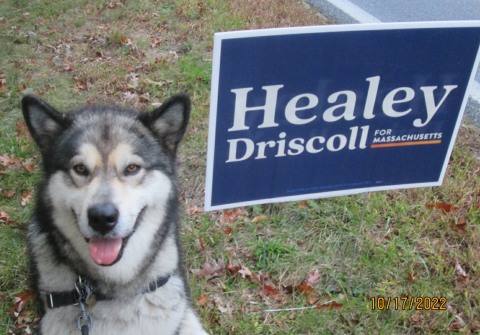
Tam campaigns for Maura Healey (governor) and Kim Driscoll (lieutenant governor).
Looking at the statewide Democratic ticket, my first thought is “Other states, eat your heart out.” Not only is it outstanding, all but one of the candidates on it are women. I supported several of them in “My Primary Picks” so you can learn more about some of them there. I was very impressed during the primary campaign by Kim Driscoll, who’s done an excellent job as mayor of Salem since 2006. Her only downside for me was being from inside not only 495 but 128, i.e., the metro Boston area, and other things being equal I’ll usually go for the candidate from further afield, like western Mass., the South Coast, or the Cape & Islands region, because we often aren’t seen from Beacon Hill, where the state government sits.
In the “perfect is the enemy of the good” department, my big disappointment in the primary was that Tanisha Sullivan lost her race against Bill Galvin, our longtime secretary of state. Galvin does the job but no more than that. He resisted such measures as mail-in voting and early voting till COVID-19 gave him a kick in the pants. Once upon a time I might have left the circle empty on my ballot, but this year? No. Across the country the Republicans are trying to shoehorn 2020 election deniers into secretary of state offices because in most states it’s the secretary of state who supervises elections. Note how important it was that Georgia’s secretary of state, Brad Raffensperger, held the line against presure from Trump in 2020. You may like nothing else about Brad Raffensperger, but you’ve got to give him credit for that.
Even Maura Healey, the next governor of the commonwealth, is making me a little nervous. She’s been an excellent attorney general (first elected in 2014), and what’s not to like about a 5-foot-4 basketball point guard who played college ball at Harvard and professional ball in Austria? But she’s also been cagey about her plans, probably — I’m hoping — because she has to appeal to an electorate that loves outgoing two-term Republican governor Charlie Baker. More recently, when she endorsed 17 of the 19 state senate Dems running for re-election, one of the two she left out was State Sen. Becca Rausch, a progressive champion. Still no explanation for that. What it all means is that we need to keep the pressure on after the Healey-Driscoll ticket takes office in January.
Here’s the statewide list:
Governor/Lieutenant Governor: Maura Healey & Kim Driscoll
Attorney General: Andrea Campbell
Secretary of State: William Galvin (incumbent)
Auditor: Diana DiZoglio
Treasurer: Deborah Goldberg (incumbent)
Regional/Local Races
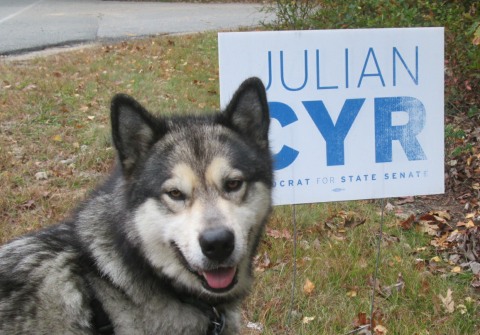
This Julian sign is showing its age (Julian, however, is not), probably since I’ve had it since he first ran for state senate in 20016.
Here in the Cape & Islands region, the races I’m focusing on are for Cape & Islands district attorny and state senate. State Senator Julian Cyr has a Republican opponent, but he’s also an incumbent (first elected in 2016) with an excellent track record and a good orgnaization.
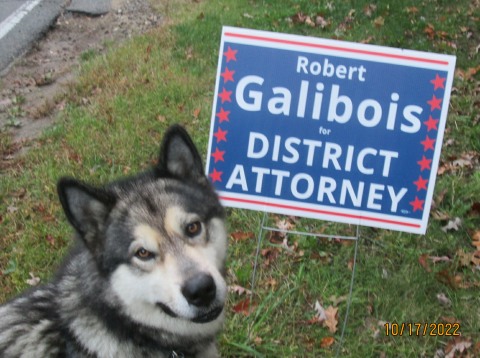
Rob Galibois is a first-time candidate running for an office that’s been held by a Republican since it was established ca. 1970. I can’t remember the last time a Democrat was even on the ballot — maybe in 2002, the year the first holder of the office, Phil Rollins, retired? His successor, Michael O’Keefe, is not running for re-election.
Rob has extensive experience both as a prosecutor and as a defense attorney; he’s got solid ideas about how to improve the equity, effectiveness, and community engagement of the office. See his website for specifics; scroll down to the Priorities section. And if you, like me at this time last year, are at best dimly aware of how important the DA’s office can be — and why in the Trump era it shouldn’t be held by a Republican — see the ACLU of Massachusetts’s web page “What a Difference a DA Makes.” Last January I attended an online program about this, and it’s because of this — and being involved in Rob’s campaign — that I know a lot more than I did a year ago. Unlike the outgoing DA, who barely knew the Vineyard existed, Rob has made solid connections over here and those are bound to continue and grow after he takes office.
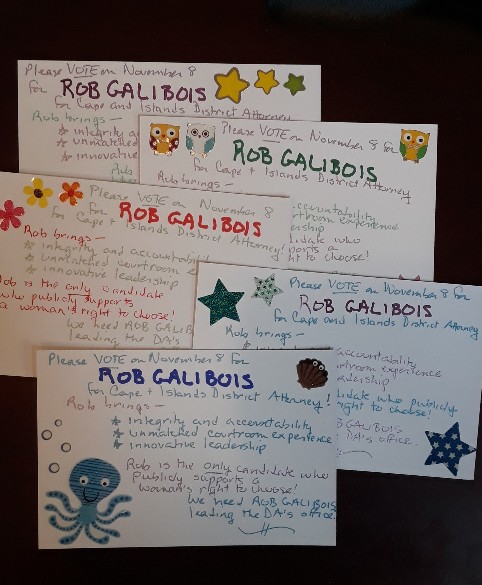
I’ve been writing postcards for Rob.
Our excellent state represebtatuve, Dylan Fernandes (D–Barnstable, Dukes, Nantucket) is running unopposed, and so is Robert (Bob) Ogden, the Dukes County sheriff, who handily won a hard-fought primary contest in September.
We on the Cape & Islands are part of the commonwealth’s 9th Congressional District. Our longtime congressman, Bill Keating, is running for re-election. He has a Republican opponent about whom I know nothing, but — I almost hate to say it — I’m not trying to learn more because no way would I ever vote for him.
So here’s the regional/local list if you’re on Martha’s Vineyard. The top three apply to the rest of the Cape & Islands as well.
Cape & Islands DA: Rob Galibois
State senator: Julian Cyr
Member in Congress: Bill Keating
State representative: Dylan Fernandes
Dukes County sheriff: Robert Ogden
As to the remaining offices on the ballot — well, I expect I’ll know more by election day, but at the moment here’s what I’m thinking:
For Dukes County Commission, there are six candidates running for seven seats, and since there are no more than two from any one town, it looks like they’ll all be elected. For sure I’m voting for Tristan Israel, Doug Ruskin, Christine Todd, and James Klingensmith. I expect to know more about the other two by the time I vote. Rumors of a write-in turned out to be true, so please write in Julianne Vanderhoop, 682 State Rd., Aquinnah. It helps to include the address, so write it on a slip of paper (or the palm of your hand) and take it with you when you go to vote.
For Martha’s Vineyard Commission (MVC), there are eight candidates running for nine slots and no more than two from any one town, so I’m guessing they’ll all be elected too. IIRC there has to be at least one elected member from each town, and since there’s no one on the ballot from Aquinnnah, a write-in would have a good chance of getting the ninth seat. I’m enthusiastically voting for Ben Robinson and Christina Brown and also for Jeff Agnoli, about whom I don’t know as much but what I do know seems pretty good. I’ll probably vote for Trip Barnes because, well, Trip Barnes. I’ll most likely leave the other ovals blank, though I’m trying to learn more about Jay Grossman, the only non-incumbent on the ballot.
Late update on Nov. 2: There are two write-ins running for the MVC: Carole Vandal (6 Waduchuemesmayak, Aquinnah) and Jennifer Smith Turner (Oak Bluffs, don’t have street address). A little strategy here: Because nine will be elected and there are only eight on the ballot, a write-in can be elected. However, since no candidate on the ballot is from Aquinnah and there must be at least one (but no more than two) from each town, Carole has an excellent chance of getting elected. So if you can only vote for write-in (maybe because you’re voting for all the candidates on the ballot), please consider voting for her. Jenniferis a longshot because there’s already an Oak Bluffs candidate on the ballot, and she’s very unlikely to out-poll him as a write-in. Me, I’m not voting for all the ballot candidates, so I’m voting for both write-ins.
About the representatives to the Up-Island Regional School Committee I’m still gathering info. Maybe I’ll update this post if I get enough. There are five candidates running for five seats, and since there’s at least one from each up-island town (West Tisbury, Chilmark, and Aquinnah), I think they’ll all be elected. The two who aren’t top vote-getters from their town will become at-large members.
Ballot Questions
There are four questions on the statewide ballot. So far I’ve mustered very little interest in either #2 or #3. Question 2 would require insurance companies “to spend at least 83% of premiums on member dental expenses and quality improvements instead of administrative expense” and would make unspecified “other changes to dental insurance regulations” (that’s from the information booklet sent out early this past summer by the secretary of state’s office). I’m inclined to vote FOR anything the insurance companies are against, but on the other hand, although I have crappy teeth I have never had dental insurance because either it wasn’t available or it was too damn expensive. Do I blame the dentists for this or the American Medical Association? Not sure, but my loathing of insurance companies will probably win out over my resentment of the dental lobby, which is to say I expect to vote YES on #2. Here’s what the dentists have to say about it.
Question 3 is also pretty esoteric: it’s about expanding the number of liquor licenses a retailer can hold. Some are framing it as the smaller liquor stores against the big chains, but based on a little dabbling, I suspect that a larger issue lurks in the background: At present, in the commonwealth of Massachusetts alcoholic beverages can only be sold in what we like to call “package stores,” aka “packies.” The food stores would love to be able to sell at least beer and wine, but of course those benefiting from the status quo don’t like this idea at all. The food store lobby hasn’t been active in this particular fight, but the VOTE NO text in the secretary of state’s booklet urges us to push for more extensive reform of the liquor laws. It’s signed by “Food Stores for Consumer Choice.” If you can access it, this Boston Globe story gives some background on what’s involved. I’m thinking of voting NO on this one.
Question 1: The Fair Share Amendment
It won’t surprise anybody that I’m voting YES on this and urging you to do so too. It probably won’t surprise anybody either that the wealthy who are outraged by the very idea of paying their fair share are working overtime to scare the non-wealthy into voting against it.
Here’s a summary from the Fair Share website of what the amendment — which indeed amends the state constitution — will do:
Question 1 would create a 4% tax on the portion of a person’s annual income above $1 million and constitutionally dedicate the funds raised to transportation and public education. This will allow Massachusetts to improve our roads, bridges, schools, and transportation by guaranteeing in the text of the Massachusetts constitution that every dollar raised by the surtax will go to only public education and transportation. And if you don’t make more than $1 million a year, you won’t pay anything more.
The Fair Share Amendment will generate $2 billion a year, every year, that is constitutionally dedicated for quality public education, affordable public colleges and universities, and the repair and maintenance of roads, bridges, and public transportation.
The anti–Fair Share scaremongers maintain that this would come down particularly hard on small-business owners and people who sell their homes. They conveniently ignore the fact that the Fair Share Amendment applies only to personal income over $1 million, not to what a small business grosses in a year. If one’s personal income from one’s “small business” is over $1 million a year, the chances are that the business is not exactly small.
And when a home sells for over a million dollars, the seller’s actual income is much less than that. First you subtract the original purchase price from the selling price, then you deduct the cost of major improvements made, and if you’ve sold your primary residence, you can also deduct up to $500K from your taxes. In 2021, fewer than 900 homes out of the approximately 100,000 sold in the commonwealth generated enough of a gain to be affected by the Fair Share Amendment.
The Fair Share Amendment’s website includes valuable information on what the amendment will do and why it’s needed. It also offers solid rebuttals to the disinformation put out by opponents. The FAQs are particularly helpful, and so is the page on real estate sales.
“The perfect is the enemy of the good” kicks in here too, because though the amendment specifies that the revenue thus raised be spent on transportation and education, the specifics are left up to the legislature, and right here in Massachusetts we have what may be the least accountable and least transparent legislature in the country. What this means is that our work doesn’t stop when the amendment is added to the state constitution. It means we have to stay on it.
Question 4: Eligibility for Driver’s Licenses
This one isn’t covered in the secretary of state’s brochure because it wasn’t certified till early September. Here’s the basic info about it. It’s an attempt by the usual suspects, i.e., Republicans, to overturn a law passed by the state legislature in May 2022 that would allow undocumented individuals to obtain driver’s licenses providing they fulfill all the other requirements, like passing the road test and giving proof of identity and birth date. It would not allow these individuals to register to vote or obtain a REAL ID.
The measure is popular with law enforcement, and the 17 states with similar laws have seen a decrease in the number of uninsured drivers and hit-and-run accidents. As far as I’m concerned, it’s a no-brainer and I’m voting YES.
Sample Ballot
Here’s the sample Early / Absentee Ballot for my town of West Tisbury. The first five offices and the ballot questions will appear on all ballots statewide. (Some areas will have additional ballot questions.) Most Vineyarders will see ballots that look a lot like this one, except the down-island towns will have different candidates for the Regional School Committee.
September wasn’t nearly as spectacular as the Best August on Record, but I did pick up Alabama. The 2022 tally now stands at 46, with Wyoming, Nebraska, Missouri, Arkansas, and West Virginia still AWOL. In the last three months of the year, the pickings are generally worse than slim, but August was so atypical that I’m not giving up yet.
You knew I was going to write something about what’s going on, right? Martha’s Vineyard hasn’t hit the national news this way since the first Clinton visit in 1993. As features editor for the Martha’s Vineyard Times I had a front-row seat for that one. My fury with the national media for their inability to see the Vineyard even while they were swarming all over it set me on the road to writing my so-far-only novel, The Mud of the Place. (Epigraph from Grace Paley: “If your feet aren’t in the mud of a place, you better watch where your mouth is.”)
Before that, the Vineyard hit the media big-time with the making and release of Jaws in the mid-1970s, and when Senator Ted Kennedy drove off a bridge on Chappaquiddick and left Mary Jo Kopechne to drown in the back seat of his car in 1969.
This story is bigger than all of the above. Chappaquiddick took a life and cost Ted Kennedy whatever presidential ambitions he had, but Florida governor Ron DeSantis’s callous PR stunt is happening at the confluence of several national stories: immigration, the impending midterm elections, and the moral, ethical, and political backruptcy of the Republican Party. And it landed right here on Martha’s Vineyard with no advance warning, not to local officials or even, it seems, to Governor Charlie Baker, a Republican of the nearly extinct breed repudiated by the Trump-following MAGAs.
The story, whose details and consequences are still unfolding, is all over the media. Here’s a good summary as of Thursday afternoon from the Vineyard Gazette. The short version: Earlier this week in San Antonio a woman calling herself Perla recruited (polite word) migrants to board a plane north, where they were told they would find housing, jobs, assistance with immigration paperwork, and/or educational opportunities. Two chartered planes carrying a total of about 50 men, women, and children apparently flew to Florida then to Martha’s Vineyard, one via South Carolina and the other via North Carolina.
No one on Martha’s Vineyard was notified in advance. The passengers thought they were headed for Boston or New York until they were notified in mid-flight that their destimation was the Vineyard, which most of them had never heard of. They arrived at Martha’s Vineyard Airport around 3 p.m. Wedneaday afternoon. Along with them was a videographer who recorded their arrival for Fox “News.” From there they were transported in two vans to Martha’s Vineyard Community Services (MVCS). How this was arranged and by whom remains unclear. The travelers had already been given brochures about MVCS, along with unhelpful maps of the Vineyard.
At that point the word went out and the Vineyard mobilized to feed, shelter, and provide necessary resources to the migrants. The homeless shelter at St. Andrew’s Episcopal Church in Edgartown was outfitted with enough cots and other supplies to house five times its usual 10-person capacity.
On Thursday afternoon the migrants moved to the Joint Base in Bourne, on the Cape, where there was more room and ready access to necessary legal, medical, and other resources.
The particular stunt was orchestrated by Florida governor Ron DeSantis. It seems the Florida legislature has appropriated $12 million for stunts like this: busing and now flying migrants to what he calls “sanctuary states.” (Earth to Ron: Massachusetts is not a sanctuary state, though several years ago Vineyard town meetings did pass warrant articles directing law enforcement not to cooperate with ICE, U.S. Immigration and Customs Enforcement, in attempting to deport undocumented immigrants.)
For a summary of how the migrants were treated by DeSantis and Department of Homeland Security officials in Florida, check this out:
Rachel Self, a Boston immigration attorney tells you everything you need to know about immigrants sent to Martha’s Vineyard.
They’d been given falsified U.S. addresses by immigration officials, perhaps ensuring that they’d be deemed in the country illegally. pic.twitter.com/mBp7AqBow1
As always, the regional and national media misrepresent the Vineyard as a “wealthy enclave,” an “upscale community,” etc., etc., but this time the media’s obtuseness has been outweighed by the appallingly vile and ignorant comments in every media outlet I’ve checked that allows them, including the two Vineyard papers. I started to write “They get their facts wrong,” but closer to the truth would be “They don’t bother with facts. Facts get in the way of their preferred narrative.” One of the preferred narratives goes something like “See how you like it when the southern border comes to Massachusetts.” Another seems to be “The rich people on Martha’s Vineyard made a show of being nice to the illegals then kicked them off the island.”
It’s not clear at this point whether DeSantis and his ilk can be charged with any crimes. Fraud, trafficking, and kidnapping have all been suggested. You don’t need a criminal statute to recognize political opportunism and moral depravity when you see it, however.
You don’t have to be an historian to realize something like this has happened before, because a few news outlets have kindly recalled it to our attention. Exactly 60 years ago southern white segregationists orchestrated the so-called “reverse freedom rides,” tricking poor Black people into boarding buses bound for the Cape Cod summer home of then president John F. Kennedy. The racist tactics and the compassionate northern response are remarkably similar to what just happened on Martha’s Vineyard.
For now I’m working hard to focus on the positive: 50 migrants who have survived more hardships than most of us can imagine found respite here, and Martha’s Vineyard rose to the occasion and showed the world what hospitality looks like.
Which you might have surmised because here I am posting on the first of the month instead of waiting a week, or, in the case of June, almost a month.
I went back over the last 10 years of license plate maps. The August tallies ranged from a low of 0 in 2014 to a high of 4 in 2020. 1s and 2s were common.
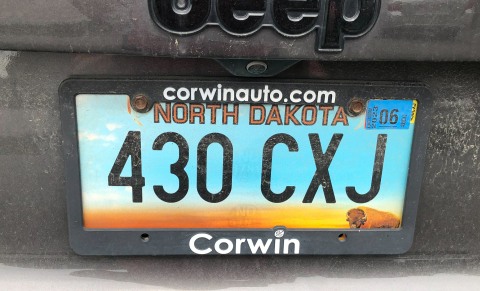
In August 2022 I saw SEVEN, and that’s not even the best of it because one of them was NORTH DAKOTA. Two of the others were Alaska and Mississippi. These are big deals.
The unicorn of license plates
Interestingly enough, all three showed up in the parking areas that ring the Martha’s Vineyard Hospital. Ellen M. of Vineyard Haven gave me the heads-up on North Dakota and Mississippi, and I think I gave her a heads-up on Alaska. She reported North Dakota — with the accompanying photograph — on a Saturday, when the hospital is so relatively deserted that I rarely cruise through the parking lots, but on the following Saturday I swung through — and there it was, in almost the same place she’d seen it: around back.
The August roll call, in order:
Idaho
Delaware
Alaska
Iowa
Louisiana
North Dakota
Mississippi
I spotted Louisiana through the hedge outside the Fine Fettle marijuana dispensary in West Tisbury — Tam and I were walking to the post office — and I think I saw long-overdue Delaware on Circuit Ave., which is also fertile ground for license-plate hunting. Not sure about Idaho or Iowa. I really should make a note where I find the less common plates and the late arrivals . . .
The total now stands at 45, with 6 left to go: Wyoming, Nebraska, Missouri, Arkansas, Alabama, and West Virginia. Usually things drop off sharply after July, but this record August showing gives me high hopes for the rest of the year.
By the way, I just learned that Paulo O. plays the game and the only one he’s missing is Kansas. So if you spot Kansas in Edgartown during regular work hours, call the register of deed’s office! I got Kansas at Kenny Belain’s garage when I was there to get inspected at the end of May, but I haven’t seen it since.
This post is for you, Massachusetts voters! Our primary is less than two weeks away — the day after Labor Day, and the day kids go back to school. Who the hell thought that was a good idea? No one in a summer-exhausted place like Martha’s Vineyard, that’s for sure.
Note for the TL:DR crowd (don’t worry, I get it: this is a long post!): Scroll down to the bottom and you’ll find my recommendations and nothing but my recommendations.
Back before I fell in with Democrats in 2016, the primary would roll around at the end of the summer and I’d barely know who was on the ballot. I’d be like your college student who hasn’t been to class all semester and just started the reading yesterday. This year? Well, for me primary season began a whole year ago. I’ve met most of the candidates, virtually if not in person. I’ve heard all of them speak at least once, and I’ve digested a slew of campaign materials. Since I can only vote once, I’m writing this blog to put all that information to good use.
Thanks to the VOTES Act passed earlier this year, making most of the temporary COVID-19 measures permanent, mail-in voting has already begun. Early in-person voting starts this Saturday, Aug. 27, which is also the last day you can register to vote in the primary. Everyone reading this is already registered, right? Right??
The late Travvy campaigns for Dylan Fernandes and Julian Cyr in 2018. They’re running unopposed in their respective primaries, but definitely vote for them.
If you’re on the Vineyard, your town clerk knows everything there is to know about where and when to vote.
You can check your registration status here on the secretary of state’s website — not a bad idea, especially if you’ve moved recently — and you can register to vote, change your registration, or twist the arm of anyone you know who just doesn’t have time to get registered here. Massachusetts is an open-primary state, which means that if you’re not enrolled in any party, you can take any party’s primary ballot. Hint: The Democrats have some excellent candidates running, and we have contested primary races for lieutenant governor, attorney general, secretary of state, auditor, and Dukes County sheriff.
Uncontested Primary Races
Several of my favorites have no primary opponents. Martha’s Vineyard is represented by have two of the best state legislators in the commonwealth, Julian Cyr in the state senate and Dylan Fernandes in the house, so you bet I’m endorsing them. As you can see above, the late Travvy was an enthusiastic campaigner. You’ll probably see Tam Lin out there one of these days.
Cape & Islands District Attorney
Rob Galibois and me at the Vineyard’s first-ever Pride celebration in June 2022. Photo by Nikki Paratore Galibois.
Also unopposed in the primary, though not in the November election, is Rob Galibois, candidate for Cape & Islands district attorney. The outgoing Republican DA ran unopposed for years, despite his lackluster performance. Efforts to recruit a good Democrat paid off when Rob stepped up to run. We couldn’t ask for a better candidate. He has extensive experience as both a prosecutor (he was an assistant DA in the Cape & Islands DA’s office from 1997 to 2003) and a defense attorney.
As DA he intends to develop “diversion” programs to help people, especially young people, veterans, and people with mental health issues, stay out of the court system. Since so many of us are at best dimly aware of what the DA’s office does, he also wants to prioritize community involvement by creating a “community engagement officer” position and by encouraging attorneys and staff to volunteer a few hours a month in their communities. Much more about Rob’s plans and priorities can be found on his website.
Dukes County Sheriff
I’m backing, rooting for, and otherwise supporting the incumbent, Sheriff Robert (Bob) Ogden, who’s running for his second six-year-term. He’s done well in addressing the myriad challenges of a demanding job. These go beyond the obvious law-enforcement tasks — keep in mind that each of the six island towns has its own police department — to include running the Communications Center and maintaining the county jail and courthouse, both of which date back to the 19th century and need extensive repair and renovation. This involves much politicking on the state level.
Bob’s opponent, Erik Blake, recently retired as Oak Bluffs police chief and is by all accounts a good guy, but after hearing both men speak twice, I’m not sure Erik is well prepared for this aspect of the job. I also haven’t heard Erik make a case for why we should discharge Bob and hire him instead.
The Martha’s Vineyard League of Women Voters is hosting a forum featuring the two candidates on Tuesday, Aug. 30, 7:30 to 9 p.m. at the Oak Bluffs library. The recording will be broadcast on MVTV afterward.
Statewide Races
Governor
Attorney General Maura Healey speaks to an MV Dems meeting in July 2017. That’s our state rep, Dylan Fernandes, at left. He ran her campaign for attorney general in 2014 and worked in her office before he was elected to the legislature in 2016.
I’d bet good money that Maura Healey, our standout attorney general since 2015, is going to be our next governor, and I think she’ll be a good one. However, State Senator Sonia Chang-Diaz is also on the ballot, although she ended her campaign in late June. I supported her at the Democratic state convention earlier that month, and I’m going to vote for her in the primary. Why? Well, when Sonia spoke to the Martha’s Vineyard Democrats last December, she said of Beacon Hill political culture that “it lacks a critical ingredient, and that ingredient is urgency.” She noted that our state legislature is dominated by “powerful people who are convinced that we can afford to go slow.” Those people are virtually all Democrats. They and the rest of the Democratic establishment are going to be exerting continual pressure on Governor Healey to go slow. Massachusetts does not need a Democratic Charlie Baker. We need to continually remind our future governor and the rest of the Democratic leadership of that. I’m starting with my primary vote.
Lieutenant Governor
In an election cycle with no shortage of excellent candidates, the lieutenant governor field has stood out. Going into the state convention, there were five contending for the nomination. My favorite, State Senator Adam Hinds, didn’t get the 15% necessary to qualify for a spot on the primary ballot, so I’m urging a vote for the guy who was my close second, State Senator Eric Lesser.
That’s State Senator Eric Lesser on the left.
Something Adam and Eric have in common is that they’re both from western Mass. This matters. Pay attention to state politics, especially as filtered through the Boston-based media, and you’ll realize how metro-Boston-centric it is. The world beyond 495 might as well be in North Dakota, and that includes the Cape & Islands as well as the western half of the state.
Eric has been a leader in the fight to establish high-speed rail from Boston to Pittsfield, something that will help link one end of the state to the other and also have huge implications for mitigating climate change, alleviating the state’s housing crisis, and promoting economic development. He’s also got a solid record on other issues, including dealing with the pandemic and the opioid crisis. There’s a lot more about Eric’s priorities on his website.
What does the lieutenant governor do, anyway? Good question! The office’s main constitutional responsibility is presiding over the Governor’s Council, a little-known body that has the important task of providing “advice and consent” to nominations to the state bench and various boards. The lieutenant governor works closely with the governor and can fill in as needed, but they have plenty of leeway to develop the job as the commonwealth’s needs and their own priorities decree.
Secretary of State
Tanisha Sullivan
In most states, including Massachusetts, the secretary of state oversees elections. The Trump administration and Trump’s attempt to overturn the 2020 election showed us how crucial this office is, which is why the GOP is working hard across the country to stack it with election deniers and those who want to make voting harder for populations that tend to vote Democratic: young people, people of color, etc., etc. No danger of that happening here, but our longtime secretary of state, Bill Galvin, dragged his feet on reforms to make voting more accessible, more accurate, and safer — until COVID-19 forced his hand. The temporary measures instituted in 2020 led to the highest voter turnout in our state’s history. Most of them were made permanent earlier this year by the VOTES Act, and guess who’s acting as if he was in favor of them all along?
Tanisha Sullivan is, no question, my pick for secretary of state, and not just because her speech at the state Democratic convention in June was electrifying. The secretary of state is in charge of more than elections, and Tanisha intends to be the commonwealth’s “chief democracy officer,” ensuring that public records are accurate, complete, and accessible. Since Massachusetts ranks near the bottom of the 50 states on transparency and accountability, this is crucial. When it comes to registering a business, very small businesses currently pay the same fees as very large corporations. Tanisha sees leveling the playing field for small business as crucial to building a thriving economy that benefits everyone. For more about her plans for the secretary of state’s office, check out her website.
Tanisha is a small business owner herself; she holds both an MBA and a JD, and since 2017 she’s been president of the Boston branch of the NAACP.
Attorney General
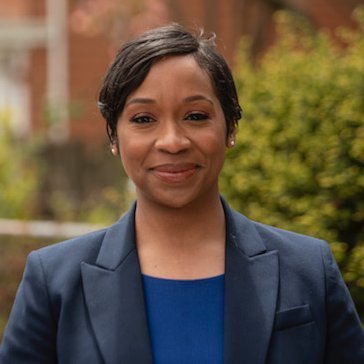
I was in Andrea Campbell‘s camp before current AG Maura Healey announced her support, so that wasn’t what persuaded me, but seriously — when the person who knows the job best endorses a candidate running to succeed her, I pay attention. Andrea has also been endorsed by my state senator, Julian Cyr, whose opinion I respect, U.S. Senator Ed Markey, the Planned Parenthood Advocacy Fund of MA, and quite a few others whose names you’d probably recognize.
Andrea Campbell
Andrea’s personal story is harrowing — and a key to her commitment to public service. When she was eight months old, her mother was killed in a car crash, en route to visit Andrea’s father, who was in prison. Andrea didn’t meet him till he got out when she was eight years old.
She credits her relatives, her community, and her teachers for helping her become the first member of her family to graduate first from college and then from law school. In 2015 she was elected to the Boston City Council; in 2018 she became its chair.
She brings to the attorney general’s office extensive familiarity with the challenges facing the commonwealth around transportation, health care, education, housing, and climate change. She plans to continue and expand the important work of the current AG’s office. For more about her priorities, see her website.
Auditor
Truth to tell, I haven’t made up my mind about the auditor’s race yet, in part because I’m still not entirely clear what’s part of the auditor’s job and what isn’t. IOW, how much of what the candidates are promising are actually within the scope — and the actual possibilities — of the job? I may add to this post in a few days. Meanwhile, you can check out the candidates’ websites for yourself: Chris Dempsey and Diana DiZoglio.
Treasurer
Incumbent Deb Goldberg is running unopposed in the primary, so that’s easy. You can learn more about her and what the treasurer does here.











 From the Seasonally Occupied Territories . . .