I still can’t wrap my head around the phrase “reality TV,” or the culture that came up with it, or the way it rolls trippingly off our tongues as if it makes sense. What will scholars from a different space-time continuum make of it?
So this blog post is titled “Reality” instead of “Reality TV,” even though TV plays a role in two of the big stories on Martha’s Vineyard this week. In one it’s obvious: the production crew has arrived to film the “docu-soap” I blogged about in February.
The docu-soapers will be gone by early July, I’m told, though the docu-soapsuds will doubtless linger longer. The newspaper photo I saw of some cast members on Main Street, Vineyard Haven, could have been taken on the same corner in July, though the actors, wearing 85-degree clothes in 60-degree weather, must have been chilly.
Which is to say that the docu-soapers looked pretty much like the real thing, whatever “the real thing” is. Summer on Martha’s Vineyard is reality TV without the cameras. Why would anyone want to make a reality TV show about reality TV?
Wait, wait, I know the answer: Because otherwise how do we know that it’s real?
Tourism, come to think of it, is reality TV’s first cousin. Reality TV’s interactive first cousin. True, it’ll be lots cheaper to watch The Vineyard in the comfort of your home entertainment center, but on the real (?) Martha’s Vineyard you can interact with locals who aren’t improvising from a script . . .
Cancel that. Most of us most of the time are improvising from a script, having learned that if we get too real, the tourists will look worried or angry and may even accuse us of being insufficiently grateful. If it weren’t for them, after all, how would we eat?
Martha’s Vineyard in the summer is like Old Sturbridge Village or Colonial Williamsburg, only it’s set in the present so we can’t call ourselves historians. We’re just the crew that keeps the show running smoothly. Bring your own cameras. You can take your own pictures.
*** *** ***
TV’s role in the other story is less obvious. This past Saturday, a barn manager on Meetinghouse Way in Edgartown found Majik, one of the miniature horses in her charge, dead in its pasture and the other one, Chance, injured. Majik had been mauled, apparently by a dog. The dog turned out to be Mugsy, a three-year-old mixed-breed rescue who was adopted from a shelter at least a year and a half ago. The owners have agreed to have Mugsy put down when the state-mandated quarantine period ends next Monday.
The most recent Martha’s Vineyard Times story includes a photo of Mugsy. I leave it to you to puzzle out what breeds might have gone into the mix. To judge by the comments on the M.V. Times website, quite a few people were dead sure from the outset that the culprit had to have been a pitbull, even though no one saw it happen and Mugsy hadn’t been identified.
Anyone who’s been paying attention to dog-and-livestock dramas on Martha’s Vineyard over the last 10 years or so had to have at least considered the possibility that a Sibe or Akita or other northern-breed dog might have killed Majik. Put it this way: If it had happened in my neighborhood and Travvy had been AWOL at the time, I would have feared the worst. But no, many commenters immediately zeroed in on pitbulls. If you wade through the comments, the same “facts” come up over and over again: it must have been a pitbull, pitbulls are trained killers, only pitbulls are capable of such things, and — a pervasive assumption that is seldom true — a dog that kills livestock might go after a child next.
I’d bet good money that they’re getting their information from TV and other news sources, and whipping themselves into a righteous frenzy with the help of various social media. Such information is predigested so it can be swallowed whole. It’s generally not hard to tell when a commenter has brought firsthand experience and some thought to the table. If these people have any to bring, they’re keeping it under wraps.
Trudy the wise woman, she of The Search for Signs of Intelligent Life in the Universe, opines that “reality is nothing but a collective hunch.” I’m inclined to agree. But what happens when our collective hunch turns out to have been packaged and served up on TV?


Nevertheless, we do prepare for considerably worse. Late this morning, through the usual combination of connections and coincidences, I found myself at the island’s first-ever disaster shelter drill. The drill was a dry run for the Vineyard’s disaster-service organizations to practice coordinating their efforts. Participants included the American Red Cross, the Medical Reserve Corps, the Salvation Army, the Boy Scouts, and the newly formed Martha’s Vineyard Disaster Animal Rescue Team (MV DART).
I cannot tell a lie: It was MV DART that piqued my interest. One of the many lessons learned from Hurricane Katrina in 2005 was that disaster planning had to take companion animals into account. Hundreds of thousands of pets died or were stranded, in part because they couldn’t be transported or sheltered with their humans. Today’s shelter drill included clients with pets.


Here’s proof.
Another sign that writing is going on: spent matches collect around the blotter. This is because I light a candle or two when I’m writing. While the candle burns, I write. I don’t do dishes or download email or (candles and pens forbid) check out Facebook.
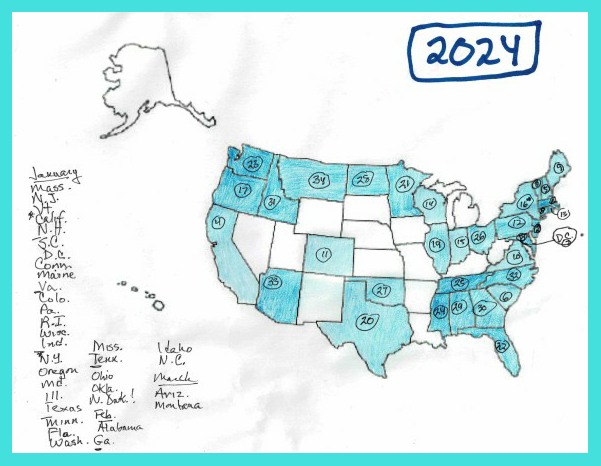
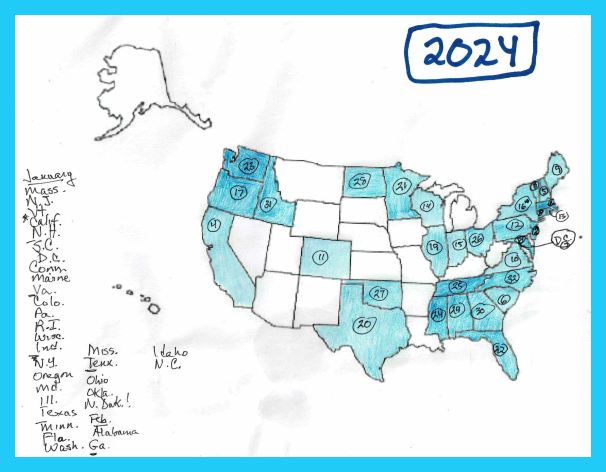
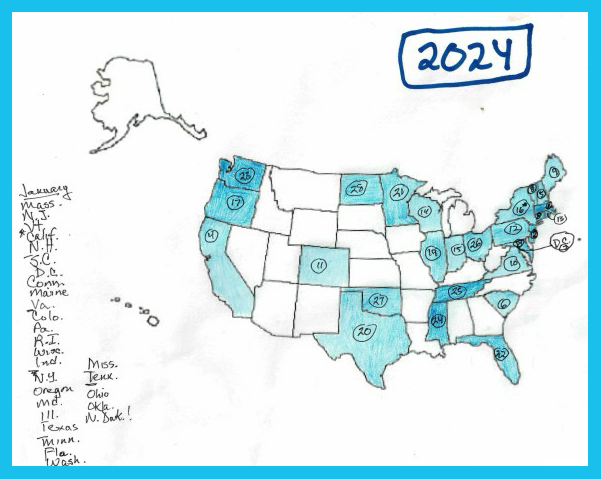
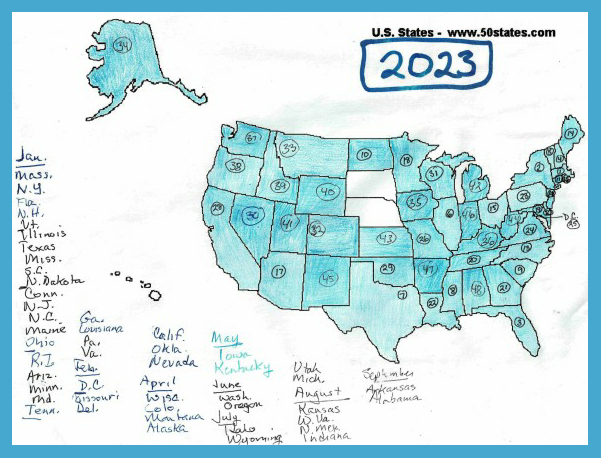
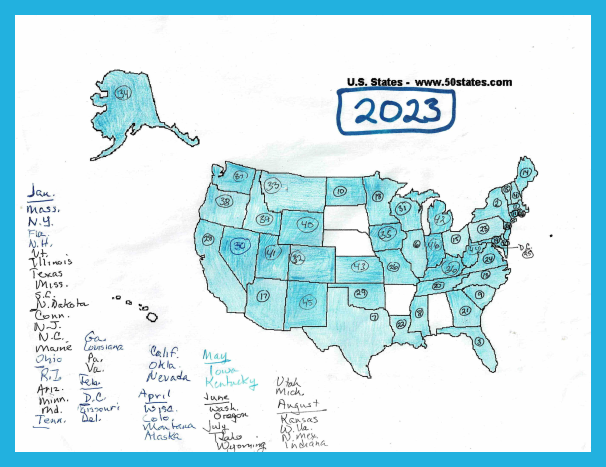
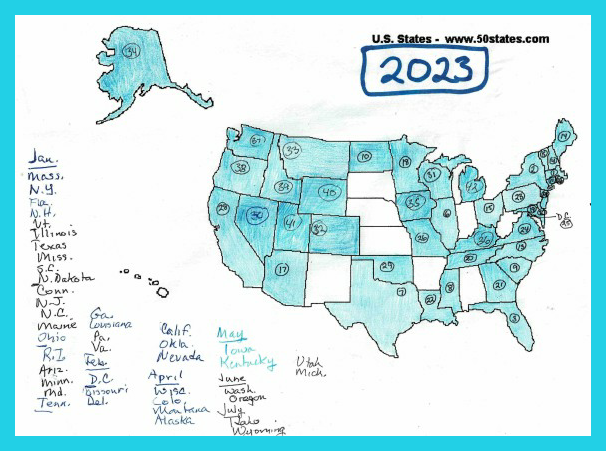
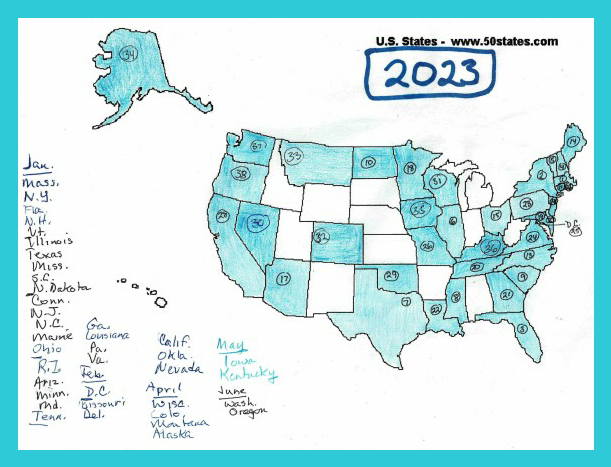
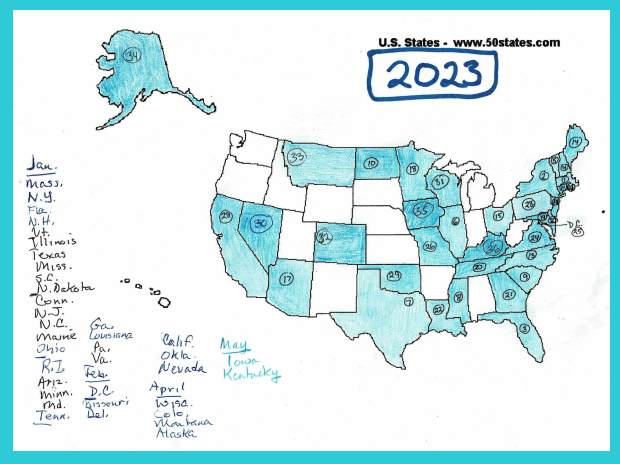
How is this license plate map different from all previous license plate maps? Sure, it looks like all its predecessors, but it was scanned on my new scanner. My venerable UMAX 3450 finally croaked. How venerable, you ask? Well, it was designed for Windows 98 if that gives you an idea. Each operating system upgrade required a driver patch to keep the scanner happy. The patch was fairly complicated for a non-techie like me, but the instructions were so clear that I (a) had no trouble, and (b) emailed UMAX tech support to commend them on the clarity of their instructions. A UMAX techie emailed me back to thank me and to commend me for being able to follow directions.